
Morning Shoulder Mobility Routine: 5-Minute Exercises for Fast Pain Relief
Do you dread getting out of bed because your shoulders feel like they’ve been locked in concrete overnight? You’re not alone. Many people wake up with tight, cranky shoulders that make simple tasks like reaching for their coffee cup or putting on a shirt feel like torture. You can do these 5 minute morning shoulder mobility routines for pain relief.
Most people focus solely on the shoulder joint itself, but that’s only part of the story. Your shoulder health is actually connected to a complex chain of five critical areas that all work together. Think of your body as an interconnected system where restrictions in one area create compensations elsewhere. For optimal shoulder function, you need to address
- Your neck – providing rotation and extension to reduce shoulder workload.
- Your thoracic spine – the upper back that supports shoulder movement.
- Your shoulder blades – the foundation for all arm movements.
- Your shoulder joint – the obvious culprit, but rarely the only problem.
- Your nerves – the pathways from the neck to the arms that can transfer the pain.
When any of these five areas becomes restricted, your shoulders pay the price. That’s why stretching just your shoulders often fails to provide lasting relief. The solution? A comprehensive 5-minute morning routine that addresses all five areas systematically, giving you the “WD-40” your body needs to start the day pain-free.
With just 5 minutes each morning, you can
- Eliminate morning shoulder stiffness and pain.
- Improve your range of motion for daily activities.
- Reduce the risk of shoulder impingement throughout the day.
- Enhance nerve mobility to prevent numbness and tingling.
- Create better posture and spinal alignment.
- Build a foundation for pain-free movement all day long.
Quick Reference Guide
- Total Time: 5 Minutes.
- Targets: Neck, thoracic spine, shoulder blades, shoulders, and median nerve.
- Goals: Pain reduction, improved mobility, and daily movement preparation.
The Complete 5-Minute Shoulder Liberation Routine
Exercise 1: Bench Opener

Purpose: Opens up the lats and upper thoracic spine to create space for shoulder movement.
Equipment Needed: Bench, chair, or sturdy surface at knee height.
How to Do It
- Kneel in front of your bench or chair.
- Place both elbows on the surface with hands together in a prayer position.
- Drop your hips back while allowing your chest to come forward.
- Feel the stretch through your lats and upper back.
Sets: 10 slow repetitions.
Tip: Don’t force the stretch – let gravity do the work as you gradually sink deeper into the position.
Exercise 2: Open Book

Purpose: Addresses neck and thoracic spine rotation while improving overall spinal mobility.
Equipment Needed: Wall space.
How to Do It
- Get into a half-kneeling position next to a wall with your hip touching the wall.
- Place both hands together in front of your chest.
- Slowly open your top hand away from the wall, following it with your eyes.
- Try to reach toward the opposite wall behind you.
Sets: 10 repetitions on each side.
Tip: It’s completely normal to have differences between sides – this asymmetry often contributes to shoulder pain.
Exercise 3: Wall Slides

Purpose: Activates proper shoulder blade movement and teaches the blades to rotate upward correctly.
Equipment Needed: Wall space.
How to Do It
- Stand facing a wall with one foot slightly in front of the other.
- Place both hands flat against the wall at shoulder height.
- Slide your hands up the wall while pushing your chest forward.
- Focus on feeling your shoulder blades move up and around your ribs.
Sets: 10 slow repetitions.
Tip: Let the wall guide the movement – you should feel your shoulder blades gliding smoothly, not fighting against restrictions.
Exercise 4: Belt First Rib Mobilization

Purpose: Mobilizes the first rib and surrounding tissues that commonly restrict shoulder movement.
Equipment Needed: Belt, resistance band, or dog leash.
How to Do It
- Sit on a bench or chair, placing the belt under your sit bones.
- Bring the belt up and over your shoulder on one side.
- Pull down and inward with the belt while looking down toward your opposite armpit.
- Then look up and away from the belt.
Sets: 10 repetitions on each side.
Tip: This exercise is particularly effective before bed if you experience shoulder pain when sleeping on your side.
Exercise 5: Axial Rotations
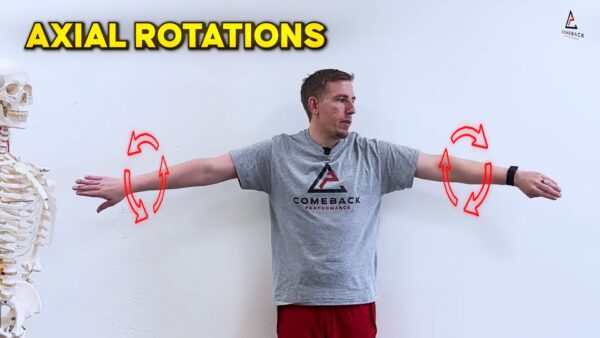
Purpose: Improves the rotational capacity of the shoulder joint itself.
Equipment Needed: None.
How to Do It
- Stand with arms extended out to your sides at shoulder height.
- Alternate bringing each arm forward and up in a controlled rotation.
- Keep the movement smooth and controlled.
- Don’t force any position that causes pain.
Sets: 1 minute continuous (or break into 20-30 second intervals if needed).
Tip: If your arms start burning, break it into smaller time chunks – this is about mobility, not endurance.
Exercise 6: Median Nerve Glides

Purpose: Mobilizes the median nerve that travels from your neck down through your arm to prevent nerve-related shoulder pain.
Equipment Needed: None.
How to Do It
- Stand in a “teapot” position with one hand on your hip.
- Extend your other arm out to the side.
- Extend your elbow, wrist, and fingers downward to feel a stretch.
- Return to neutral and repeat on the opposite side.
Sets: 10 gentle repetitions on each side.
Tip: It’s normal to experience numbness or tingling during this exercise. The nerve is likely restricted and needs this mobility work.
Your Path to Pain-Free Mornings
These exercises work because they address the root causes of shoulder stiffness, not just the symptoms. You’re setting yourself up for pain-free movement throughout the entire day if you spend about just 5-6 minutes each morning on these critical areas. The immediate benefits are obvious – you’ll notice increased range of motion and reduced stiffness within the first week. But the long-term gains are even more impressive: better posture, reduced risk of injury, and the confidence to move without fear of pain.
However, if you’ve been dealing with persistent shoulder pain despite trying physical therapy, you should schedule a session to ascertain what’s wrong.
About the Author: Dr. Joey Seyforth


