
Fix Front Shoulder Pain: 5 Proven Exercises for Fast Relief
Does your shoulder feel like it’s on fire every time you push, pull, or lift? It could be that sharp, nagging pain in the front of your shoulder that doesn’t go away. If this sounds familiar, you’re not alone. Thousands of people deal with front shoulder pain, whether they’re hitting the gym for bench press or just trying to live their daily lives.
But here’s the good news: you don’t have to live with it, because these at-home exercises for front shoulder pain relief will help mitigate the discomfort caused by the pain.
Front shoulder pain isn’t just a shoulder problem—it’s a chain reaction involving your entire upper body. When your shoulder blade doesn’t rotate properly, your thoracic spine is stiff, or your stabilizing muscles aren’t doing their job, your shoulder joint compensates by moving incorrectly. This creates a domino effect that leads to inflammation, irritation, and that burning pain you can’t shake.
The secret isn’t just rest, ice, or stretching. The real solution lies in improving mobility first, then backing it up with targeted strength and stability work to prevent the problem from returning.
With just 15 minutes a day, you can
- Eliminate sharp, burning pain during daily activities and workouts.
- Restore pain-free overhead movement for sports and exercise.
- Improve posture and reduce compensatory movement patterns.
- Prevent future shoulder injuries through better stability.
- Get back to your favorite activities without fear of pain.
- Sleep better without shoulder discomfort disrupting your rest.
Quick Reference Guide
- Total Time: 15 Minutes.
- Targets: Front shoulder, shoulder blade, thoracic spine, stabilizing muscles.
- Goals: Pain reduction, improved mobility, enhanced stability.
Exercise 1: Banded Posterior Shoulder Mobilizations
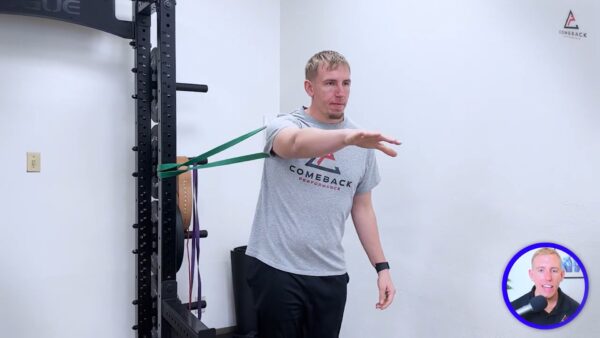
Purpose: Free up joint space and reduce friction in the front of your shoulder.
Equipment Needed: Resistance band and anchor point (door, rig, or sturdy object).
How to Do It
- Attach the band to a secure anchor point at shoulder height.
- Place the band around the front of your affected shoulder.
- Allow the band to gently pull your shoulder backward while you move in and out of a chest press position.
- Focus on the gentle traction as the band offloads the front of your shoulder.
Sets: 2 sets of 15 reps.
Tip: The band should provide gentle backward pressure—don’t fight against it. Let it do the work of creating space in your joint.
Exercise 2: Wall Slides

Purpose: Teach your shoulder blades proper upward rotation to reduce impingement.
Equipment Needed: Wall.
How to Do It
- Stand facing a wall with one foot in front of the other.
- Place both hands flat against the wall at shoulder height.
- Slowly slide your arms up the wall, allowing your chest to come forward naturally.
- Focus on feeling your shoulder blades rotate upward as your arms rise.
Sets: 2 sets of 10 reps.
Tip: Don’t force the movement. Your shoulder blades should glide smoothly up the wall without shrugging your shoulders toward your ears.
Exercise 3: Wall Open Books

Purpose: Improve thoracic spine mobility and rotation to reduce shoulder compensation.
Equipment Needed: Wall.
How to Do It
- Get into a half-kneeling position next to a wall.
- Keep your hip connected to the wall throughout the movement.
- Rotate away from the wall, following your hand with your eyes.
- Try to touch your opposite shoulder to the wall behind you.
Sets: 2 sets of 12 reps on each side.
Tip: If you can’t touch the wall, that’s okay—this reveals a mobility restriction that’s likely contributing to your shoulder pain. Ensure you work within your comfort range.
Exercise 4: Banded Cheerleaders

Purpose: Build dynamic stability in your shoulder through multi-directional strengthening.
Equipment Needed: Resistance band.
How to Do It
- Hold a resistance band with arms straight out in front, palms facing up.
- Perform a pull-apart by extending arms out to the sides.
- Return to the center, then move into a diagonal pattern (up and out).
- Repeat the diagonal in the opposite direction.
Sets: 3 sets of 5-8 reps (one rep = all three directions).
Tip: Hold each position for 2-5 seconds to increase muscle engagement and fatigue the stabilizers. You should feel this working the back of your shoulder and upper back.
Exercise 5: Banded Bear Sliders
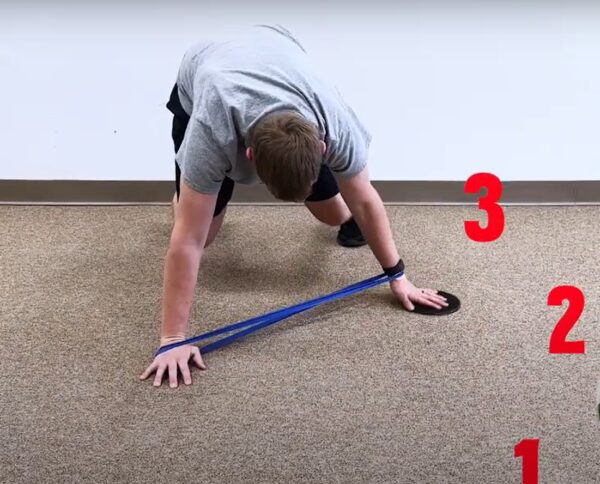
Purpose: Challenge total shoulder control and core stability simultaneously.
Equipment Needed: Resistance band, furniture slider, or paper plate.
How to Do It
- Place a band around your wrists and get into a bear crawl position.
- Lift your knees off the ground, maintaining a straight line from head to heels.
- Place one hand on the slider and slide it in three directions: forward, diagonal, and to the side.
- Keep your core engaged and avoid rotating or compensating with your lower back.
Sets: 3 sets of 5 reps on each shoulder.
Tip: If this is too challenging, perform the exercise on your hands and knees instead. Focus on control over speed—this exercise should challenge your stability, not your endurance.
Understanding Your Shoulder’s Ball-and-Socket Design
Think of your shoulder as a golf ball sitting on a tee. The goal is for this ball to roll and glide smoothly in all directions as you move your arm. However, when the stabilizing muscles aren’t doing their job, that ball moves too freely and either
- Rubs forward, causing front shoulder pain
- Rubs upward, creating that pinching sensation
Your shoulder blade plays a crucial role in the overall health of your shoulder. When it doesn’t upwardly rotate properly—reaching that critical 60-degree angle—your shoulder ball gets compressed between the shoulder and shoulder blade. This compression, called impingement, creates pain and limits your range of motion.
When your shoulder blade moves correctly, you can lift your arm overhead, reach across your body, and go behind your back without pain—significantly offloading your shoulder joint.
What Are You Waiting For?
Consistency is key to eliminating your front shoulder pain. Perform these exercises daily, and you likely notice improvements in pain and mobility within the first week. Complete shoulder rehabilitation has to be tailored to your specific needs and movement patterns. If you’ve tried physical therapy, chiropractic care, massage, acupuncture, injections, or even surgery without lasting results, it may be time for a more personalized approach.
About the Author: Dr. Joey Seyforth


