
Front Shoulder Pain Keeping You From Your Workouts? Here’s Your Bicep Tendonitis Fix
The sharp, nagging pain in the front of your shoulder every time you bench press, do overhead movements, or perform curls despite applying ice, stretching, and doing band work might be bicep tendonitis, but the problem isn’t actually your bicep tendon.
Your bicep tendon is essentially playing firefighter, taking on extra work because other parts of your shoulder system aren’t pulling their weight. This holistic problem requires a holistic solution – and in this blog, we’ll show you the simple bicep tendonitis fix you can try.
Quick Reference Box
- Total Time: 15 Minutes
- Targets: Shoulder blade, rotator cuff, posterior deltoid, core stability
- Goals: Improve shoulder mechanics, reduce bicep tendon stress, build functional strength
Exercise Breakdown
Exercise 1: Banded Scapular Angels
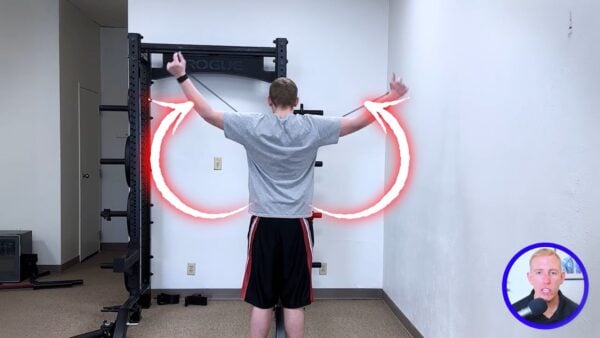
Purpose: To teach your shoulder blade to rotate properly, creating space and reducing front shoulder compression.
Equipment Needed: Light resistance band.
How to Do It
- Anchor a light band at chest height and grab with both hands, creating mild tension.
- Pull your hands back toward your pockets, then slowly raise your arms out to the sides into an “angel” position.
- Keep your ribs down and avoid arching your lower back.
- Return with control to the starting position.
Sets: 2 sets of 8-10 slow, controlled reps.
Tip: Focus on smooth movement—if you feel pinching, reduce your range of motion until it feels comfortable.
Exercise 2: Banded Extension with External Rotation

Purpose: To strengthen your posterior shoulder muscles so your bicep tendon doesn’t have to overwork itself.
Equipment Needed: Light resistance band.
How to Do It
- Stand with a band around your wrists behind your back, arms straight.
- Pull the band apart to create external rotation tension.
- While maintaining tension, move your shoulders slightly back into extension.
- Return to the start with control, feeling the work between your shoulder blades.
Sets: 2-3 sets of 8-10 reps.
Tip: You should feel this between and behind your shoulders, not in your neck. Adjust the band tension if needed.
Exercise 3: Shoulder Taps
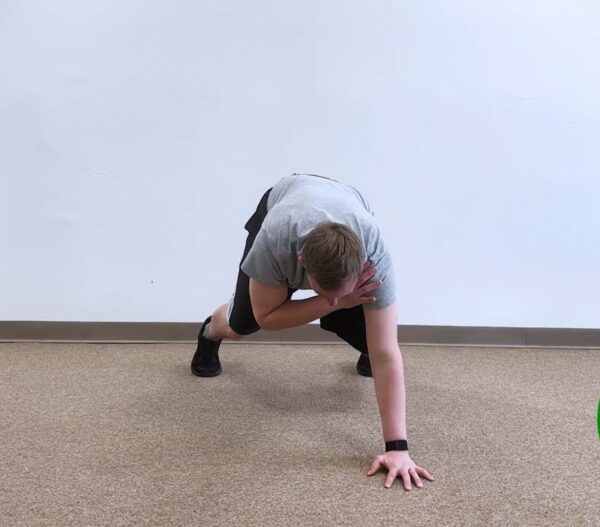
Purpose: Builds closed-chain stability so your shoulder joint feels safe and secure under load.
Equipment Needed: None.
How to Do It
- Start in a push-up position (or with hands on an elevated surface for an easier version).
- Place feet slightly wider than hip-width for stability.
- Shift weight and tap opposite shoulder with one hand, then switch.
- Keep torso tight with minimal hip movement.
Sets: 2 sets of 8-10 taps per side.
Tip: Quality beats speed—start slow and focus on maintaining a rigid torso throughout the movement.
Bonus: Speed’s Test for Self-Assessment

Purpose: Quickly determine if your bicep tendon is contributing to your shoulder pain.
How to Do It
- Extend the painful arm straight out at shoulder height, palm facing up.
- Keep your elbow locked and place your other hand on top of the outstretched wrist.
- Try to raise your arm while the other hand gently rests on it.
- Sharp pain at the front of the shoulder indicates bicep tendon involvement
Note: This is a diagnostic tool, not an exercise—perform once to assess, not repeatedly.
Do What’s Necessary
Your bicep tendon hurts because it’s doing too much work in a bad position. By doing these exercises, which are specifically designed to restore proper shoulder mechanics, you’ll relieve your pain. Try to commit to 15 minutes daily, and you’ll likely notice improvements within 2-3 weeks. However, if you’re stuck in the cycle of pain, rest, and flare-ups every time you return to lifting, it’s time for a comprehensive assessment of your entire shoulder system.
About the Author: Dr. Joey Seyforth


