
The Complete 10-Minute Shoulder Impingement Relief Routine: Fix Your Pain Without Surgery
If you’re dealing with shoulder impingement pain that’s making it difficult to reach overhead, sleep comfortably, or even put on a shirt without wincing, you’re not alone. In fact, 67% of people will experience shoulder pain in their lifetime, and impingement is one of the most common culprits.
This shoulder impingement isn’t the structural death sentence you might think it is. Despite what you may have heard about bone spurs or “wrong-shaped” bones, shoulder impingement is actually a movement problem, not a structural one. This means it’s entirely fixable with the right approach.
Here’s a targeted 10-minute routine that addresses the root cause of your impingement while providing immediate pain relief. It’s a complete system that has helped thousands of people avoid surgery and get back to living pain-free.
Quick Reference Guide
- Total Time: 10 Minutes
- Targets: Shoulder joint, shoulder blade, thoracic spine, rotator cuff
- Goals: Pain reduction, improved mobility, long-term stability
Exercise Breakdown
Exercise 1: Banded Posterior Glides
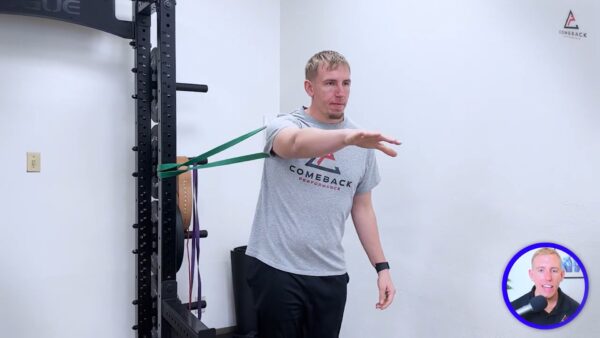
Purpose: To directly decompress the front of your shoulder joint by creating space where the impingement occurs.
Equipment Needed: A resistance band, sturdy anchor point.
How to Do It
- Attach a resistance band to something sturdy at shoulder height.
- Place the band around the front of your shoulder, then step forward until you feel tension.
- Gently move your arm in and out of a chest press position, letting the band pull your shoulder backward.
- Focus on feeling the space created in front of your shoulder joint.
Sets: 2 sets of 12-15 reps.
Tip: Don’t force the movement – let the band do the work of pulling your shoulder back into proper position.
Exercise 2: Wall Slides
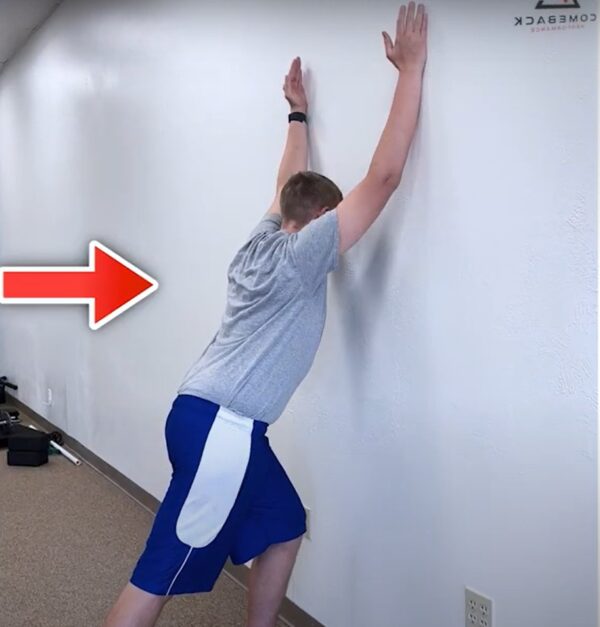
Purpose: This exercise retrains your shoulder blade to rotate upward properly, eliminating the compression that causes impingement.
Equipment Needed: Wall.
How to Do It
- Stand facing a wall with one foot in front of the other for stability.
- Place your hands on the wall with your elbows slightly bent.
- Slide your arms up the wall while leaning your chest forward at the top.
- Focus intensely on feeling your shoulder blades rotating upward as you raise your arms.
Sets: 2 sets of 12 reps.
Tip: This exercise trains the exact 60-degree upward rotation your shoulder blade needs to avoid impingement; many people find it challenging at first, so start slowly and focus on control over speed.
Exercise 3: Crab Rock
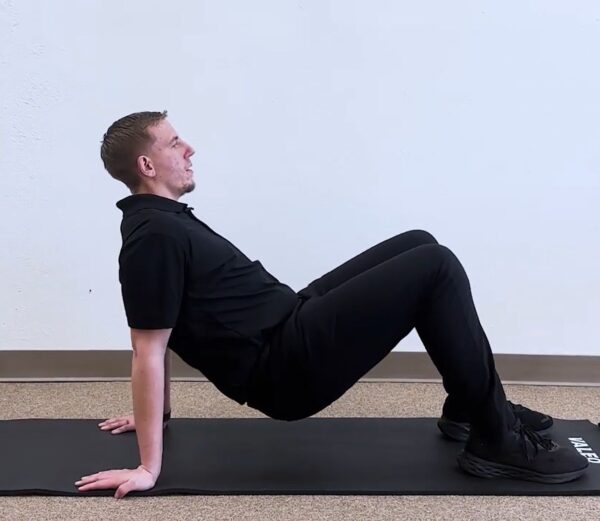
Purpose: This powerful exercise strengthens your shoulder in the opposite position of impingement while training all the stabilizing muscles simultaneously.
Equipment Needed: None.
How to Do It
- Sit on the floor with your hands placed behind you, fingers pointing away from your body.
- Lift your hips into a reverse tabletop position.
- Slowly rock forward and backward, allowing your shoulders to move through extension.
- Maintain the tabletop position throughout the entire movement.
Sets: 2 sets of 8-10 rocks.
Tip: This closed-chain exercise provides excellent rotator cuff stability training because your hands are fixed in place – it’s like a plank for your shoulders.
Restore Your Shoulders
Your shoulder will develop the proper movement patterns and strength to prevent future impingement episodes when you consistently do these exercises correctly. You’ll move with confidence again, knowing your shoulder can handle whatever comes. Remember, shoulder impingement has a 93% recovery rate when approached correctly – no surgery required. However, everyone’s presentation is slightly different. Some people need more focus on neck positioning, and others require additional thoracic spine mobility work.
Ready to take your recovery to the next level?
About the Author: Dr. Joey Seyforth


