
3 Simple Steps for Quick Shoulder Flare-Up Pain Relief
Shoulder pain affects millions of people daily, turning simple activities into painful ordeals. For some people, putting on a shirt feels impossible, while for others, they wince every time they reach overhead.
The truth is, your shoulder doesn’t work in isolation. Five interconnected areas must function together for pain-free movement: your neck, thoracic spine, shoulder blade, shoulder joint, and nerves.
When even one of these areas isn’t working correctly, your shoulder compensates and eventually breaks down. Traditional treatments fail because they focus solely on the shoulder, ignoring the root cause. By exercising for just 15 minutes a day, you can transform your shoulder health and reclaim your life.
Quick Reference Guide
- Total Time: 15 Minutes.
- Targets: Neck, thoracic spine, shoulder joint, and nerve pathways
- Goals: Immediate pain reduction, restored mobility, long-term prevention.
Exercise 1: Chin Tucks with Extensions

Purpose: Decompress nerves and reset shoulder blade positioning by addressing neck mobility, the foundation of the Big Five system.
Equipment Needed: None.
How to Do It
- Sit comfortably with your back straight and shoulders relaxed.
- Gently tuck your chin straight back (not down), as if you’re making a double chin.
- Hold for 2 seconds, then slowly tilt your head back and look toward the ceiling.
- Return to the starting position and repeat the sequence.
Sets: 10-15 repetitions with deep breathing throughout.
Tip: If you’re in severe pain, focus only on the chin tuck portion while deep-breathing. Never push through sharp pain—this should feel like a gentle release.
Exercise 2: Banded Open Books
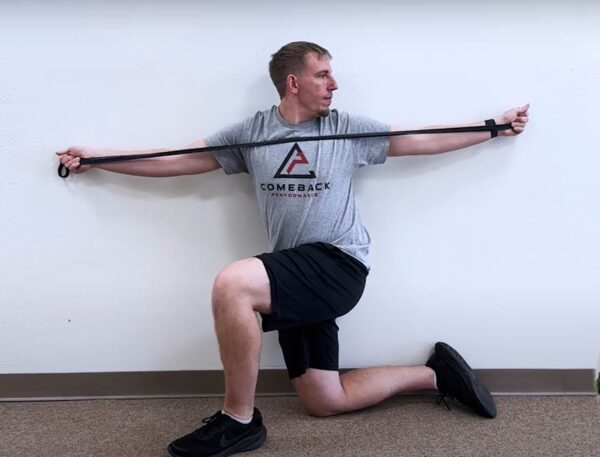
Purpose: Restore crucial mid-back rotation that your shoulder desperately needs for healthy movement patterns.
Equipment Needed: Resistance band and wall.
How to Do It
- Hold the resistance band at chest height and kneel facing the wall anchor.
- Start with both hands together in front of your chest, holding the band.
- Rotate your upper body away from the anchor and pull the band across your chest.
- Follow your hand movement with your eyes, but keep your lower body stable.
Sets: 2 sets of 8-10 rotations on each side.
Tip: Focus on the opening sensation in your mid-back rather than how far you can rotate. Quality of movement trumps quantity every time.
Exercise 3: Kettlebell Pull-Through (Modified Plank)
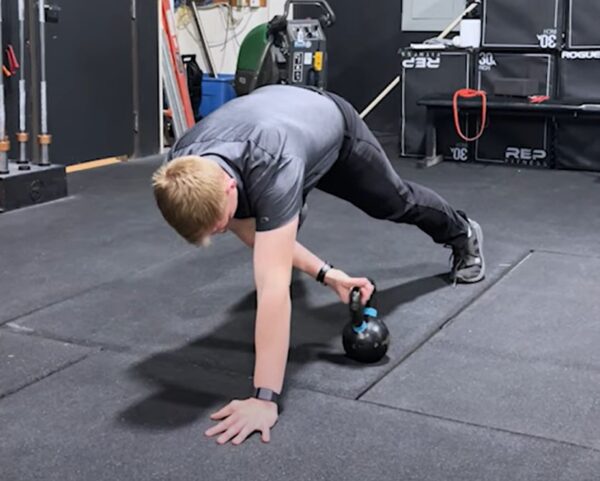
Purpose: Teach your shoulder’s ball-and-socket joint to stabilize while moving, integrating multiple components of the Big Five system.
Equipment Needed: Kettlebell or any weighted object.
How to Do It
- Get into a plank position with a kettlebell placed next to one hand.
- Reach under your body with the opposite hand and grab the kettlebell.
- Pull it through to the other side while keeping your core tight and hips level.
- Maintain plank position throughout the entire movement.
Sets: 2 sets of 8-10 pulls on each side.
Tip: If a full plank is too challenging, perform this exercise on your hands and knees. The key is controlled movement, not showing off your strength.
Your Path to Long-Term Shoulder Health
It’s normal to temporarily modify movements during a flare-up for a few days. However, if you’ve been avoiding overhead movements or living in fear of “wrong” movements for weeks or months, you’re actually convincing your body to stay injured. With these exercises, you can relieve shoulder flare-ups.
Ready to bulletproof your shoulders?
About the Author: Dr. Joey Seyforth


