
Shoulder Arthritis After 40: 3 Tests and Exercises to Keep Lifting Without Pain
If you’re over 40 and your X-ray or MRI shows shoulder arthritis, you’ve probably been told the crushing news: “slow down” or “stop lifting altogether.” Maybe you’re experiencing that deep, gnawing ache every time you bench press, overhead press, or simply reach up to grab something from a cupboard. Perhaps you can’t sleep on that shoulder without hours of throbbing pain afterward, and you’re terrified that arthritis means your lifting days are over for good.
Here’s the good news: arthritis doesn’t automatically mean the end of your training journey.
Not when there are exercises you can do to relieve yourself of that discomfort. In just 15 minutes a day, you can learn to work with your shoulder arthritis instead of against it. You don’t need expensive equipment, lengthy rehab sessions, or complete activity restriction.
Quick Reference
- Total Time: 15 Minutes
- Targets: Your shoulder joint, shoulder blade, upper back, and posterior shoulder muscles.
- Goals: To assess your shoulder pain assessment, improve mobility, and joint stability.
Essential Shoulder Tests: Know Where You Stand
Test 1: Active Overhead Flexion Assessment
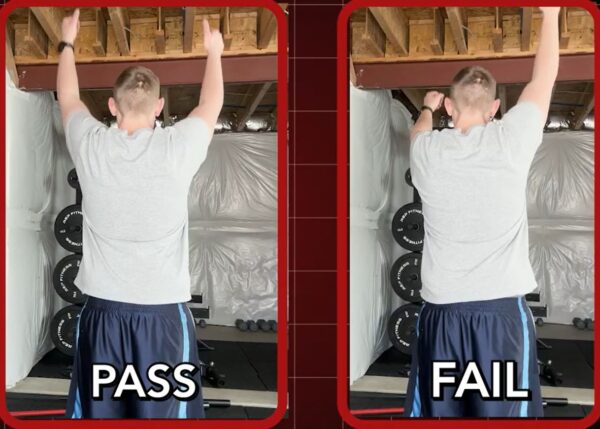
Purpose: To evaluate how your shoulder handles overhead movement and identify pain patterns.
Equipment Needed: None.
How to Do It
- Stand tall with your thumb pointing up.
- Slowly raise your arm straight out in front and up toward your ear.
- Don’t lean back or twist your body to compensate.
- Compare both sides and note any pain or limitations.
What to Look For: You should be able to get close to your ear without a strong ache that settles quickly. If you hit a hard block halfway up or experience sharp, deep joint pain, it indicates that overhead movement needs to be modified.
Tip: Don’t push through sharp pain – this test is about gathering information, not proving toughness.
Test 2: Hand-Behind-Back Reach
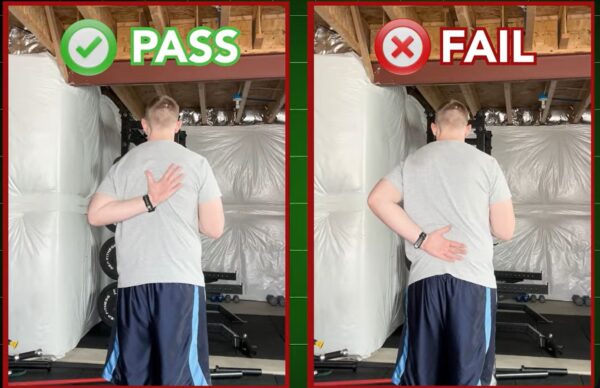
Purpose: Assess extension and internal rotation capacity, which correlates to bench press bottom position and daily reaching tasks.
Equipment Needed: None
How to Do It
- Stand tall and slide your hand behind your back.
- Reach into your back pocket, then slide it up as high as is comfortable.
- Don’t force the movement.
- Compare both sides for range and pain.
What to Look For: If one side is significantly lower or produces early deep joint ache, this indicates internal rotation limitations that need gradual improvement.
Tip: Tightness without pain is trainable – sharp pain requires respect and modification.
Test 3: 90/90 External Rotation
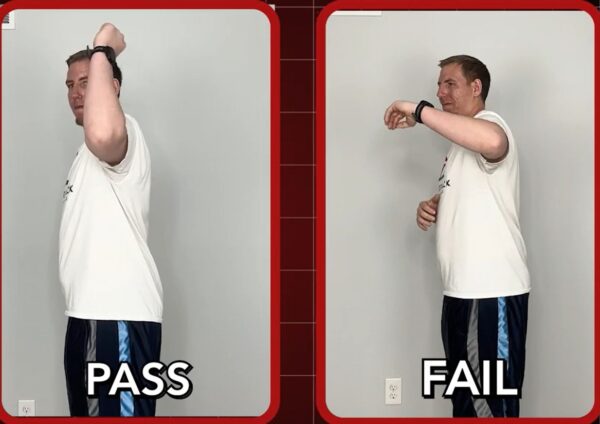
Purpose: Evaluate your shoulder’s tolerance for the classic pressing and throwing position.
Equipment Needed: None
How to Do It
- Lift your arm out to the side with your elbow at shoulder height.
- Bend your elbow to 90 degrees.
- Slowly rotate your forearm back, as if winding up to throw.
- Compare the left and right sides.
What to Look For: Sharp, deep joint pain in the front or top of the shoulder indicates this position needs support and gradual loading. Simple tightness is another “lane” you can gradually open up.
Tip: This position is crucial for pressing movements – respect limitations but don’t assume they’re permanent.
The 3 Key Exercises
Exercise 1: Wall Slides

Purpose: Help your shoulder blade and shoulder joint work together overhead instead of jamming the joint.
Equipment Needed: Wall
How to Do It
- Stand facing a wall with one foot slightly forward.
- Place your hands on the wall at shoulder height, pinkies touching.
- Gently press into the wall and slowly slide your arms up as high as comfortable.
- Avoid sharp pinching or excessive back arching.
Sets: 2 sets of 8-10 slow repetitions.
Tip: Focus on feeling your shoulder blades moving up and around your ribs rather than forcing range through the joint itself.
Exercise 2: Wall Open Book

Purpose: Free up upper back rotation so your shoulder doesn’t have to compensate for every bit of movement.
Equipment Needed: Wall
How to Do It
- Stand or half-kneel, facing the wall, with your hip close to it.
- Place your hands together at chest height in front of you.
- Keep the hip connected to the wall while opening the top arm and chest away.
- Follow your hand with your eyes, as if opening a book.
Sets: 2 sets of 8-10 repetitions per side
Tip: The motion should come through your ribs and upper back, not by cranking on the shoulder joint.
Exercise 3: Banded Extension

Purpose: Activate muscles in the back of the shoulder to provide joint stability and support.
Equipment Needed: Resistance band.
How to Do It
- Place both arms behind your back, holding the band.
- Keep elbows mostly straight.
- Pull arms back into extension, squeezing shoulder blades.
- Return slowly to the starting position.
Sets: 2 sets of 10-12 repetitions
Tip: You should feel this working the back of your shoulder and upper back, not creating sharp pain in the front of the joint.
Your Comeback Starts Today
The steps are simple. Start by assessing your current shoulder function with the three tests, start building alternative movement routes with the targeted exercises, and respect your traffic light system. Your shoulder arthritis doesn’t define your limitations – how you train around it does.
You’re not trying to reverse arthritis – you’re building a smarter, more resilient system around it.
Ready to dive deeper?
About the Author: Dr. Joey Seyforth


