
Fix Your Scapular Winging in Just 5 Minutes a Day
Scapular winging is a serious mechanics problem that causes everything from shoulder instability to impingement to rotator cuff overload. When your neck is stiff, your mid-back is locked up, or your shoulder blade muscles aren’t firing correctly, your entire shoulder complex compensates in all the wrong ways. Most people have never been given the right exercises to address it.
But here’s what changes everything: With just 5 minutes a day and a single resistance band, you can retrain your shoulder blade to work properly again.
Quick Reference Box
- Total Time – 5 Minutes
- Targets: Your serratus anterior, lower trapezius, shoulder blade stabilizers, thoracic spine, and nerve mobility.
- Goals: To restore proper shoulder blade movement patterns, eliminate winging, reduce shoulder pain and instability
Exercise Breakdown
Exercise 1 – Scap CARs
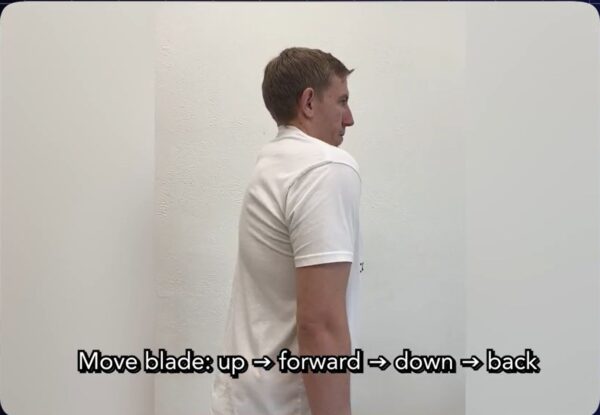
Purpose: Retrain your shoulder blade’s motor pattern through its full range of motion – the foundation for fixing winging.
Equipment Needed: None
How to Do It
- Stand tall with your arm relaxed at your side or straight out in front.
- Slowly move your blade in a circle: up toward your ear (elevation), forward around your rib cage (protraction), down toward your back pocket (depression), then back toward your spine (retraction).
- Reverse the direction and repeat.
Sets: 2 sets of 5 slow rotations clockwise + 5 counterclockwise per side.
Tip: If one direction feels stiff or limited, that’s your restricted range. Try to spend extra time there.
Exercise 2: Banded Scap Angels
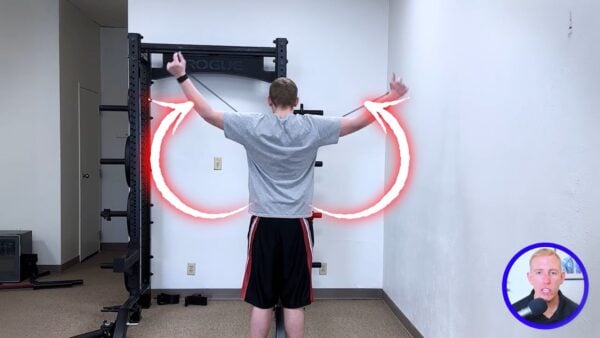
Purpose – To build the upward rotation pattern that winging directly prevents while strengthening your lower traps.
Equipment Needed – Light resistance band.
How to Do It
- Anchor a band at chest height, grab with both hands, and walk back to create light tension.
- Start by placing your hands at your hips with your shoulders down and back.
- Slowly raise arms into a wide Y position, ending with biceps near ears.
- Think about shoulder blades tipping back and rotating upward as arms rise.
Sets: Do 2 sets of 10 controlled reps.
Tip: Don’t arch your lower back to fake the overhead range.
Exercise 3 – Push-Up Plus
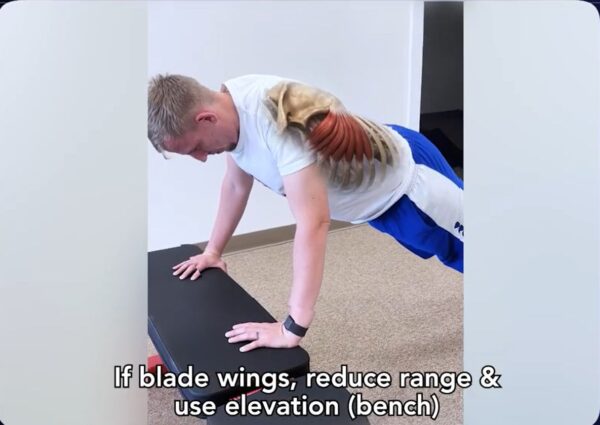
Purpose: To directly train your serratus anterior at its most demanding end range to keep the blade flush against your rib cage.
Equipment Needed: None (floor or bench)
How to Do It
- Get in a push-up position, hands slightly wider than shoulders.
- Lower down, letting shoulder blades naturally come together.
- Press up, then add the “plus” – push extra through shoulder blades, rounding them forward.
- Hold the plus position for 1 second.
Sets: 2 sets of 10 reps
Tip: If you feel your blade winging during the movement, reduce the range and only work where the blade stays flat
Exercise 4: Banded Bear Sliders
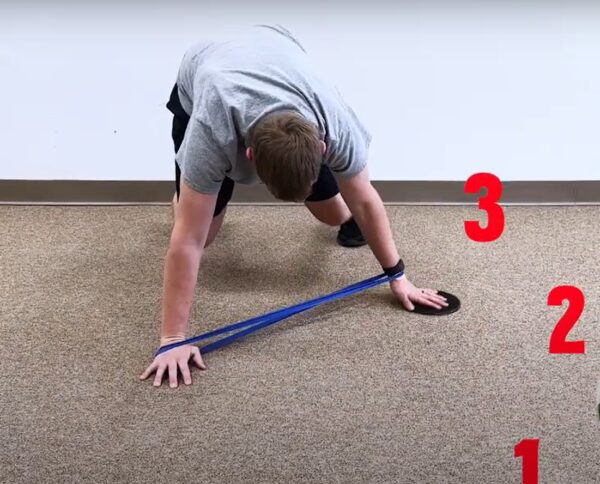
Purpose – To integrate shoulder blade and joint stability in a weight-bearing position for real-world function.
Equipment Needed: Resistance band
How to Do It
- Get in a bear position (hands under shoulders, knees under hips), and loop the band around your wrists.
- Lift knees to hover just off the floor.
- Slide one hand forward, to the side, and diagonally while maintaining blade control.
- Return to the center between each slide, then switch sides.
Sets: 2 sets of 5 slow slides in each direction per side
Tip: The goal is keeping your supporting blade flat and stable, not the distance of the slide
Going Steady And Strong
Remember, scapular winging is a motor pattern problem, and motor pattern problems don’t fix themselves with occasional exercise. They change through consistent daily repetition. Put in just 5 minutes of focused work each day, and you’ll see your shoulder blades starting to stay flatter, your instability reducing, and your downstream shoulder pain beginning to resolve.
These four exercises target all five areas that drive scapular winging. And while this routine is incredibly effective for many people, some cases need a more personalized approach based on which of these five areas is your specific weak link. So if you’re ready to dive deeper and recover your shoulder, book you free consultation.
About the Author: Dr. Joey Seyforth


