
3 Exercises for Biceps Tendonitis From Lifting That Keeps Flaring Up
If you experience pain at the front of your shoulders and suddenly it fades, but when you head back to the gym, load up some curls, chin-ups or a bench press, it comes right back, you’re likely dealing with bicep tendonitis from lifting.
Rest doesn’t fix it – it only calms things down for a while, but it doesn’t get your shoulder ready to handle the same workout again. This article covers a quick test to check whether your bicep tendon is involved, what keeps irritating it, and three exercises that take the load off the tendon so you can keep training.
Try the Speed’s Test
Before you start the exercises we’ve shared in this blog, check whether your bicep tendon is likely involved.

How To Do It
- Stand tall and hold your painful arm straight out in front of you at shoulder height, palm up and elbow locked.
- Put your other hand on top of your wrist.
- Try to raise the arm while your other hand gently presses down against it.
A positive sign is sharp or achy pain at the front of the shoulder, where the bicep tendon attaches. Test both sides and remember how each one feels, because you’ll retest after the exercises.
Quick Reference Guide
- Total Time: About 10–15 minutes
- Targets: Shoulder joint, shoulder blade, lats, rotator cuff
- Goals: Take the load off the bicep tendon, improve overhead movement, build stability under load
The 3 Exercises to Take the Load Off Your Bicep Tendon
Exercise 1: Banded Rollbacks
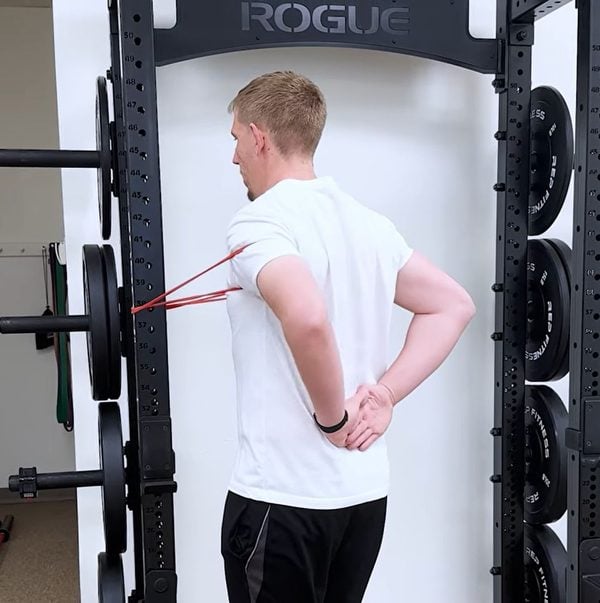
Purpose: Teaches your shoulders and shoulder blades to tip back and wakes up the back of the rotator cuff, which takes pressure off the front of the shoulder.
Equipment Needed: Resistance band
How to Do It:
- Loop a band around your upper arms.
- Put your hands on your hips or lower back.
- Pull your shoulders back against the band with control.
- Return slowly to the start.
Sets: 2 sets of 15 controlled reps
Tip: Your shoulders should do the moving, not your hands. If your hands are doing the work, you’ve lost the movement.
Exercise 2: Supine Weighted Pullover

Purpose: Builds your lats and shoulder blades into the overhead range with your back flat, so your bicep isn’t left holding the shoulder together overhead.
Equipment Needed: A light weight
How to Do It:
- Lie on your back holding a light weight above your chest, with a slight bend in your elbows.
- Slowly lower the weight overhead to a comfortable range.
- Pull it back over your chest.
- Keep your back flat against the ground the whole time.
Sets: 3 sets of 8 reps
Tip: Start light and only go as far as you can control. This exercise is about control, not load.
Exercise 3: Banded Kettlebell Upside-Down Press
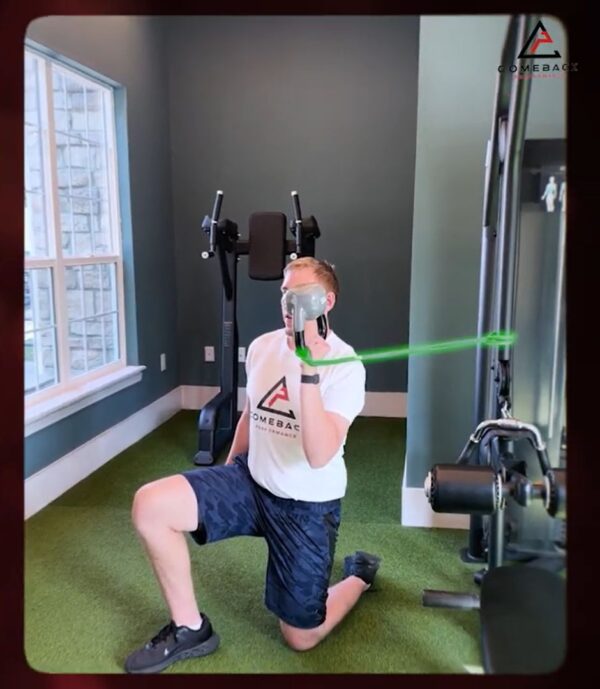
Purpose: Trains stability under load. Holding the kettlebell upside down makes your rotator cuff and shoulder blade do the stabilizing so your bicep doesn’t have to.
Equipment Needed: Kettlebell, resistance band
How to Do It:
- Anchor a band around you and loop it around the handle of a kettlebell.
- Hold the kettlebell bottom-up, with the bell pointing at the ceiling.
- Press it slowly overhead while resisting the band pulling it back.
- Keep your ribs down and the bell steady.
Sets: 3 sets of 8 reps on each side
Tip: This is a harder, higher-level exercise than it looks. If it’s too much right now, start with a light shoulder press.
After the exercises, do the Speed’s test again: arm in front, resisting pressure from your other hand. Less pain at the front of the shoulder tells you that you’re taking load off the tendon.
Stop Guessing With Your Shoulder Pain
A stubborn shoulder discomfort usually isn’t caused by a lack of effort. It’s usually caused by not knowing the right exercises, dosage and progressions for where you’re starting and where you need to go next. A full shoulder assessment looks at the areas above and below the shoulder to pinpoint why your bicep keeps getting overloaded. Without it, you’re throwing exercises at the wall and seeing what sticks.
To help with that,
About the Author: Dr. Joey Seyforth


