
Tight Pec Minor Shoulder Pain? Why Stretching Keeps Failing You and 3 Exercises That Actually Help
You’ve done the doorway stretch more times than you can count. Your chest loosens up for a little while, and then the tightness and the shoulder pain come right back, sometimes before the day is even over. If that sounds familiar, the stretch probably isn’t the real fix. With tight pec minor shoulder pain, the tightness is often a symptom of a movement problem somewhere else. Once you deal with that problem, your chest has no reason to keep locking up.
In this article, you’ll learn a quick wall test, why your chest keeps tightening, and three exercises for shoulder pain that fix the movement problem. None of them is a chest stretch.
Quick Reference Guide
- Total Time: A few minutes, plus a quick before-and-after test
- Targets: Upper back (thoracic spine), shoulder blades, shoulder joint, back of the rotator cuff.
- Goals: Shoulder pain relief, better shoulder blade movement, and lasting range of motion.
Test 1: The Wall Angel Test

- Stand with your back flat against a wall, with your low back, upper back and head all touching it.
- Bring your arms up and out to the sides with your elbows bent, like a goalpost.
- Try to bring the backs of your hands and arms back toward the wall.
What you’re looking for: Can your hands reach the wall without your low back arching off it? If your hands can’t get there, or your back has to peel away to get them there, the test is positive. The front of your shoulder isn’t letting your arm into that position.
Remember where you got to. You’ll retest after the exercises.
The 3 Exercises (No Chest Stretches Required)
Exercise 1: Banded Rollbacks
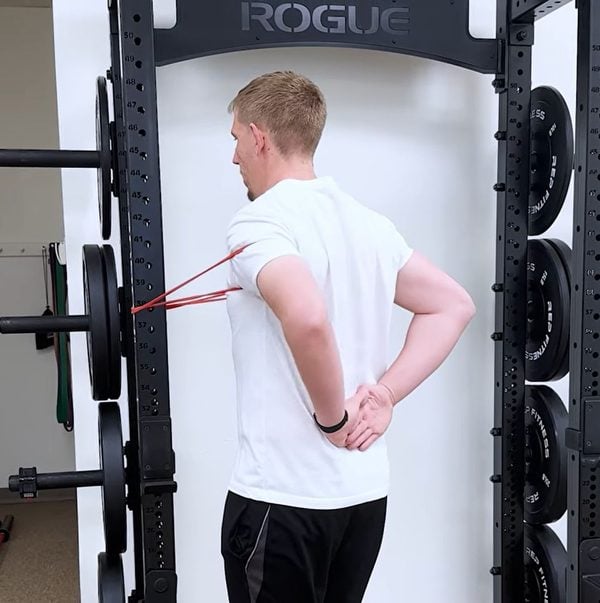
Purpose: Trains your shoulder blades to pull back and tip back, and wakes up the back of the rotator cuff.
Equipment Needed: Resistance band
How to Do It:
- Loop a band around your upper arms and put your hands on your hips or lower back.
- Pull your shoulders back against the band with control.
- Slowly return to the start.
- Think “shoulders moving back,” not your hands.
Sets: 3 sets of 10–12 controlled reps
Tip: If your hands are doing the work, you’ve lost the exercise. Let the shoulders lead.
Exercise 2: Banded Wall Open Book
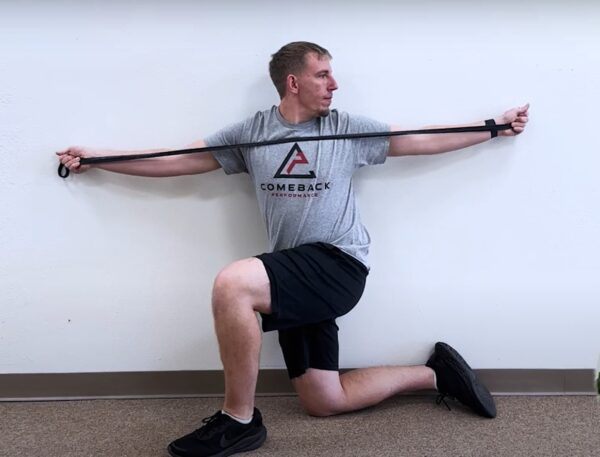
Purpose: Opens up rotation through your upper back so your shoulder blade isn’t stuck riding forward.
Equipment Needed: Resistance band, wall
How to Do It:
- Get into a half-kneeling position with your hip against the wall and your arms out in front of you, palms up, holding the band.
- Keep one hand in the center and take the other arm up and away from the wall, following that hand with your eyes.
- Go as far as you can while keeping tension on the band.
- Return to the start.
Sets: 2 sets of 10 reps on each side
Tip: Don’t let your low back twist to fake the range. The turn should come only from your upper back. Also check whether one side opens more than the other, because that difference can be adding to your shoulder pain.
Exercise 3: Extension Rocks

Purpose: Builds strength and control with your shoulders behind your body, which is exactly the position rounded shoulders avoid.
Equipment Needed: None (a bench is optional)
How to Do It:
- Sit on the floor with your hands planted behind you under your hips, knees bent and feet flat.
- Lift your butt slightly off the ground into a low crab position.
- Gently rock your body forward and back.
- Keep your chest proud and your shoulders away from your ears.
Sets: 3 sets of 8 reps
Tip: Move slowly and don’t collapse into your shoulders. If the floor is too much, put your hands up on a bench.
Go back to the wall and do the wall angel test again.
Are your hands closer to the wall? Is your low back arching less? If so, your shoulder just reached a position it couldn’t reach a few minutes ago, without a single chest stretch.
Building Shoulders That Stay Open
Here’s the big takeaway: stretching isn’t bad, but its effects are temporary. If you keep stretching your chest without asking why it’s tight, you could be doing that doorway stretch for the rest of your life. Putting your body into a position and holding it there does little for lasting pain relief or more range of motion.
That’s why we may skip stretches for shoulder pain with our clients, unless necessary. Instead, we use active mobility that teaches your shoulders to own their range of motion and keep it during the workday.
About the Author: Dr. Joey Seyforth


