
3 Exercises for Bone-on-Bone Shoulder Pain (And Why Your X-Ray Isn’t the Final Word)
“It’s bone on bone. Come back when you’re ready for a replacement.”
If you’ve heard those words, you probably did what most people do. You stopped reaching overhead and stopped going to the gym. You did the physical therapy and the stretches you were given. And still, that deep ache shows up first thing in the morning and again at the end of the day.
Here’s what nobody told you: that X-ray is a picture of what your shoulder joint looks like. It is not a prediction of what your shoulder can do.
Arthritis in the shoulder isn’t only about the joint itself. Your neck, upper back, shoulder blade and even your nerves all affect how much stress lands on that worn surface. Once you see how they connect, you’ll see why the right exercises for bone-on-bone shoulder pain can bring real relief, starting today.
Quick Reference Guide
- Total Time: About 10 minutes
- Targets: Shoulder blade, thoracic spine (upper back), shoulder joint and rotator cuff
- Goals: Reduce shoulder pain, improve range of motion and spread load away from the worn joint surface.
The 3 Exercises for Bone-on-Bone Shoulder Relief
Exercise 1: Wall Slides

Purpose: Retrains your shoulder blade to rotate up and around your ribs so the arthritic joint isn’t carrying the full load. It also adds some upper back extension.
Equipment Needed: A wall
How to Do It
- Stand facing a wall with one foot in front of the other and place your hands flat on the wall at shoulder height, with your elbows hovering just off it.
- Slide your arms smoothly up the wall.
- At the top, lean your chest slightly forward. Think “shoulder blades wrapping up and around my ribs.”
- Return slowly to the start.
Sets: Do 2 sets of 10 controlled reps.
Tip: Don’t force the range and don’t shrug toward your ears.
Exercise 2: Wall Open Book

Purpose: Restores rotation in your upper back so the shoulder doesn’t have to steal it.
Equipment Needed: A wall
How to Do It
- Get into a half-kneeling position with your side against the wall. If kneeling is too hard, do this standing. Keep your hip connected to the wall.
- Hold your hands together straight out in front of you at about chest height.
- Rotate your top arm all the way away from the wall, following your hand with your eyes. Go as far as you comfortably can.
- Return to the start.
Sets: Do 2 sets of 8–10 reps per side.
Tip: Keep that hip on the wall the whole time. Don’t let it drift to fake the range. Also notice whether one side rotates more than the other, because that difference is often a big contributor to shoulder pain.
Exercise 3: Wall Axial Rotations
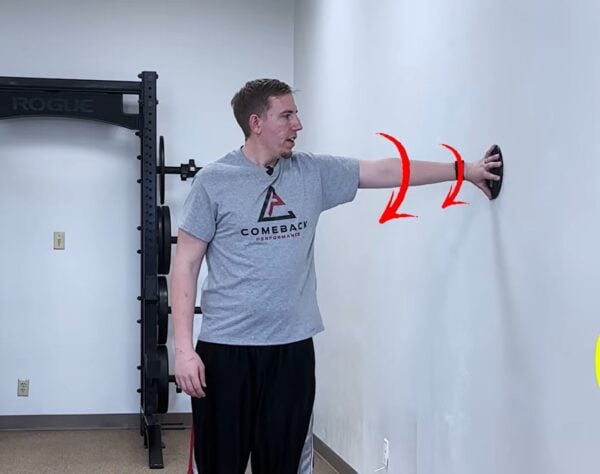
Purpose: Trains the shoulder and shoulder blade to rotate through their full range together without jamming.
Equipment Needed: A wall, plus a slider or small towel (optional, but it makes it easier)
How to Do It
- Stand side-on to a wall. Place your hand on the wall with your elbow straight, using a slider or towel under your hand if you have one.
- Lean your body weight gently into that arm so your shoulder is actively supporting you.
- Rotate your arm like a windshield wiper, down toward internal rotation and up toward external rotation.
- Keep the movement small, slow and controlled.
Sets: 2–3 sets of 8–10 slow rotations
Tip: Stay inside a pain-free arc. This one is about quality over quantity.
Stop Avoiding, Start Moving
These exercises for bone-on-bone shoulder pain are a strong starting point. Do them consistently, and you’ll likely feel easier movement fairly quickly. For long-term change, though, you should get a shoulder assessment. It looks at the areas above and below your shoulder to pinpoint exactly what needs to be addressed for lasting improvement in pain and range of motion.
About the Author: Dr. Joey Seyforth


