
The Ultimate Fix For Shoulder Bursitis That Keeps Coming Back
Shoulder bursitis is inflammation – inflammation as a result of something squeezing the bursa. As long as that squeeze is there, the pain will keep returning no matter how often you calm it down.
You’ve probably tried the usual things like rest, ice, anti-inflammatories, and physical therapy. Maybe a cortisone shot gave you a few good weeks before the pain came back. If that sounds familiar, you’re likely dealing with shoulder bursitis that keeps coming back, and the reason may surprise you.
The good news is that this doesn’t have to go on forever. You have to treat the compression, not only the inflammation. And you’ll find out how in this blog.
Start With This Quick Test
Before the exercises, check whether compression is behind your sharp shoulder pain. This is called Neer’s test.
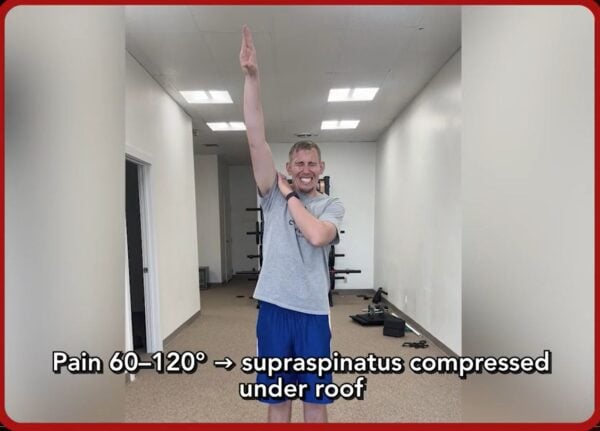
How to do it
- On the painful side, turn your palm down so your thumb points toward the floor.
- Keep your elbow straight and raise that arm in front of you toward the ceiling in one smooth motion.
- Watch for a sharp, familiar pain at the front top of the shoulder as the arm goes up.
If you feel it, the test is positive, which means compression is happening at that spot. Note where the pain showed up and how sharp it was. You’ll test again at the end.
Quick Reference Guide
- Total Time: A few minutes
- Targets: Shoulder Joint, Shoulder Blade, Core
- Goals: Open Up Space for the Bursa, Train Upward Shoulder Blade Rotation, Build Strength Under Real Load
3 Exercises to Start Fixing Shoulder Bursitis
Exercise 1: Banded Inferior Mobilizations with Dowel Flexion
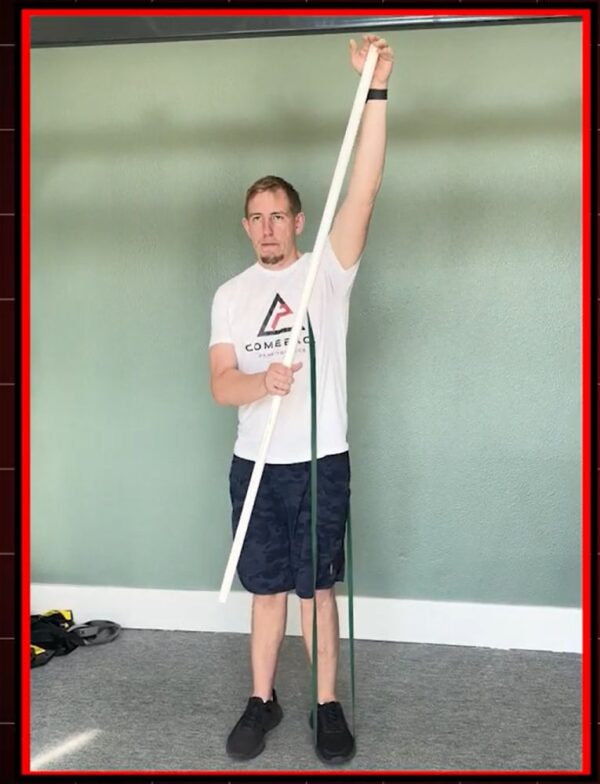
Purpose: Creates more space between the shoulder joint and the shoulder blade, giving the bursa more room.
Equipment Needed: Resistance band, dowel
How to Do It
- Step on a resistance band and place it over the top of your shoulder so it pulls down.
- Hold a dowel in both hands.
- Raise your arm straight out in front of you and overhead. The band pulls the joint down while you lift, so you open up the space as you move through it.
Sets: 2 sets of 12 reps
Tip: Don’t push into pain. Move through the best range you can control.
Exercise 2: Banded Scap Angels
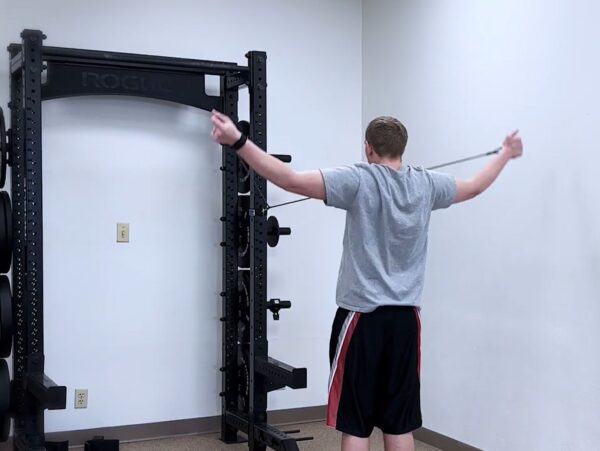
Purpose: Teaches your shoulder blade to move up and around your rib cage instead of staying stuck and jamming the front of the joint.
Equipment Needed: Light resistance band
How to Do It
- Anchor a light band in front of you at about chest height. Grab it with both hands, elbows straight, and step back to create light tension.
- Bring your hands back toward your pockets.
- Slowly move your arms up into a wide position until your biceps are by your ears.
- Return down with control. Think about your shoulder blades tipping back and rotating up while your ribs stay down.
Sets: 2 sets of 8–10 controlled reps
Tip: Don’t arch your lower back to fake the range.
Exercise 3: High Plank Walk-Ups
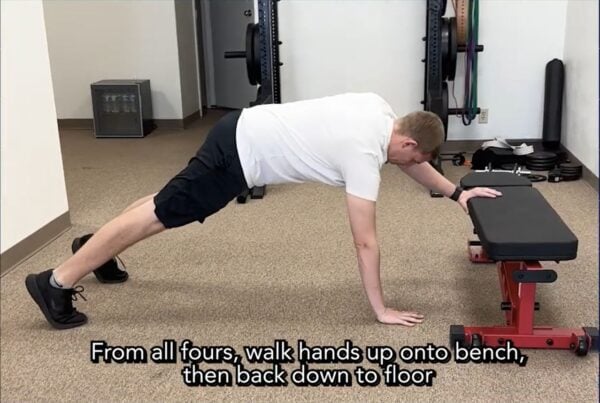
Purpose: Loads the shoulder with your hand fixed in place, so everything you just worked on has to hold up under real weight.
Equipment Needed: Floor space and a bench or stairs
How to Do It
- Start in a high plank with your hands under your shoulders and your feet apart for stability.
- Lift one hand onto the bench, then the other.
- Reverse the movement on the way down.
Sets: 2 sets of 8–10 reps per side
Tip: Keep your core braced, with no rocking through the hips and no rotating through the torso. If that’s too hard, do shoulder taps with your hands on a bench. The same rules apply.
Building a Shoulder That Stays Pain-Free
Bursitis is a symptom, not the root cause. Think of a bruise on your arm – the bruise isn’t the problem; the problem is poking it over and over. Shoulder bursitis that keeps coming back works the same way: if you don’t change how you move, you keep putting the same stress on the bursa and inflaming it again.
Many people put in plenty of effort with their exercises. What they’re missing is knowing which exercises to start with and how to modify and progress them. Looking at all five areas is how you find what’s driving your shoulder pain.
About the Author: Dr. Joey Seyforth


