
Stop Ignoring That Shoulder Click: The 4-Exercise Fix That Actually Works.
That clicking and popping in your shoulder isn’t random; it’s your body sending you a clear message that something isn’t tracking correctly. If you’re tired of dealing with shoulder clicks that interrupt your workouts, limit your daily activities, or simply annoy you throughout the day, you’re not alone.
The good news? Shoulder clicking is almost never a sign that something is torn or broken. In most cases, it’s a mechanics problem, and something you can absolutely fix.
Quick Reference Box
- Total Time: 15 Minutes
- Targets: The neck, thoracic spine, shoulder blade, shoulder joint, and nervous system.
- Goal: To restore proper shoulder mechanics, reduce clicking/pain, build functional stability
Three Tests to Identify Your Click Source
Test 1: The Painful Arc Test
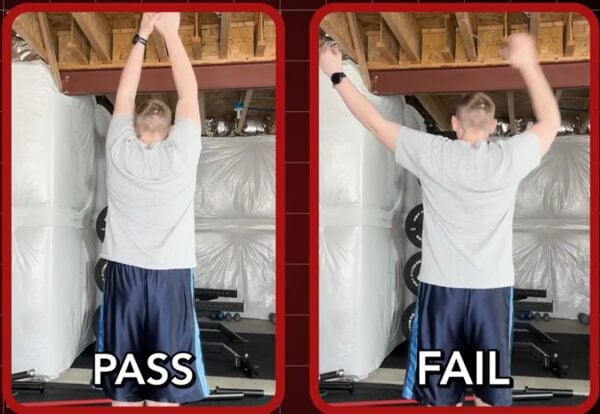
Purpose: To identify clicking in the impingement zone.
How to Do It
- Stand tall with good posture.
- Raise your arm out to the side, palm facing forward.
- Slowly lift your arm overhead, noting where clicking occurs.
- Pay special attention to the 60-120° range (shoulder to ear height).
What It Means – The clicking in this middle zone suggests subacromial involvement; your shoulder blade isn’t creating enough space as your arm rises.
Test 2 – Cross-Body AC Screen
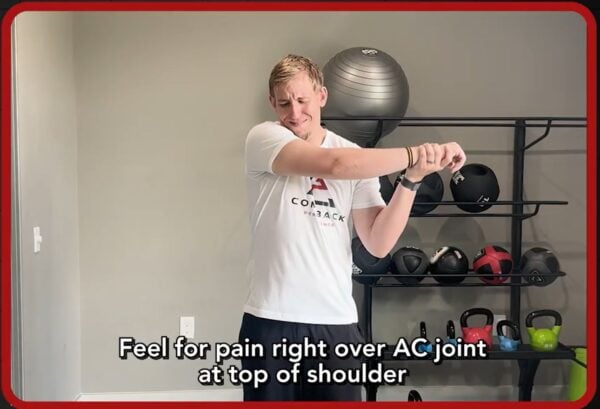
Purpose: Checks for AC joint involvement
How to Do It
- Raise your affected arm to shoulder height.
- Use your other hand to pull that arm across your chest.
- Hold and note any clicking at the very top of your shoulder.
What It Means: Pain or clicking at the top of your shoulder indicates AC joint compression.
Test 3: O’Brien’s Active Compression Test
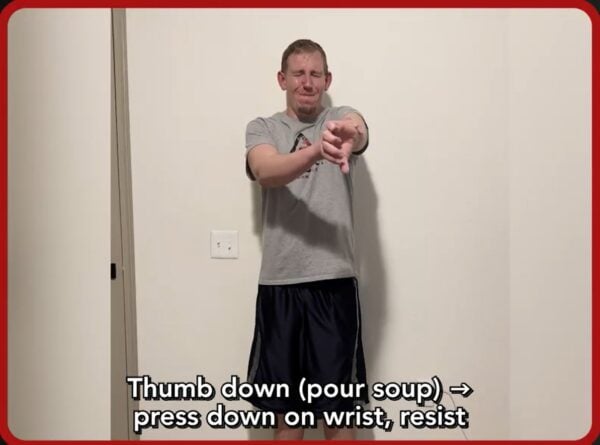
Purpose: Screens for labral involvement
How to Do It
- Raise your affected arm straight forward to 90°.
- Move it slightly across your body (10-15°).
- Turn your thumb down and resist as someone pushes down on your wrist.
- Repeat with your thumb up and compare.
What It Means: Significantly worse pain with thumb down suggests labral involvement.
Your 4 Exercise Shoulder Fix Routine
Exercise 1 – Bench Opener

Purpose Unlocks your mid-back so your shoulder stops compensating with every movement.
Equipment Needed: Broomstick, PVC pipe, or dowel; bench or sturdy chair
How to Do It
- Kneel in front of a bench, placing elbows on the bench while holding the stick overhead.
- Drop your chest toward the floor.
- Hold the stretch, breathing deeply and letting gravity deepen the position.
- Return to your starting position.
Sets – Do 2 sets of 10 slow, controlled reps
Tip: Focus on feeling the stretch between your shoulder blades and in your lats. The more you relax, the better the release.
Exercise 2: Banded Slides
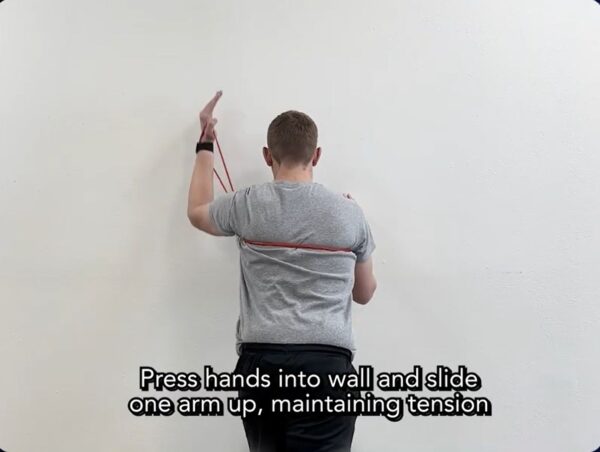
Purpose: Retrains your shoulder blade to glide smoothly along your rib cage—the most direct fix for clicking.
Equipment Needed: Resistance band
How to Do It
- Place band across your back, under your shoulder blades, holding ends in your hands.
- Press hands into the wall at shoulder height.
- Slide one arm up the wall while maintaining band tension.
- Return with control, focusing on smooth blade movement.
Sets: Do 2 sets of 12 reps per arm.
Tip: Your shoulder blade should glide flat against your ribs the entire time.
Exercise 3 – Kettlebell Pull-Through
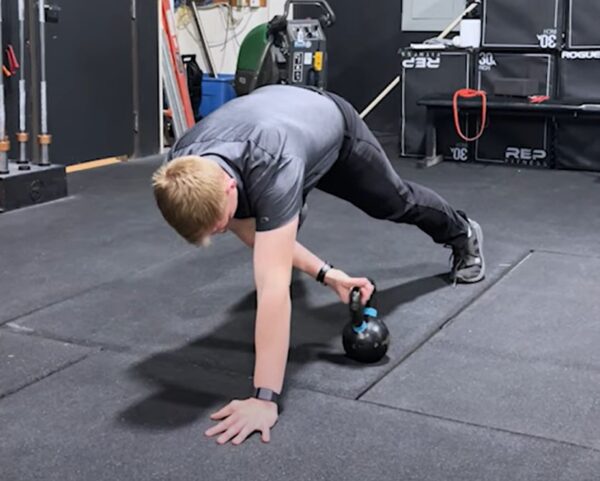
Purpose – Builds the closed-chain stability that keeps your shoulder tracking properly under real-world loads.
Equipment Needed: Kettlebell (or dumbbell).
How to Do It
- Start in a high plank position while keeping your feet wider than shoulder-width.
- Place the kettlebell outside one hand.
- Reach under your body with the opposite hand to grab the kettlebell.
- Pull it across to the other side, maintaining square hips.
Sets: 2 sets of 6-8 reps per side.
Tip: Zero hip rotation allowed. If your hips swing, you’re cheating the exercise and losing the shoulder stability benefits.
Exercise 4: Banded Extension with External Rotation

Purpose – To strengthen the posterior shoulder to keep the ball centered in the socket.
Equipment Needed: Light resistance band
How to Do It
- Hold the band behind your back, arms straight at sides.
- Pull the band apart to create external rotation tension.
- While maintaining outward pull, extend arms backward.
- Return to start with control.
Sets: Do 2-3 sets of 8-10 reps.
Tip: Keep shoulders down and away from ears.
Commit to Daily Practice for Lasting Results
Perform this 15-minute routine daily, especially before any pressing, pulling, or overhead work. You can also use it first thing in the morning to reset your shoulder mechanics for the day ahead.
Most people notice their clicking decrease within 5-7 days of consistent practice. This isn’t a coincidence—it’s your shoulder blade learning to track properly again, your thoracic spine unlocking, and your joint finding its optimal position.
Ready to take the next step?
About the Author: Dr. Joey Seyforth


