
Fix Neck and Shoulder Pain In 5 Minutes Without Leaving Your Workspace
If you’re reading this hunched over your computer screen with aching shoulders and a stiff neck, you’re not alone. Millions of desk workers experience the same daily torture: that burning sensation between your shoulder blades, the tight grip in your upper traps when using your mouse, and that feeling of being completely “stuck” when trying to transition from work to gym or even just getting comfortable in bed.
With just 5 minutes at your desk, you can:
- Reset your neck position and restore natural movement patterns
- Open up compressed upper back, lat, and front shoulder muscles
- Realign shoulder blade and joint positioning for better function
- Restore rotational freedom in your thoracic spine
- Build stability that carries over to both work tasks and gym performance
- Reduce end-of-day pain and tension significantly
The Big Five Desk Reset: Exercise Breakdown
Exercise 1: Chin Tuck + Extension

Purpose: To counteract forward head posture and restores healthy neck movement patterns.
Equipment Needed: Your office chair.
How to Do It
- Sit up tall in your chair with feet flat on the floor.
- Gently nod your chin straight back, like making a double chin (no jamming, just a small glide).
- From the tucked position, slowly look up toward the ceiling as far as comfortable.
- Return to your starting position and repeat the sequence.
Sets: Do 10 slow but controlled repetitions.
Tip: Focus on gliding the chin back, then lengthening upward, and avoid simply tilting your head randomly.
Exercise 2: Desk Bench Opener

Purpose: Opens compressed tissues in your upper back, lats, and front shoulders from prolonged sitting.
Equipment Needed: Your desk, chair, or bench.
How to Do It
- Scoot your chair back from your desk.
- Place your elbows on the desk surface with your hands together (or holding a dowel if available).
- Allow your chest to drop between your arms, stopping before sharp pain.
- Hold the stretch for a few seconds, then return to the starting position.
Sets: 10 slow repetitions with brief holds.
Tip: Think “chest dropping between arms” rather than “shoulders to ears.”
Exercise 3 – Wall Slide

Purpose: Restores proper shoulder blade and joint mechanics for both posture and overhead activities.
Equipment Needed: Wall or door frame.
How to Do It
- Stand facing a wall and place forearms or hands at about shoulder height.
- Gently press into the wall and slowly slide your arms upward.
- Let your chest move slightly toward the wall as you slide up.
- Go only as high as comfortable without sharp pinching, then slide back down.
Sets: 10-15 smooth repetitions.
Tip: Keep ribs gently tucked and avoid arching your lower back to fake a range of motion.
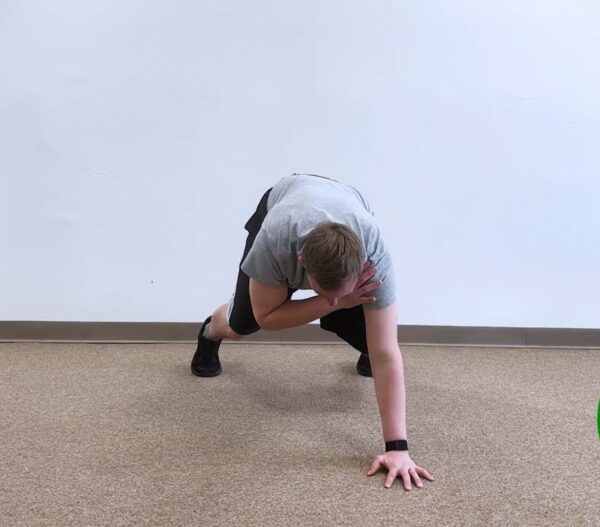
Exercise 4: Wall Open Book

Purpose: Restores rotational movement in your thoracic spine that gets locked from forward posturing.
Equipment Needed: Wall.
How to Do It
- Stand in a half-kneeling position with your hip lightly touching the wall.
- Place both hands slightly in front of your chest.
- Slowly rotate your top arm and chest away from the wall, as if opening a book.
- Let your eyes follow your hand, pause briefly at the end range, then return.
Sets: 8-10 repetitions each side.
Tip: Note if one side opens more than the other – this asymmetry could be contributing to your pain. Motion should come from your ribs and upper back, not your lower back.
Exercise 5 – Shoulder Taps
Purpose: Builds the stabilizing strength your shoulders need for typing, carrying, and gym activities.
Equipment – Floor or an elevated surface, such as a desk edge/bench.
How to Do It
- Get into a plank position with your hands under your shoulders and your body in a straight line.
- Lift one hand and tap the opposite shoulder.
- Place your hand back down and alternate sides.
- Keep your body as steady as possible throughout the movement.
Sets: 30-45 seconds, rest and then repeat for another 30-45 seconds.
Tip: Do small, controlled taps are more effective than large, sloppy movements.
From Constant Pain to Freedom
One of the clients that our online shoulder rehab program worked perfectly for described his transformation: “When I was at my worst, I would have to push my chair all the way up to the desk and lean into my chair just to get comfortable.” The constant pressure and slumping weren’t fixing anything.
After implementing the Big Five system, his results spoke for themselves: “The different types of motions have improved dramatically. The tightness, most of that has gone away.” He went from constantly shifting to find comfort to sitting and working normally, with much smoother transitions when moving into evening workouts. The goal isn’t perfect posture – it’s a shoulder and neck system that can actually tolerate your daily demands.
How to Use Your 5-Minute Reset
Daily Implementation:
- Perform once or twice on long desk days.
- Ideal timing: midday break and/or before leaving work.
- Use before evening workouts to avoid taking desk posture straight to the gym.
- Continue on rest days to prevent stiffening between training sessions.
Expected Benefit
- Fewer neck and shoulder aches by day’s end.
- Easier transitions from desk to gym.
- Reduced nighttime pain from desk-driven tension.
- Improved workout performance and recovery.
Beyond Quick Fixes: Addressing the Root System
You need to address the source of the discomfort by checking if it’s coming from the neck, upper back, shoulder blades, shoulder joint, and nervous system and doing the needful. If you only stretch where it hurts without addressing the interconnected system, you’ll keep chasing the same pain-and-tightness cycle. This 5-minute reset gives you immediate relief while beginning to retrain proper movement patterns.
Ready to take control of your desk-related pain?.
About the Author: Dr. Joey Seyforth


