
The 3 Missing Exercises That Could Finally Fix Your Post-Surgery Shoulder Pain
You had the surgery, completed months of physical therapy, and followed every protocol to the letter. Yet your shoulder still aches, feels weak, or lacks the confidence to tackle the activities you love. If this sounds familiar, you’re not alone.
The good news? This isn’t a failure of your surgery or your effort. The issue lies in a fundamental misunderstanding of shoulder recovery. We’re going to point out the important things you should know about post-surgery shoulder pain and what you should do about it.
Quick Reference Guide
- Total Time – 15 Minutes
- Targets – Your cervical spine, thoracic spine, shoulder blade, surgical site, and nerve system.
- Goals: Restore mobility, rebuild dynamic stability, integrate full kinetic chain function
Exercise 1 – Windmill Lift-Off
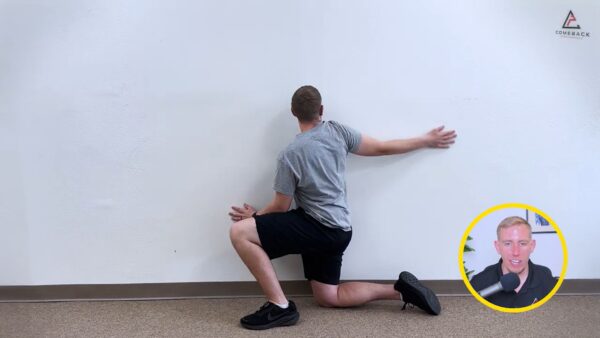
Purpose To restore your shoulder and thoracic spine mobility.
Equipment Needed: Wall space
How to Do It
- Position yourself in half-kneeling against a wall, keeping your hip connected throughout.
- Slide your arm up the wall in an arching pattern, following your hand with your eyes.
- At the end range, lift your arm off the wall and hold for 2 seconds.
- Reverse the arch pattern back to the starting position with full control.
Sets: 2 sets of 10 reps per side
Tip: If you can’t achieve full range, that’s valuable information—not failure. It shows exactly how much mobility your standard protocol missed.
Exercise 2: Side-Lying Ball External Rotation Toss
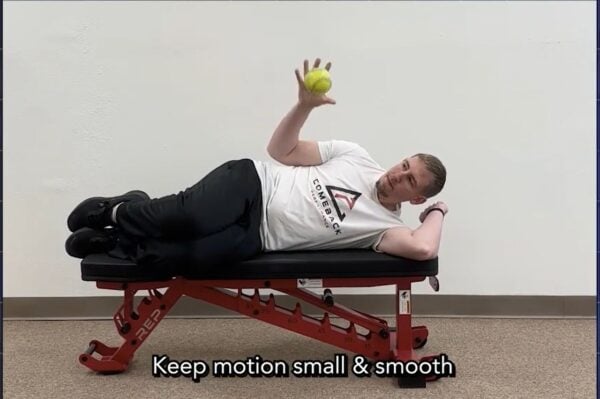
Purpose: Rebuild dynamic rotator cuff coordination lost during post-operative immobilization
Equipment Needed: Small ball (tennis ball, lacrosse ball, or baseball)
How to Do It
- Lie on your non-surgical side with the surgical arm elbow bent to 90 degrees.
- Keep your upper arm resting against your rib cage throughout the movement.
- Slowly externally rotate your shoulder, raising your forearm toward the ceiling.
- Toss and catch the ball in this external rotation position with controlled movements.
Sets: Do 2-3 sets of 30-45 seconds of controlled toss and catch.
Tip: Keep movements small and controlled.
Exercise 3 – High Plank Walk-Up
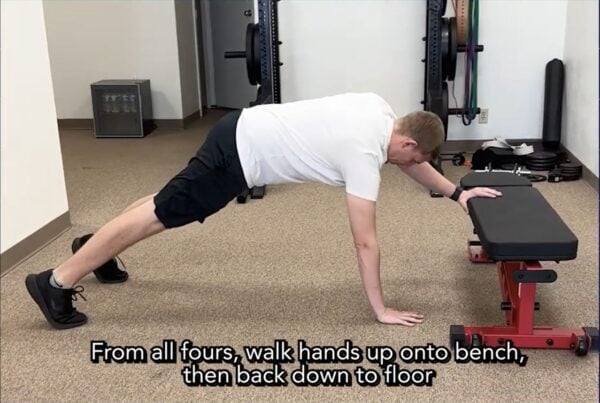
Purpose – Create a bridge from baseline rehab to real-world shoulder performance through closed-chain shoulder stability.
Equipment Needed: Bench or elevated surface (countertop for modifications)
How to Do It
- Start in a push-up position on the floor.
- Walk your hands up onto a bench while maintaining plank position.
- Reverse by walking hands back down to the floor.
- That’s one complete rep.
Sets: 2 sets of 6-8 walk-ups.
Tip: Your shoulder blades should feel actively engaged, not sinking or winging. If blades lift off your rib cage, elevate the surface and work from there.
Better Feeling Shoulders
Perform these exercises daily or at minimum five times per week. Think of them as filling the gaps your formal rehab left behind. Most people notice improved shoulder confidence and movement quality within the first week. Keep in mind that these exercises aren’t replacements for your surgeon’s protocol; they’re the missing pieces that transform baseline recovery into true performance restoration.
About the Author: Dr. Joey Seyforth


