
Do This When Your MRI Shows Nothing Wrong, But Your Shoulder Still Hurts
If you’ve been told your shoulder MRI looks perfectly normal, but you’re still dealing with persistent shoulder pain that disrupts your work, workouts, sleep, and daily activities, you’re not alone (and you’re not crazy).
This is one of the most common problems people who experience shoulder pain face. They spend hundreds or thousands on imaging, only to be told to “rest it” or “try some PT sessions.”
In this blog, you’ll find three simple yet powerful exercises that you can do to take care of your shoulder pain. You only need to set aside about 15 minutes per day to complete these exercises.
Quick Reference: Your 15-Minute Shoulder Reset
- Total Time: 15 Minutes
- Targets: The thoracic spine, shoulder blades, shoulder joint stability, and nerves.
- Goal: To restore proper movement mechanics, reduce compensations, and build functional stability in your shoulder.
3 Game-Changing Exercises to Fix What Your MRI Missed
Exercise 1: Bench Opener

Purpose: To restore upper back extension mobility so your shoulder doesn’t have to compensate during overhead movements.
Equipment Needed: Bench or sturdy chair, stick/PVC pipe/broom handle.
How to Do It
- Kneel in front of a bench with a stick held in both hands, palms facing up, hands shoulder-width apart.
- Place your elbows on the bench surface and sit your hips back toward your heels.
- Gently drop your chest toward the floor, allowing your head to come between your arms.
- Stay in this position for 2-3 breaths, feeling the stretch through your upper back and shoulders, then return to the starting position.
Sets: 2 sets of 8-10 slow, controlled repetitions.
Tip: Focus on the stretch through your upper back and lats, not a sharp sensation in your shoulder joint. Slightly adjust your hand or reduce the range of motion when you feel pinching in your shoulders.
Exercise 2: Banded Scapular Angels
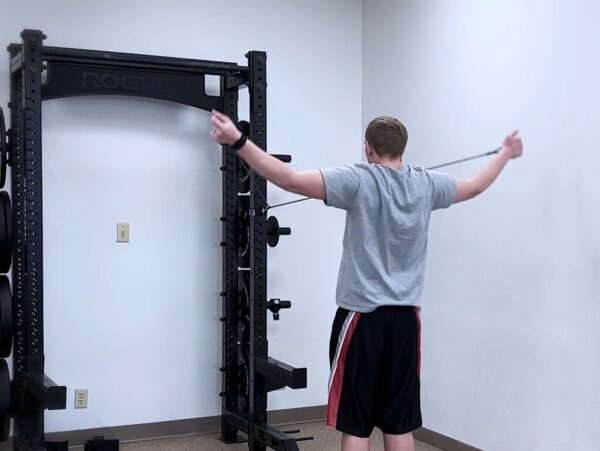
Purpose: To train your shoulders for proper shoulder blade rotation, prevent impingement, and restore overhead mechanics.
Equipment Needed: Light resistance band.
How to Do It
- Anchor a light band at chest height and grab with both hands, arms straight.
- Step back to create light tension, then bring your hands toward your hips.
- Slowly move your arms out and up into a wide “angel” position, ending with biceps near your ears if comfortable.
- Focus on rotating your shoulder blades up and back while keeping your ribs down and avoiding excessive arching.
Sets: 2 sets of 8-10 slow, controlled repetitions.
Tip: Think “shoulder blades rotating up and around” rather than just lifting your arms. The band should provide light resistance throughout the movement.
Exercise 3: Kettlebell Pull-Throughs
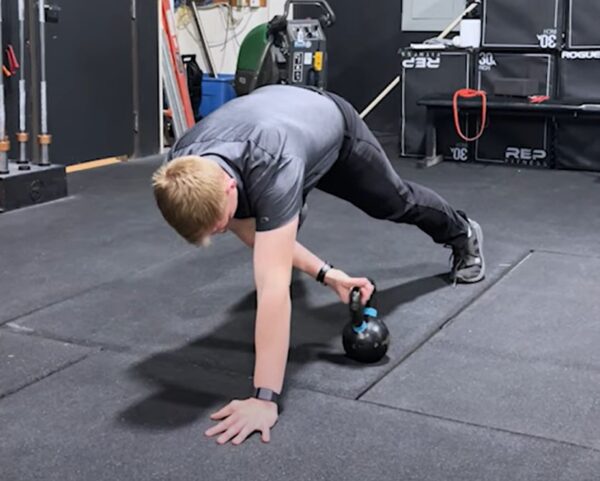
Purpose: To build functional shoulder and core stability in real-world positions while improving coordination.
Equipment Needed: Light kettlebell (10-20 lbs to start).
How to Do It
- Assume a high plank position with your hands on the floor (or on a bench if needed for a modification).
- Place a light kettlebell just outside one hand.
- Reach across with the opposite hand to grab the kettlebell handle.
- Pull it across to the other side while keeping your hips level and minimizing rotation.
Sets: 2-3 sets of 6-8 pull-throughs per side
Tip: Start very light—this exercise is about control and stability, not maximum strength. Focus on “quiet hips, quiet ribs, strong shoulders” throughout the movement. Your core should be working hard to prevent rotation.
The Three Hidden Mechanical Problems MRIs Never Detect
Problem #1: Thoracic Spine Stiffness (The Compensation Cascade)
When your upper back becomes rounded and stiff from desk work, poor posture, or previous injuries, your shoulder is forced to “steal” motion every single time you reach overhead or press. This creates a cascade of problems:
Your shoulder joint is jammed into the front of the socket, causing impingement and soft-tissue irritation. The muscles around your shoulder blade work overtime trying to stabilize an unstable foundation. Your rotator cuff and bicep tendons become inflamed from the abnormal mechanics, even though the structures themselves are perfectly healthy.
This is why you might feel fine at rest but experience sharp pain when reaching for something on a high shelf or pressing weights overhead—your shoulder is being forced to move in ways it wasn’t designed to handle.
Problem #2: Poor Shoulder Blade Rotation (The Impingement Creator)
Your shoulder blades need to rotate upward and around your rib cage during overhead movements to create space for your arm bone to move freely in the socket. When this doesn’t happen properly—often due to muscle imbalances or poor movement patterns—the ball of your shoulder rides up and forward, creating:
- Impingement symptoms with overhead activities
- Front-of-shoulder pain during pressing movements
- Bicep and rotator cuff irritation from abnormal joint positioning
- “Pinching” sensations when reaching across your body
The frustrating part? Your MRI will look completely normal because the structures are fine—they’re just being forced into poor positions by faulty movement patterns.
Problem #3: Functional Instability (The Trust Issue)
Even when your ligaments and joint capsule are intact, your shoulder can feel unstable and “untrustworthy” if the muscles around it haven’t learned to coordinate properly. This creates:
- That “sketchy” feeling with certain arm positions or loads
- Compensatory muscle tension as your body tries to create stability through stiffness
- Exercise avoidance because you can’t trust your shoulder under load
- Sleep disruption from subconscious guarding and positioning issues
This functional instability often develops after an initial injury or period of pain, when your nervous system essentially “forgets” how to properly coordinate the 17+ muscles that stabilize your shoulder during movement.
From Frustration to Function
The three exercises above work best when performed daily as part of your routine, not just when you’re experiencing symptoms. Think of them as “movement hygiene” – essential maintenance for your shoulder system, just like brushing your teeth is for oral health.
You can take the next step and improve your shoulder health by booking a session with our specialist.
About the Author: Dr. Joey Seyforth


