
Stop Stretching Your Tight Shoulder: Do This Instead for Lasting Relief
If you’re constantly stretching a tight shoulder only to feel tight again minutes later, you’re not alone—and you’re not broken. Good news: your shoulder tightness usually isn’t a “short muscle” problem. It’s a control and protection problem you can fix in just a few minutes a day with the right moves. Below are practical, simple shoulder pain relief exercises you can do in five to ten minutes that address the real reasons your shoulder feels tight, so you can get quick relief now and build long-term mobility that sticks.
Why Stretching Isn’t Working (And What To Do Instead)
That tight, pinchy feeling isn’t just a stiff muscle. When your body senses pain or threat, your nervous system hits the “emergency brake” by guarding the area. Repeatedly yanking on tight tissues gives you short-term relief, but it doesn’t convince your nervous system that movement is safe—so the tightness snaps back.
Shoulder motion depends on five areas working together. If one is limited, your shoulder compensates with tension and pain. You’ll perform three targeted exercises that restore scapular motion, open the thoracic spine, and build active control in your shoulder ranges that usually feel “stuck.” Expect immediate relief and steady gains with consistency.
With just 10 minutes a day, you can
- Reduce that front-of-shoulder pinch and “stuck” feeling when lifting your arm.
- Improve overhead reach without impingement or shrugging.
- Restore shoulder blade glide for smoother, pain-free motion.
- Build active control so relief lasts beyond the workout.
- Sleep more comfortably on your side and reach behind you without zingers.
- Protect your rotator cuff by fixing the root cause, not just stretching symptoms.
Quick Reference Box
- Total Time: 8–12 minutes
- Targets: Neck, thoracic spine, shoulder blade (scapula), shoulder joint, nervous system
- Goals: To build real mobility (active control), reduce pain/tightness from protective guarding, and improve scapular mechanics and overhead function.
Exercise Breakdown
Exercise 1: Windmill + Liftoff
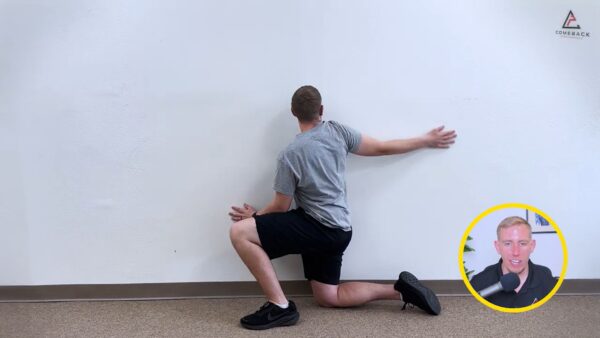
Purpose: Restore scapular upward rotation and thoracic rotation so the shoulder stops impinging.
Equipment Needed: Wall
How to Do It
- Half-kneel beside a wall with the hip closest to the wall lightly touching it. Place your forearm/hand on the wall at shoulder height.
- Slide your arm up and around the wall (windmill) while rotating your upper back—keep ribs down.
- At your comfortable end range, gently lift your hand off the wall 1–2 inches for 2–3 seconds; relax and return.
Sets: 2 sets of 8 reps per side
Tip: Don’t force range. Keep the shoulder blade gliding up and around—avoid shrugging your ear to your shoulder.
Exercise 2: Extension Rocks

Purpose: Reclaim thoracic extension and coordinated shoulder extension to open the front of the shoulder.
Equipment Needed: None
How to Do It
- Sit with knees bent, hands behind your hips, fingers pointing out or slightly back.
- Lift your hips a few inches and open your chest; gently rock your body forward and back to load shoulder extension.
- Move slowly, keeping neck long and ribs down; breathe throughout.
Sets: 2 sets of 10 slow rocks
Tip: If you feel wrist strain, turn fingers slightly outward and keep rocks small. Aim for chest opening, not low-back arching.
Exercise 3: Angels Over Cones

Purpose: Build active control of the scapula and rotator cuff in the ranges that usually feel “tight.”
Equipment Needed: 3 small objects (cones, yoga blocks, books) as targets
How to Do It
- Lie on your stomach with a towel under your forehead; arms long at your sides, thumbs up.
- Place three small objects around your head/shoulders as “hurdles” to clear (overhead, diagonal, side).
- Lift arms slightly and sweep them up and over each target with control, then return—slow and steady.
Sets: 1 set of 5 slow passes “down and back” (do 2 sets if time permits)
Tip: Keep shoulders away from ears and avoid rib flaring. The goal is smooth, pain-free control—quality over height.
Something Better Than Stretches!
Stretches are temporary, if you focus on active mobility, you will see results. You should notice that you’re experiencing less “pinch,” easier overhead motion, smoother reaching, better scapular mechanics, stronger end-range control, and fewer flare-ups. When you retrain the neck, thoracic spine, scapula, shoulder joint, and nervous system to work together, your shoulder moves freely without the nervous system slamming the brakes.
Want a tailored plan that matches your exact movement restrictions and goals? Book a free consultation now!
About the Author: Dr. Joey Seyforth


