
How to Heal Shoulder Pain Without Surgery (9 Proven Exercises): A Complete Recovery Guide
If you’re dealing with nagging shoulder pain that’s keeping you up at night, limiting your activities, and making you worry about tears or injuries. here’s some good news: most shoulder pain is caused by movement dysfunction. So here’s my complete guide on how to heal shoulder pain without surgery or injections.
The moment shoulder pain strikes, fear takes over. Is it torn? Do I need an MRI? Will I need surgery?
But here’s what most medical professionals won’t tell you upfront: surgery and injections are often unnecessary Band-Aid solutions that don’t address the root cause of your problem.
The Chain Reaction That’s Really Causing Your Pain
Your shoulder doesn’t exist in isolation. Think of your body like a busy city roundabout—when every car (muscle group) follows the rules and communicates properly, traffic flows smoothly. But when just one car stops following the rules, everything backs up, accidents happen, and chaos ensues.
That’s exactly what’s happening in your shoulder. When your neck stiffens, your thoracic spine loses mobility, your shoulder blades get stuck, and your rotator cuff stops firing properly, your shoulder becomes the victim of a system-wide breakdown. The pain you’re feeling isn’t the problem—it’s the alarm bell telling you that traffic has stopped flowing.
Instead of treating symptoms with shots or surgery, we’re going to restore proper movement patterns throughout your entire kinetic chain. With just 15-20 minutes a day, you can address the real causes of your shoulder pain and get back to the activities you love—whether that’s pickleball, overhead lifting, or simply sleeping through the night without pain.
With just 15-20 minutes a day, you can:
- Sleep through the night without shoulder pain waking you up
- Lift your arms overhead without sharp, shooting pain
- Return to sports like pickleball, tennis, or golf with confidence
- Eliminate nerve tension that causes those sudden jolts of pain
- Restore natural shoulder mechanics for long-term pain prevention
- Avoid unnecessary medical procedures and their associated risks and costs
Quick Reference
- Total Time: 15-20 Minutes Daily
- Targets: Neck, thoracic spine, shoulder blades, shoulder joint, nerve pathways
- Goals: Restore mobility, activate dormant muscles, strengthen movement patterns
The Five Critical Areas Behind Your Shoulder Pain
Before diving into exercises, you need to understand why your shoulder hurts. It’s not just about the shoulder itself—five interconnected areas must work together for pain-free movement.
Area 1: Your Neck (Cervical Spine)
When your neck loses its natural range of motion, your shoulder has to compensate by moving into positions it wasn’t designed for. This compensation pattern creates stress and eventually pain.
Area 2: Your Mid-Back (Thoracic Spine)
Your thoracic spine needs to extend when you press overhead and rotate for sports movements. When it’s stiff and immobile, your shoulder joint takes on extra stress it can’t handle.
Area 3: Your Shoulder Blades (Scapulae)
The shoulder blades must move up and around to create space for your arm to move freely. When they’re stuck, you get compression of the bursa (fluid-filled sacs), rotator cuff tendons, and bicep tendons.
Area 4: Your Shoulder Joint
As a ball-and-socket joint, your shoulder needs the ball (humeral head) to drop down, roll, glide, and rotate through a full 180-degree range. When the ball stays “sucked up” in the socket, every movement becomes painful.
Area 5: Nerve Tension
This is often the missing piece in shoulder pain recovery. Nerves that start in your neck travel down through your shoulder, and can refer pain throughout the entire area. When these nerves get compressed – especially around the first rib area – you get that sharp, jolting pain and nighttime discomfort that disrupts your sleep.
Your Three-Step Recovery Protocol
Now that you understand the why behind your pain, let’s fix it with a systematic three-step approach: Mobilize, Activate, and Strengthen.
Step 1: Mobilize – Restore Lost Movement
Purpose: Unlock restricted areas and restore clean movement patterns where your body has locked down.
Exercise 1: Bench Openers

Purpose: Open up the chest and front shoulder while mobilizing the thoracic spine.
Equipment Needed: Bench, couch, or sturdy chair
How to Do It
- Kneel facing a bench and place your elbows on it, hands holding a stick with palms up (optional).
- Sit your hips back as you drop your chest toward the floor.
- Pause where you feel a stretch across your upper back and lats (not pain), then return.
Sets: 2 sets of 10 reps
Tip: Focus on the rotation coming from your mid-back, not forcing the stretch with your arm
Exercise 2: Wall Slides

Purpose: Restore overhead shoulder mobility while engaging the shoulder blades.
Equipment Needed: Wall
How to Do It
- Stand facing a wall, placing your forearms and hands on the surface with elbows slightly bent. Stagger your feet for better balance.
- Slowly begin to slide your arms up the wall, reaching as high as you comfortably can.
- As your arms go up, actively press your chest toward the wall. This encourages your shoulder blades to rotate upward correctly.
- Slide back down to the starting position with control.
Sets: 2 sets of 15 reps
Tip: Keep your lower back flat against the wall throughout the entire movement.
Exercise 3: Open Books
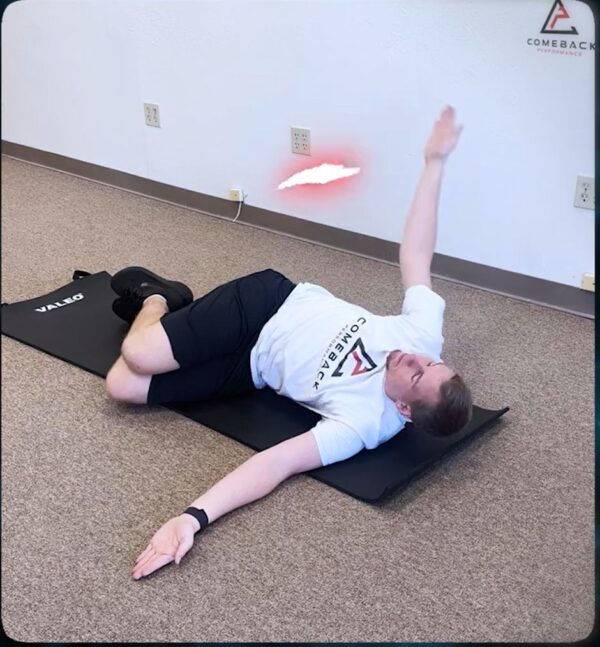
Purpose: Mobilize thoracic spine rotation and reduce nerve tension.
Equipment Needed: None
How to Do It:
- Lie on your side with knees bent to 90 degrees.
- Extend both arms straight out in front of you.
- Slowly lift your top arm up and rotate it over to the other side.
- Follow your hand with your eyes and feel the twist through your mid-back.
Sets: 2 sets of 10 reps each side.
Tip: Keep your knees together and on the ground—the movement should come from your spine, not your hips
Step 2: Activate – Wake Up Dormant Muscles
Purpose: Reactivate muscles that pain has shut down and restore proper muscle firing patterns.
When you experience pain, your nervous system automatically shuts down muscles as a protective mechanism—like pulling your hand away from a hot stove. We need to bring these muscles back online with control-based exercises.
Exercise 4: Banded W Holds

Purpose: Activate the middle trapezius and posterior deltoids for shoulder blade stability.
Equipment Needed: Grab a band for this exercise. You are going to be targeting the upper back and rotator cuff together, and moving in 3 different directions.
How to Do It
- Hold a resistance band with arms extended in front of you.
- Pull the band apart while bending your elbows into a “W” shape.
- Squeeze your shoulder blades together and hold for 3-5 seconds.
- Slowly return to the start position.
Sets: 3 sets of 6-8 reps.
Tip: Focus on squeezing your shoulder blades together first, then pulling with your arms
Exercise 5: Prone Swimmers

Purpose: Activate the posterior chain and improve shoulder blade-arm coordination
Equipment Needed: None
How to Do It
- Lie face down with arms extended overhead.
- Lift arms off the ground
- Alternate lifting the opposite arm and leg in a swimming motion.
- Keep movements slow and controlled.
Sets: 2 sets of 10 reps
Tip: Keep your head in a neutral position and avoid arching your back excessively.
Exercise 6: Banded Cheerleaders

Purpose: Activate the serratus anterior and improve shoulder blade upward rotation
Equipment Needed: Resistance band
How to Do It
- Hold a resistance band with arms out in front with your palms up.
- First, pull the band apart to the sides, then return to neutral.
- Move into a diagonal pattern with your arms moving opposite, then return to the neutral position and repeat the other direction.
Sets: 3 sets of 5 reps each direction
Tip: Think “reach for the ceiling” rather than pressing forward
Step 3: Strengthen – Integrate the System
Purpose: Teach your body to move as one coordinated unit and bulletproof your shoulders against future pain.
This final step is crucial for preventing your pain from returning. We’re building strength within the new movement patterns you’ve restored.
Exercise 7: Banded Scap Angels

Purpose: Strengthen the entire posterior chain while maintaining proper shoulder mechanics
Equipment Needed: Resistance band
How to Do It
- Attach the band at shoulder height and face away from the anchor
- Start with arms at your sides, holding the band
- Slowly raise arms overhead in an angel-like motion
- Control the return to the starting position
Sets: 2 sets of 8-10 reps
Tip: Keep constant tension in the band and avoid letting your shoulders roll forward
Exercise 8: Banded Bear Taps

Purpose: Build shoulder stability and core strength in a functional position
Equipment Needed: Resistance band around wrists
How to Do It
- Get into a bear position with your hands under your shoulders and knees under your hips.
- Put a band around your wrists.
- Lift your hips and tap hand in all 3 directions.
Sets: 2 sets of 10 taps each side
Tip: Move slowly and focus on maintaining perfect form rather than speed
Exercise 9: Banded Bottom-Up Press
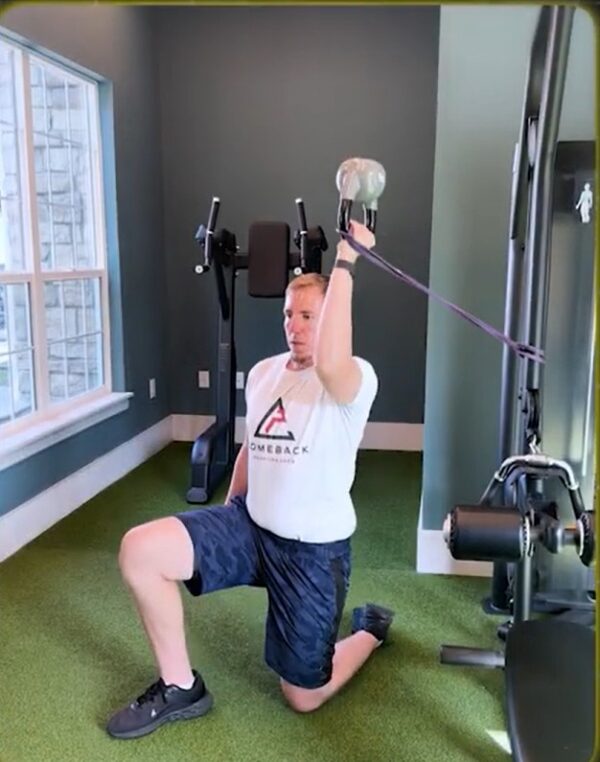
Purpose: Challenge shoulder stability while building functional pressing strength
Equipment Needed: Resistance band, kettlebell.
How to Do It
- Put a band around the kettlebell and begin pulling back.
- Flip the kettlebell upside down.
- Press overhead while ending with bicep to ear
Sets: 3 sets of 10 reps
Tip: Start with light resistance and focus on control rather than power
Your Path to Permanent Shoulder Pain Relief
Consistency is your secret weapon. These exercises work because they address the root causes of your shoulder pain, not just the symptoms. You’ll likely notice some immediate relief in movement quality and pain reduction, but the real magic happens when you commit to this routine daily for 2-4 weeks.
The good news? You’re not just treating pain—you’re building a stronger, more resilient shoulder system that will serve you for years to come. No more waking up and noticing that everything has stiffened back up overnight. No more sharp jolts of pain during daily activities. No more fear about what might be “torn” or “damaged.”
Your shoulder pain is fixable, and surgery or injections aren’t the answer for most people. By restoring proper movement patterns and getting all parts of your kinetic chain working together again, you’re addressing the real problem.
Sometimes, having an expert guide you through your specific movement dysfunctions and create a custom recovery plan can accelerate your results and ensure you’re addressing your unique problem areas.
Ready to take the next step?
About the Author: Dr. Joey Seyforth


