
3 Worthy At Home Exercises For Shoulder Impingement Relief
Have you ever tried to lift your arm, reach for something on a high shelf, or even just put on a jacket, only to be met with a sharp, pinching pain deep inside your shoulder? It’s a frustrating feeling, almost like something is catching or grinding with every move. This common issue is likely coming from your shoulder region, and you can get rid of it with these at home exercises for shoulder impingement.
The good news is that the solution often lies beyond just the shoulder joint itself. Your shoulder is part of a complex system, and the pain you feel is usually a symptom of a “chain reaction” caused by poor mechanics elsewhere—specifically, with your shoulder blade (scapula).
If your shoulder blade doesn’t move correctly, it can reduce the space in your shoulder joint, causing those tendons to get pinched.
But what if you could start correcting this issue and find real relief in just five minutes a day? You can. This article will guide you through a simple, effective routine to start creating more space in your shoulder, retraining its movement, and putting you back in control.
With just five minutes a day, you can:
- Reduce Tendon Irritation: By creating more room, you’ll decrease the constant pinching and inflammation of the sensitive rotator cuff tendons.
- Retrain Healthy Mechanics: Teach your shoulder and shoulder blade to work together in proper “scapula humeral rhythm,” ensuring smooth, pain-free movement.
- Improve Functional Strength: Strengthen the key stabilizing muscles in your rotator cuff and mid-back that are essential for resolving impingement for good.
- Regain Your Range of Motion: Start reaching overhead, across your body, and behind your back with newfound confidence and less pain.
- Enjoy Better Sleep: Find relief from the nagging discomfort that comes from lying on the affected side.
Quick Reference Box
- Total Time: 5 Minutes
- Targets: Rotator cuff tendons, scapula (shoulder blade), and mid-back stabilizing muscles.
- Goals: Reduce impingement pain, improve scapular mobility and upward rotation, and strengthen shoulder stabilizers.
The 3-Move Solution to Shoulder Impingement
Here are the three exercises from Dr. Joey Seyforth that form a powerful sequence to combat shoulder impingement. Perform them for the best results.
Exercise 1: Banded Posterior Shoulder Mobilization
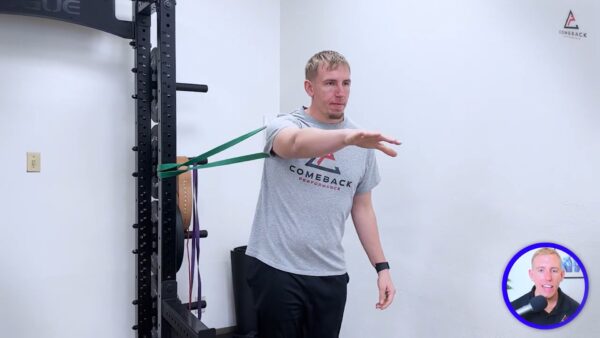
Purpose: You’ll feel the impact of this posterior shoulder mob exercise because it uses band tension to pull the head of the arm bone backwards gently. By doing this, it opens up space in the front of the shoulder where impingement typically occurs.
Equipment Needed: One light to medium resistance band.
How to Do It
- Attach a resistance band to a sturdy anchor (like a doorknob or squat rack) at shoulder height.
- Loop the band around the very front of your shoulder joint and step away from the anchor to create moderate tension.
- From this position, gently move your arm forward and back in a slow, controlled chest press motion.
Sets & Reps: 2 sets of 15 reps.
Tip: Don’t fight the band. Allow the band to gently pull your shoulder into a better position as you move it around because, as we earlier mentioned, the goal is mobilization.
Exercise 2: Wall Slides

Purpose: This wall slide exercise is useful for retraining the proper upward rotation of your shoulder blade, which is essential for preventing impingement during overhead movements.
Equipment Needed: A wall.
How to Do It
- Stand facing a wall, placing your forearms and hands on the surface with elbows slightly bent. Stagger your feet for better balance.
- Slowly begin to slide your arms up the wall, reaching as high as you comfortably can.
- As your arms go up, actively press your chest toward the wall. This encourages your shoulder blades to rotate upward correctly.
- Slide back down to the starting position with control.
Sets & Reps: 2 sets of 12 reps.
Tip: Focus on the feeling of your shoulder blades gliding and rotating. Avoid shrugging your shoulders up towards your ears; keep your neck relaxed.
Exercise 3: Banded Scap Angels
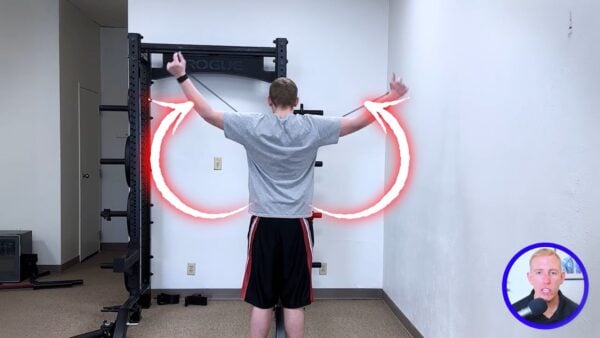
Purpose: This exercise strengthens the rotator cuff and mid-back muscles while promoting a “posterior tilt” of the shoulder blade. Both help offload the front of the shoulder.
Equipment Needed: One light resistance band.
How to Do It
- Stand holding a resistance band with both hands about shoulder-width apart. Your arms should be out in front of you with palms facing up.
- Create initial tension by pulling your shoulder blades back and down.
- Maintaining this tension, raise your arms up and out in a “snow angel” motion, then control the movement as you lower them back down.
Sets & Reps: 2 sets of 10-12 reps.
Tip: The key to this exercise is maintaining constant tension on the band throughout the entire movement. Never let it go slack.
From Quick Fix to Lasting Solution
There it is – the three targeted moves in five minutes. If you diligently practice this sequence daily, you will actively retrain your shoulder’s mechanics, create space, and reduce pain without aggravating the joint.
These exercises are a decisive first step and can provide tremendous relief. However, they are not a substitute for a comprehensive, long-term solution. To permanently fix shoulder pain, it’s essential to get a proper movement assessment to understand the unique why behind your specific issue.
If you’ve already tried basic physical therapy, stretches, or other methods and are still struggling, it may be time for a more tailored approach.
About the Author: Dr. Joey Seyforth


