
STOP Stretching! Why Your Shoulder Pain Isn’t Getting Better (Do This Instead)
If you’ve been religiously stretching your shoulders every day and your pain isn’t getting better, you need to stop what you’re doing right now. First, you need to find out why your shoulder pain gets worse with stretching and the things you can do to correct that.
Your shoulder is the most mobile joint in your entire body, which makes it incredibly versatile but also dangerously unstable. When most people feel shoulder stiffness or pain, they automatically assume it’s tight and needs stretching. But what’s really happening is far more complex.
You should know that your body is smart. It tightens muscles as a protective mechanism when something isn’t stable. When your rotator cuff and shoulder blade muscles aren’t firing properly, your body compensates by tightening up other areas to protect the joint. This creates a vicious cycle where stretching only pulls on already stressed tissues, making the underlying problem worse.
The chain reaction starts with weak stabilizing muscles around your shoulder blade and rotator cuff. These muscles are supposed to provide a stable foundation for your shoulder movement, but when they’re not doing their job, everything else has to work overtime. Stretching might give you temporary relief, but it never addresses the root cause—which is why your pain keeps coming back.
With just 15 minutes a day, you can
- Eliminate chronic shoulder pain that’s been bothering you for months or years.
- Restore proper shoulder stability for pain-free daily activities.
- Improve your range of motion naturally without forced stretching.
- Prevent future shoulder injuries by building a strong foundation.
- Get back to activities you love without fear of pain flare-ups.
- Break the cycle of temporary relief and achieve lasting results.
Quick Reference Guide.
- Total Time: 15 Minutes.
- Targets: Rotator cuff, shoulder blade stabilizers, subscapularis, core.
- Goals: Stability, strength, pain reduction.
The 4 Exercises That Actually Fix Shoulder Pain
Exercise 1: Banded Uppercuts for Shoulder Stability

Purpose: Strengthen the rotator cuff and improve shoulder stability through functional movement patterns.
Equipment Needed: Resistance band.
How to Do It
- Get into a half-kneel position or stand tall while holding a resistance band with both hands, palms facing up.
- Keep your elbows by your sides and pull the band into external rotation, activating the back of your shoulders.
- Drive your hands upward in a punching motion while maintaining elbow position and band tension.
- Slowly lower back down with control and repeat.
Sets: 2 sets of 8 reps.
Tip: Focus on keeping your elbows close to your body throughout the entire movement—this ensures proper activation of the stabilizing muscles rather than compensating with larger muscle groups.
Exercise 2: Banded Subscap Punch for Front Shoulder Control

Purpose: Activate the often-weak subscapularis muscle and improve control for those experiencing front shoulder pain.
Equipment Needed: Resistance band and anchor point.
How to Do It
- Attach a resistance band to a sturdy object and stand sideways to the band.
- Hold the band with your inside arm and position yourself so there’s tension in the starting position.
- Move your hand upward in a punching motion with your elbow slightly bent, aiming to get your bicep to your ear level.
- Slowly return to the starting position with control.
Sets: 3 sets of 10 reps.
Tip: This exercise targets a deep rotator cuff muscle that’s often neglected—if you feel this working in the front of your shoulder near your armpit, you’re doing it correctly.
Exercise 3: Bear Crawl Shoulder Taps for Core Integration
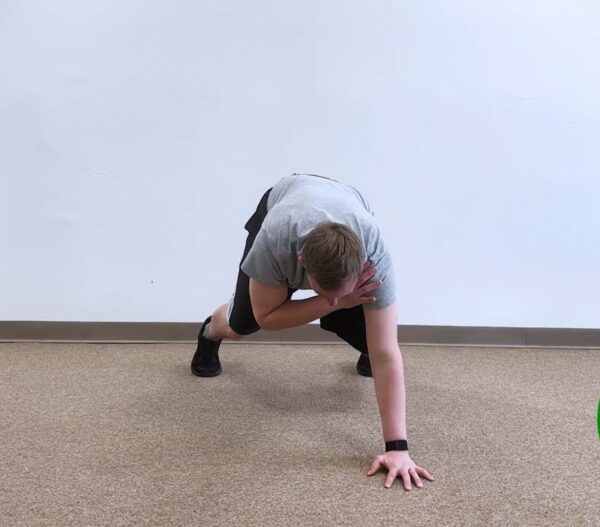
Purpose: Build shoulder stability while integrating core stabilization and anti-rotation control.
Equipment Needed: None.
How to Do It
- Get into a bear crawl position with your knees slightly off the ground, hands under your shoulders, knees under your hips.
- Slowly lift one hand and tap the opposite shoulder while keeping your core engaged.
- Focus on not rocking or compensating with the movement – move slowly and controlled.
- Alternate sides with each rep.
Sets: 2 sets of 8 reps per side.
Tip: The key is maintaining a stable core and not letting your hips rock side to side—this teaches your shoulder to work with your core for real-world stability.
Exercise 4: Medicine Ball ABCs for Rotator Cuff Endurance
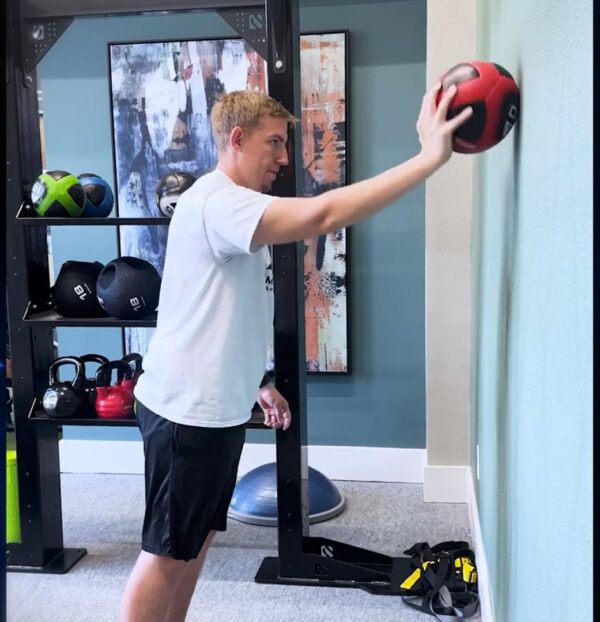
Purpose: Build endurance and fine motor control of the rotator cuff through sustained activation.
Equipment Needed: Light medicine ball or small ball.
How to Do It
- Hold a light medicine ball against a wall with one hand.
- Extend your arm and trace the letters of the alphabet against the wall.
- Try to complete the full alphabet without stopping—this is a rotator cuff burner.
- If you need to break it up into sections, that’s perfectly fine.
Sets: 2-3 complete alphabets per side.
Tip: Use a lightweight. This exercise is about endurance and control, not strength. If your shoulder starts shaking, that’s normal and shows the deep stabilizers are working.
Get The Relief You’re Looking For!
While you might feel some immediate relief after your first session, the real magic happens when you practice these movements daily. Your shoulder needs to relearn proper movement patterns and build the strength to maintain them.
The immediate benefits you’ll notice after doing these exercises, include reduced morning stiffness, less pain during daily activities, and improved confidence in your shoulder movements. But you shouldn’t stop there. If you’ve tried physical therapy, chiropractic care, massage therapy, injections, or even surgery without lasting results, it’s time for a different, personalized approach.
Ready to take the next step?
About the Author: Dr. Joey Seyforth


