
Why Your Cortisone Shot Failed (And 3 Exercises That Actually Fix Shoulder Pain)
You got the cortisone shot. Maybe it helped for a few weeks. Maybe it didn’t help at all. Either way, the pain is back, and now you’re wondering what’s next.
The problem extends far beyond your shoulder joint because your body operates as an interconnected system. Therefore, stiffness in your neck, locked thoracic spine, and nerve tension create a chain reaction that overloads your shoulder tissues. When cortisone only treats the painful spot while ignoring these upstream causes, the relief is temporary at best.
With targeted exercises that address the root cause, you can start experiencing relief and begin retraining the movement patterns that created the problem in the first place.
Quick Reference Box
- Total Time: 15 Minutes
- Targets: Shoulder blade, thoracic spine, posterior shoulder, neck mobility
- Goals: Pain reduction, proper movement mechanics, long-term shoulder health
3 Root Causes Why Your Cortisone Shot Failed
Cause #1: They Only Treated Your Shoulder (But The Problem Was Everywhere Else)
This is the big one. The cortisone went to the spot that hurt, but your shoulder doesn’t hurt for no reason.
Five interconnected areas control your shoulder pain; we call them “The Big 5”:
- The Neck – Stiffness and nerve tension change how your entire arm chain moves
- Thoracic Spine – A locked mid-back forces your shoulder to handle motion it was never designed for
- Shoulder Blade – Must rotate 60° every time you raise your arm, or tissue gets pinched
- Shoulder Joint – Ball and socket must glide freely, or the rotator cuff overworks
- Nervous System – Sends tension from the neck to the arm that refers pain directly to the shoulder
When any one of these breaks down, your shoulder takes the hit. But basic shoulder exercises, generic PT, and cortisone shots never look at the whole system—they only treat the spot that hurts.
Cause #2: Repeated Cortisone Weakens Your Tissues Over Time
Here’s something your doctor may not have told you: repeated cortisone injections break down the quality of the tissue they’re injected into.
Solid research shows that multiple injections degrade collagen structure in tendons and bursa over time. The tissue becomes softer, more fragile, and less able to handle load. You get short-term relief in exchange for long-term structural damage to the exact tissue you’re trying to save.
Cause #3: You Returned to the Same Movements Without Changing How Your Shoulder Loads
This is the most honest reason and the most fixable. The shot helped, pain backed off, you felt good. So you went back to your normal activities using the same movement patterns that caused the problem in the first place.
Nothing changed—you just had a few weeks of reduced inflammation while the broken mechanics continued in the background. The pain coming back isn’t your body failing; it’s your body telling you the movement hasn’t changed yet.
The Exercises
Exercise 1 – Windmill Plus Lift-Off
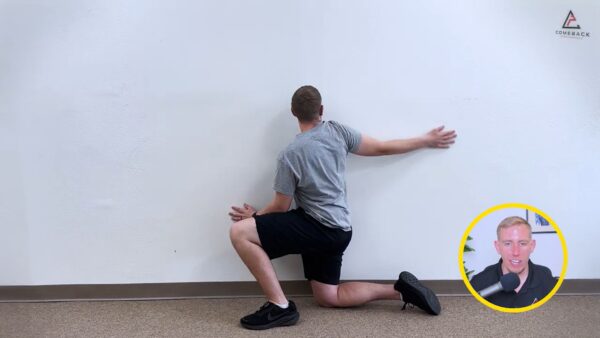
Purpose – To retrain your shoulder blade, neck, thoracic spine, and shoulder joint to move through their full proper range—something no cortisone shot can do.
Equipment Needed: Wall
How to Do It
- Get into a half-kneeling position against the wall, keeping your hip connected throughout.
- Slide your arm up the wall in an arching pattern, following your hand with your eyes.
- At the end range, lift your arm off the wall, hold for 3 seconds, and return to the wall.
- Reverse the arch motion back to the starting position with full control.
Sets: 2 sets of 10 reps per side
Tip: If your hip lifts off the wall, you’re cheating the range. Keep it connected.
Exercise 2 – Banded Pulses
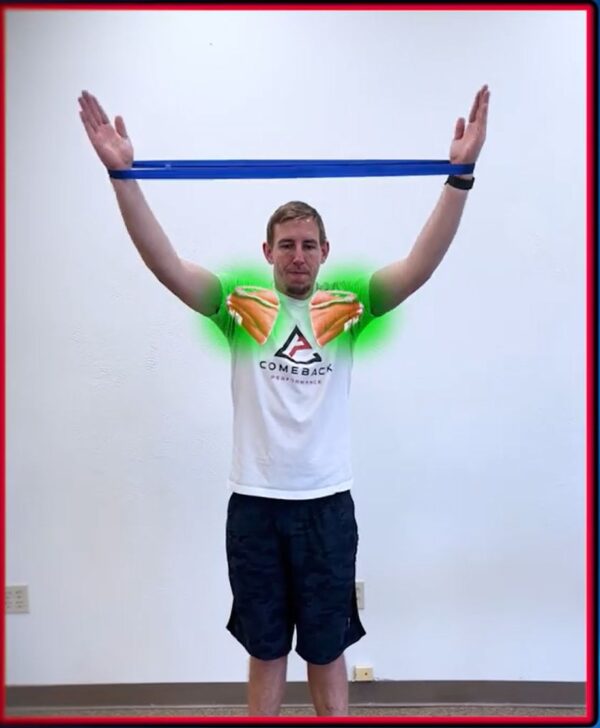
Purpose: To teach your shoulder blade and posterior shoulder to activate in a controlled, repeatable pattern so you stop defaulting to broken mechanics.
Equipment Needed: Light resistance band
How to Do It
- Place a band around wrists, elbows slightly bent, and shoulders down.
- Perform small controlled pulses, pulling hands toward sides in rhythmic motion.
- Move arms out front and overhead while maintaining pulse pattern.
- Focus on activating the back of your shoulder system in short, sharp bursts.
Sets: 3 sets of 10 controlled reps
Tip: If you’re shrugging or pulling your head forward, you’ve lost posterior shoulder activation.
Exercise 3: Banded Extension with External Rotation

Purpose: To strengthen the back of your shoulder system so that overloaded tissue stops being the only thing stabilizing your joint.
Equipment Needed: Light resistance band
How to Do It
- Place a band around your wrists behind your back, arms straight.
- Pull the band apart slightly to create external rotation tension.
- While maintaining outward tension, slowly move your shoulders back into extension.
- Return to the starting position with full control—smooth out, smooth back.
Sets: 2 sets of 8-10 slow, controlled reps
Tip: If traps take over, reduce band tension and focus on posterior shoulder activation first.
Beyond These 3 Exercises
These exercises address some, but not all, of the “Big 5” areas that control shoulder function. Your personal weak link might be different, which is why cookie-cutter approaches fail. Every shoulder has individualized movement problems and needs individualized solutions. Giving every person the same exercises and expecting the same result is insanity.
Ready for a permanent fix?
About the Author: Dr. Joey Seyforth


