
Can’t Reach Overhead? Here’s What’s Really Blocking You (And 5 Moves to Fix It Fast)
Do you feel like you’re hitting an invisible ceiling every time you try to reach overhead? Whether you’re putting dishes away, changing a light bulb, or trying to exercise, that frustrating limitation might be keeping you from activities you enjoy. And it’s likely going to be your shoulder blades. But don’t worry, because these movements to improve overhead shoulder mobility I shared in this blog are effective.
You should know what’s happening.
When your shoulder blade doesn’t rotate upward properly, the ball of your shoulder joint gets compressed against the shoulder blade as you lift your arm. This compression causes impingement on tissues like the bursa, creating pain and dysfunction. But when your shoulder blade can fully rotate to that crucial 60-degree position, you can lift your arm freely without any compression.
Similarly, if your thoracic spine is stuck in a flexed position (think hunched forward), you can only raise your shoulders so far. Restore that extension, and suddenly your shoulders can move into all positions more freely and smoothly.
With just 10 minutes a day, you can
- Eliminate shoulder impingement pain during overhead movements.
- Increase your overhead reach by 20-30 degrees in the first week.
- Improve your posture and reduce upper back tension.
- Enhance your workout performance for exercises like overhead press.
- Make daily activities easier, like reaching high shelves or washing your hair.
- Prevent future shoulder injuries by addressing root causes.
Quick Reference Box
- Total Time: 10 Minutes.
- Targets: Shoulder blades, thoracic spine, lat muscles, and shoulder joint.
- Goals: Improved mobility, pain reduction, and restored overhead function.
The 5-Move Solution That Actually Works
Exercise 1: Wall Slides

Purpose: Trains proper shoulder blade movement while your arms move overhead.
Equipment Needed: Just a wall.
How to Do It
- Stand with one foot in front of the other, facing a wall.
- Place your hands on the wall with forearms not touching.
- Slide your arms up the wall, allowing your shoulder blades to move up and around.
- Lean your chest forward at the top and let the wall assist the movement.
Sets: 2 sets of 10 reps.
Tip: Let the wall do the work – you’re simply using it to guide proper movement patterns while reducing strain on your shoulders.
Exercise 2: Banded Inferior Mobilization
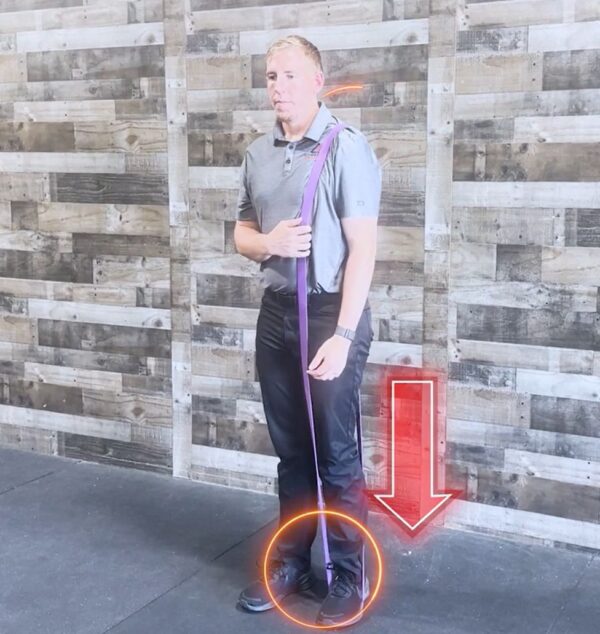
Purpose: Creates more space in the shoulder joint for pain-free movement.
Equipment Needed: Resistance band.
How to Do It
- Place the band over your shoulder and step on the other end.
- Allow the band to pull your shoulder downward, creating space gently.
- Slowly raise your arm forward into shoulder flexion.
- Move through whatever range feels comfortable, noticing the stretch and glide.
Sets: 2 sets of 10 reps.
Tip: Focus on the sensation of space being created in the front of your shoulder – this is what proper shoulder mechanics should feel like.
Exercise 3: Bench Opener

Purpose: Addresses lat tightness and thoracic spine mobility simultaneously.
Equipment Needed: Bench or chair, broomstick or PVC pipe.
How to Do It
- Kneel in front of a bench, holding the broomstick with palms facing up.
- Place the stick on the bench and rock your butt back.
- Allow your chest to come forward, feeling a deep stretch in your lats and upper back.
- Hold and take deep breaths at the bottom position.
Sets: 2 sets of 8 reps, holding for 2-3 seconds.
Tip: This targets two crucial areas for overhead mobility – tight lats are often the hidden culprit behind compensatory movements.
Exercise 4: Windmill + Liftoff
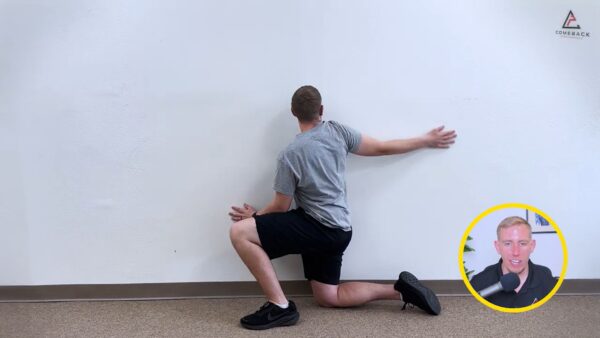
Purpose: Integrates neck, thoracic spine, shoulder, and shoulder blades into one coordinated movement.
Equipment Needed: Wall.
How to Do It
- Get into a half-kneeling position with your hip against the wall.
- Slide your arm up the wall in a rainbow pattern, following with your eyes.
- At the end range, lift your hand off the wall if possible.
- Hold for 1-2 seconds, then reverse back to the starting position.
Sets: 2 sets of 10 per side.
Tip: This exercise can be more challenging than it looks – take note if one side rotates better than the other, as this imbalance could be contributing to your shoulder pain.
Exercise 5: Lat Eccentric

Purpose: Strengthens and stretches the lats while preventing compensatory arching.
Equipment Needed: Dumbbell or PVC pipe, bench.
How to Do It
- Lie flat on a bench with your back pressed down.
- Hold the weight above your head with arms extended.
- Focus on keeping your ribs down and back flat (no arching).
- Control the movement to target lat mobility without compensation.
Sets: 3 sets of 8 reps.
Tip: If you feel like you need to arch your lower back during overhead movements, lat tightness is likely the culprit – this exercise addresses that directly.
Finally
Exercising for just 10 minutes daily can create noticeable improvements within the first week because these exercises work by addressing the root causes rather than just treating symptoms. You’ll likely notice improved range of motion after your first session. But remember, while these exercises can provide significant relief for many people struggling with shoulder pain, they’re not a complete long-term solution for everyone.
For lasting results, you should do a proper assessment. Get started below!
About the Author: Dr. Joey Seyforth


