
The Complete AC Sprain Recovery Guide: 5 Expert Exercises to Heal Your Shoulder Separation Fast
If you’re dealing with an AC sprain (also known as shoulder separation), you’re likely frustrated by the sharp pain that occurs whenever you reach across your body, sleep on your side, or try to resume activities like mountain biking or skiing. The good news is that AC joint injuries don’t have to sideline you for months, especially when you can take care of them with these AC joint sprain rehab exercises.
Most people think an AC sprain only affects the shoulder joint itself, but that’s only part of the story. When your acromioclavicular joint is injured, it creates a chain reaction throughout your entire shoulder complex. Your pectoral muscles tighten up to guard the area, your posterior shoulder weakens from lack of use, and your range of motion decreases rapidly.
The Traditional Approach is Outdated (And Actually Harmful)
The old-school method of throwing your arm in a sling for weeks actually makes recovery slower and more difficult. While you’re “resting,” everything starts to stiffen up, and you lose range of motion very quickly. The longer you wait to restore that motion, the harder it becomes to get back.
With the right approach, you can start your recovery immediately with targeted exercises that calm inflammation, restore mobility, and begin strengthening the supporting muscles around your AC joint.
With just 15 minutes a day, you can
- Reduce AC joint pain and inflammation naturally.
- Restore shoulder mobility without forcing painful movements.
- Strengthen the supporting muscles that your damaged ligament can’t provide.
- Prevent future shoulder injuries and complications.
- Get back to your favorite activities faster than traditional rest-only approaches.
- Avoid the stiffness and weakness that come from prolonged immobilization.
Quick Reference Guide
- Total Time: 15 Minutes Daily.
- Targets: AC joint, posterior shoulder, pectoral muscles, latissimus dorsi.
- Goals: Pain reduction, mobility restoration, strength rebuilding.
Exercise Breakdown: Your 5-Step Recovery Protocol
Exercise 1: Dowel Abduction (Gentle Range of Motion)

Purpose: Safely restore shoulder abduction without forcing painful movements through the AC joint.
Equipment Needed: PVC pipe, broomstick, or golf club.
How to Do It
- Place the hand of your affected shoulder on the dowel.
- Use your unaffected arm to gently assist the movement into a “snow angel” motion.
- Move only to the point of mild discomfort, then back off immediately.
- If full abduction is too painful, modify to a 45-degree angle to offload the joint.
Sets: 3 sets of 15 repetitions.
Tip: Never force the motion—this exercise is about gentle mobilization, not pushing through pain. Your pain-free range will improve gradually with consistency.
Exercise 2: Pec Wall Stretch (Tension Release)

Purpose: Loosen tight pectoral muscles that guard and restrict movement after AC joint injury.
Equipment Needed: Corner wall or doorway.
How to Do It
- Find a corner and place one foot in front of the other for stability.
- Position both arms at 90 degrees against the wall.
- Lean your chest forward until you feel a gentle stretch across your pectorals.
- Move in and out of the stretch position rather than holding static.
Sets: 2 sets of 15 repetitions.
Tip: This simple exercise is incredibly effective for releasing the protective tension that builds up around an AC injury. Focus on the gentle in-and-out motion rather than aggressive stretching.
Exercise 3: Prone I’s (Posterior Shoulder Activation)
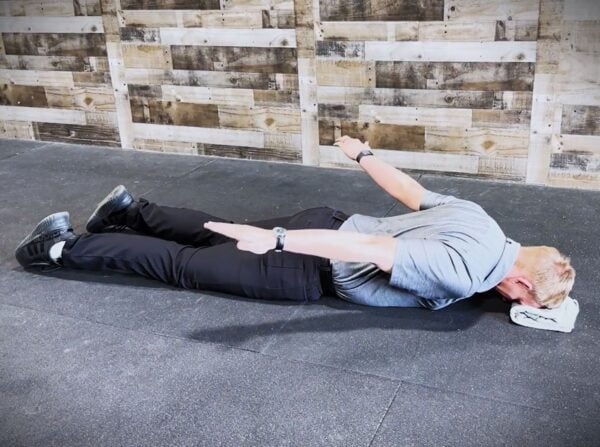
Purpose: Engage the often-neglected posterior shoulder and lower trapezius muscles that provide crucial stability.
Equipment Needed: Towel (optional for comfort).
How to Do It
- Lie face down with your forehead resting on a towel.
- Position your arms at your sides with palms facing down.
- Lift your arms off the ground, forming an “I” shape with your body.
- Hold for 3 seconds at the top before lowering slowly.
Sets: 3 sets of 10 repetitions with 3-second holds.
Tip: This exercise is harder than it looks, especially with shoulder pain. Start with shorter holds if needed—your shoulders will be burning by the end, which means it’s working.
Exercise 4: Adduction Pull (Lat and Pec Strengthening)
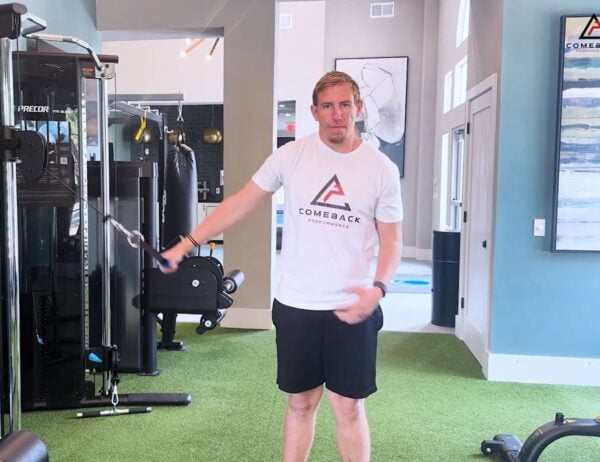
Purpose: Target the latissimus dorsi and pectoral muscles while increasing healing blood flow to the injured area.
Equipment Needed: Resistance band or cable machine.
How to Do It
- Start with your arm straight out to the side, holding the band or cable.
- Keep your elbow completely straight throughout the movement.
- Pull the band down to your side hip in a smooth, controlled motion.
- Control the return to the starting position.
Sets: 3 sets of 10 repetitions.
Tip: Focus on keeping your pain levels low while maintaining control throughout the entire range of motion. This exercise shouldn’t aggravate your AC joint.
Exercise 5: Banded Pull-Aparts (Scapular Strengthening)

Purpose: Strengthen the posterior shoulder muscles and improve scapular stability while opening up space in the AC joint.
Equipment Needed: Resistance band.
How to Do It
- Hold the band in front of your chest with arms extended and palms facing up.
- Keep your elbows straight as you pull the band apart.
- Focus on squeezing your shoulder blades together as you separate the band.
- Hold for 2-3 seconds when your elbows reach your sides.
Sets: 3 sets of 10 repetitions with 2-3 second holds.
Tip: The palms-up position is crucial—it opens up space in the AC joint and reduces impingement during the movement.
Your Recovery Starts Today!
These five exercises represent the critical first phase of AC joint rehabilitation. By consistently performing this routine, you’re calming inflammation, restoring mobility, and beginning to rebuild the strength your shoulder needs to function correctly. While these exercises are excellent for early-stage recovery, complete rehabilitation requires a progressive approach that eventually includes advanced strengthening and sport-specific movements. Remember: the number one predictor of future shoulder injury is past shoulder injury. Taking care of your AC sprain properly now prevents recurring problems down the road.
About the Author: Dr. Joey Seyforth


