
Say Goodbye to Shoulder Impingement: 3 Banded Exercises That Work
If your shoulder pain flares up every time you reach overhead or across your body, you’re likely one of the thousands of people who struggle with shoulder impingement. And just like many of them, you may have been treating the symptoms, not the cause. Shoulder impingement is a complex mechanical issue involving your neck, thoracic spine, shoulder blades, shoulder joint, and nervous system. When any of these components are off, your shoulder pays the price. In this blog, I outlined some important shoulder impingement exercises with bands that are very effective.
Think of your shoulder mechanics like a finely tuned machine. When your shoulder blade doesn’t rotate properly, it creates a chain reaction. Your shoulder joint gets compressed, tissues get pinched, and suddenly that simple overhead reach becomes painful. It’s like trying to open a door when the hinges are misaligned – no amount of force will make it work smoothly.
Set aside 10 minutes daily because with just 10 minutes a day, you can
- Create immediate space in your shoulder joint for pain-free movement.
- Retrain your shoulder blades to move correctly during arm elevation.
- Build coordinated strength between your shoulder and your shoulder blade.
- Reduce front-of-shoulder pain during overhead activities.
- Improve your ability to reach across your body without discomfort.
- Develop long-term movement patterns that prevent impingement from returning.
Quick Reference Box
- Total Time: 10 Minutes.
- Targets: Shoulder joint, shoulder blade (scapula), rotator cuff, and surrounding stabilizers.
- Goals: Restore proper mechanics, reduce compression, build functional strength
Exercise Breakdown
Before starting these exercises, test your shoulder with these two assessments below. After completing the exercises, retest. Any reduction in pain or improvement in range shows you’re addressing the right mechanical issues.
Clearing Test: Place your hand on your opposite shoulder and lift your elbow. Note any pain in the front of your shoulder.
Hawkins-Kennedy Test: Bring your arm forward with the elbow bent at 90 degrees. Have someone gently press down on your hand, rotating your shoulder inward. Again, note any front shoulder pain.
Exercise 1: Banded Posterior Shoulder Mobilization
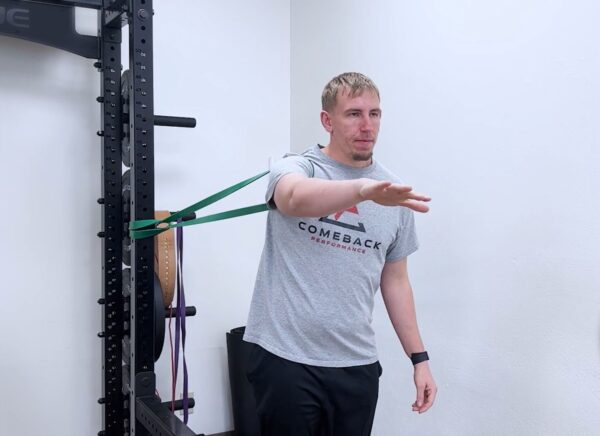
Purpose: Creates crucial space in your shoulder joint by addressing forward joint positioning that causes compression.
Equipment Needed: Resistance band, sturdy anchor point at shoulder height.
How to Do It
- Loop the resistance band around the front of your affected shoulder and anchor it at shoulder height.
- Step back until you feel gentle tension pulling your shoulder backwards.
- Perform a chest press motion, moving your arm forward and back while the band maintains backward pressure.
- Focus on letting the band guide your shoulder into a better position.
Sets: 2 set of 15 controlled repetitions.
Tip: The band should feel like it’s gently “decompressing” your shoulder – if you feel pinching, reduce the band tension.
Exercise 2: Banded Scapular Angels
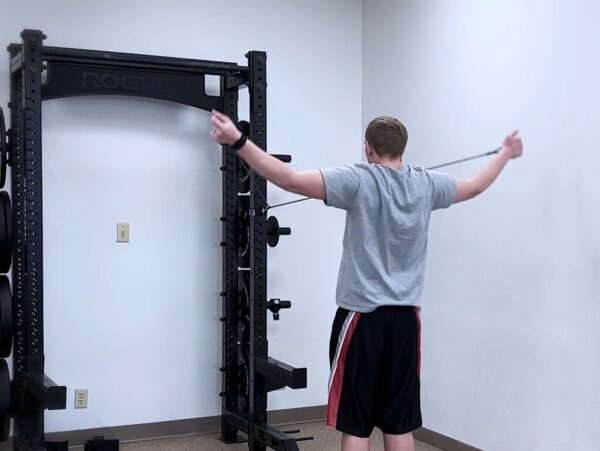
Purpose: Retrains proper shoulder blade movement patterns essential for overhead motion without impingement.
Equipment Needed: Light resistance band
How to Do It
- Hold the band in front of you with both hands, arms extended.
- Pull the band apart while bringing your elbows back.
- Transition into an “angel” motion by raising your arms out to the sides.
- Continue until your biceps are near your ears, then return to the start.
Sets: 2 set of 10 slow, controlled repetitions.
Tip: Focus on feeling your shoulder blades tilt back and rotate outward – this is the key movement pattern for impingement-free motion.
Exercise 3: Banded Bear Slider
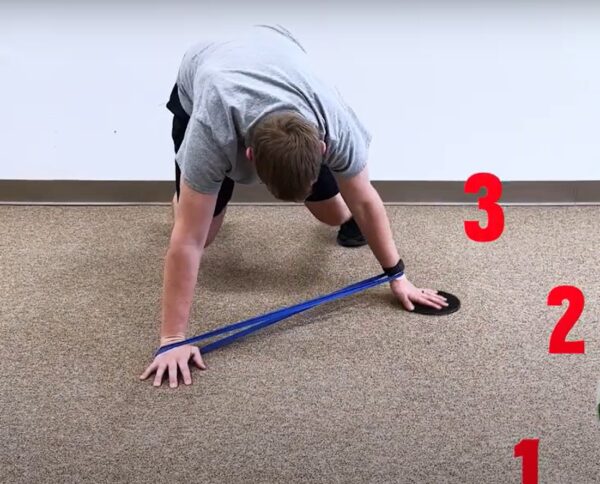
Purpose: Integrates shoulder blade and joint movement while building functional stability in weight-bearing positions.
Equipment Needed: Light resistance band.
How to Do It
- Start in a bear position (hands under shoulders, knees under hips) with a band around wrists.
- Lift your knees slightly off the ground.
- Slide one hand forward, then to the side, then diagonally – maintaining band tension.
- Return to the center and repeat with the other hand.
Sets: 5 slow slides in each of 3 directions per arm.
Tip: Keep your core engaged and hips level – this exercise builds the coordination needed for real-world shoulder function.
Ready To Relieve The Pain?
While many people experience immediate improvement after just one session, consistent practice will help you resolve the issues you’re having. Your shoulder didn’t develop these patterns overnight, and fixing them requires dedication. These three exercises work because they address the mechanical root causes of shoulder impingement. Daily practice rewires your movement patterns, creating lasting change that traditional strengthening exercises can’t achieve.
If you’ve been stuck in the pain-exercise-pain cycle and want a tailored solution for your specific impingement pattern, we offer professional guidance that can accelerate your recovery.
About the Author: Dr. Joey Seyforth


