
How to Bulletproof Your Shoulder After a Rotator Cuff Tear: 5 Game-Changing Exercises
If you’ve suffered a rotator cuff tear, you’ve likely been told that getting back to “normal” is the goal. But here’s the shocking truth: what got you injured in the first place is normal.
Most people think they’re healed when their shoulder pain disappears, but they’re making a critical mistake. They’re settling for baseline recovery instead of bulletproofing their shoulder for life. This approach leaves you vulnerable to reinjury and keeps you living in fear of your next workout or daily activity.
The Hidden Chain Reaction Affecting Your Shoulder
Your rotator cuff doesn’t work in isolation. It’s part of an intricate system that includes your cervical spine, thoracic spine, shoulder blade, shoulder joint mechanics, and nervous system coordination. When one area is compromised, it creates a domino effect that puts excessive stress on your already-damaged rotator cuff.
Traditional physical therapy often focuses on repetitive exercises using resistance bands at your side. While this gets you back to baseline, it falls catastrophically short of true bulletproofing. The result? You’re left with a shoulder that’s just waiting for the subsequent injury to happen.
The good news is that you can transform your vulnerable shoulder into a bulletproof powerhouse. True bulletproofing requires a comprehensive approach that addresses the root causes and builds your shoulder stronger than it was before the injury.
Quick Reference Guide
- Total Time: 15 minutes daily.
- Targets: Rotator cuff, shoulder blade, cervical spine, thoracic spine, nervous system.
- Goals: Pain elimination, strength building, injury prevention.
The 5 Bulletproofing Exercises That Change Everything
Exercise 1: Banded Alternating Punch
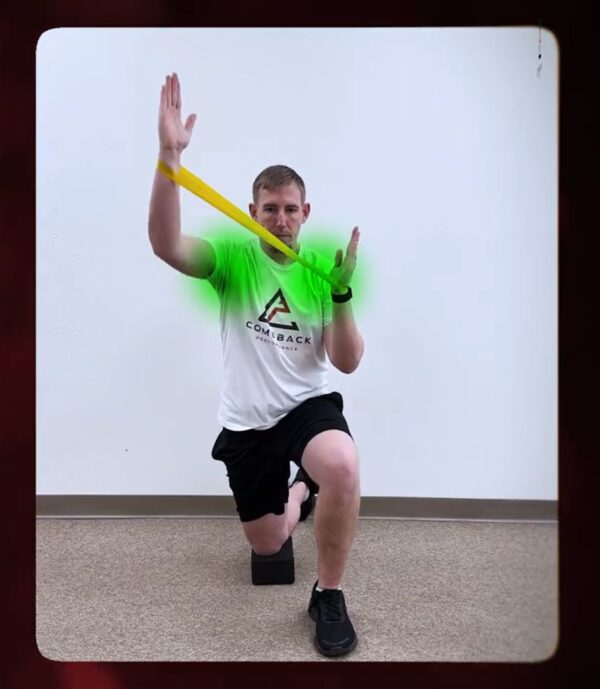
Purpose: Develops dynamic stability and coordination while strengthening the rotator cuff in functional movement patterns.
Equipment Needed: Resistance band.
How to Do It
- Place a resistance band around both wrists.
- Position your arms at a 45-degree angle in front of your body.
- Alternate punching forward with each arm while maintaining tension.
- Focus on controlling the resistance as you return to the starting position.
Sets: 2 sets of 6-8 reps per side.
Tip: This exercise trains your rotator cuff to stabilize during dynamic movements – precisely what you need for real-world activities. Keep your core engaged throughout the movement.
Exercise 2: Banded Kettlebell Upside-Down Press
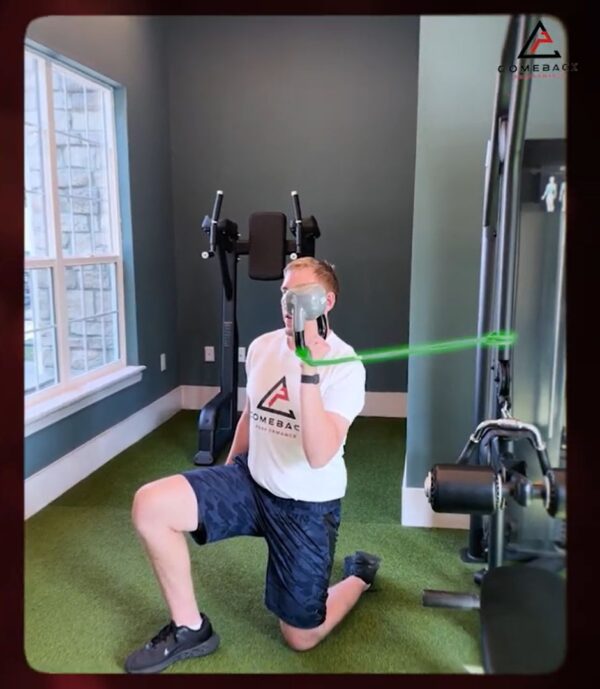
Purpose: Challenge stability, strength, and coordination simultaneously under variable resistance.
Equipment Needed: Kettlebell, resistance band, anchor point.
How to Do It
- Hold a kettlebell upside down by the handle (bell facing up).
- Attach a resistance band to the kettlebell with the other end anchored behind you.
- Press the kettlebell overhead while maintaining control against the backward pull.
- Slowly lower back to the starting position.
Sets: 2 sets of 8-10 reps.
Tip: This advanced exercise bulletproofs your shoulder by training it to maintain stability under unpredictable forces. Start with a lighter weight to master the coordination.
Exercise 3: Crab Position Hold
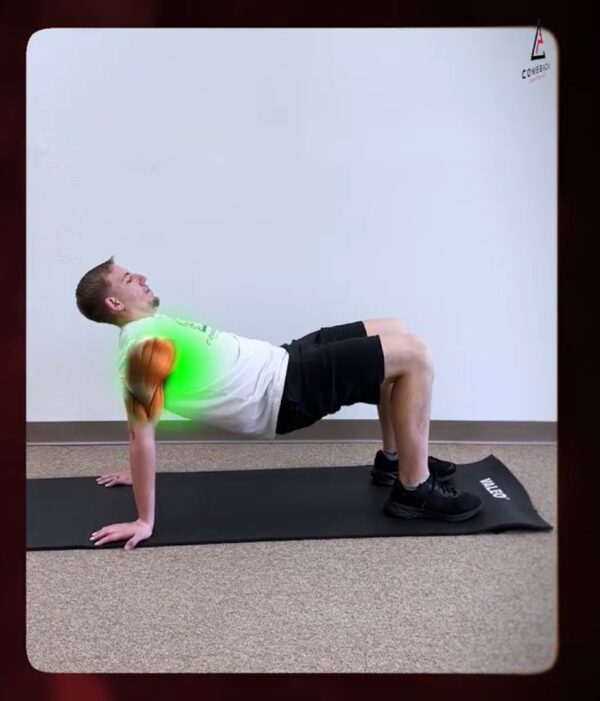
Purpose: Builds weight-bearing shoulder stability while promoting shoulder extension mobility.
Equipment Needed: None.
How to Do It
- Sit on the ground with your hands placed behind your hips, fingers pointing away.
- Bend your knees and plant your feet flat on the ground.
- Lift your hips off the ground, creating a “crab” position.
- Hold the position while maintaining shoulder extension.
Sets: 2 sets of 8 reps (hold for 3-5 seconds each).
Tip: This exercise builds the kind of functional strength that prevents reinjury by training your shoulder to support body weight in extension—a movement most people neglect.
Exercise 4: Angel Over Cones

Purpose: Enhances shoulder blade and rotator cuff coordination through a full range of motion.
Equipment Needed: 2 cones or similar objects.
How to Do It
- Lie face down with cones placed on either side of your body at shoulder height.
- Start with your arms at your sides.
- Perform “angel” movements, sweeping your arms up and over the cones.
- Return to the starting position with control.
Sets: 2 sets of 5 complete reps (up and back down).
Tip: If you can’t lift your arms very high initially, that’s perfectly normal. Move through whatever range you can and gradually improve over time.
Exercise 5: High Plank Walk-Up
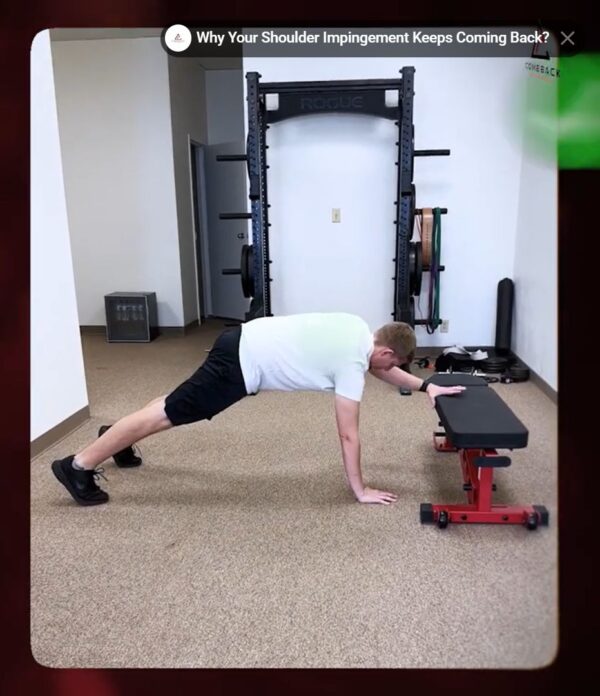
Purpose: Ultimate bulletproofing exercise combining core stability with dynamic shoulder control.
Equipment Needed: A sturdy bench or an elevated surface.
How to Do It
- Start in a push-up position with a bench positioned in front of you.
- Walk one hand up onto the bench, then the other.
- Reverse the movement by walking each hand back down to its original position.
- Maintain plank position throughout the entire movement.
Sets: 2 sets of 5 walk-ups.
Tip: This exercise is “spicy” for the shoulders—it’s challenging! Focus on maintaining perfect form rather than speed. Your core and shoulders work together in this movement.
Make The Move
These five exercises provide the foundation for bulletproofing your shoulders. You’ll start noticing improvements in pain and mobility within the first few weeks, but the real magic happens when you build strength and confidence that surpasses your pre-injury baseline. The bulletproofing difference is profound. While others are stuck in cycles of reinjury and pain, you’ll have the confidence and strength to live life on your terms.
Ready to take your shoulder bulletproofing to the next level?
About the Author: Dr. Joey Seyforth


