
How to Fix Bicep Tendonitis at Home: 3 Proven Exercises for Shoulder Pain Relief
Are you constantly battling that nagging pain in the front of your shoulder that shoots down into your bicep? Does reaching overhead to grab something from a high shelf make you wince in discomfort? If simple activities like pushing a door open or pulling a suitcase have become painful reminders of your shoulder injury, you’re not alone—and more importantly, you’re not stuck with this pain forever.
Here’s the good news: bicep tendonitis isn’t just a mysterious shoulder problem that requires expensive treatments or invasive procedures. While most people focus solely on the bicep area where they feel pain, the real solution lies in understanding that your shoulder is part of an intricate network of muscles, tendons, and nerves that all work together.
What’s Behind Your Shoulder Pain?
Your bicep tendonitis isn’t just about your bicep. It’s actually a symptom pointing to deeper issues in your shoulder’s support system. When your rotator cuff muscles (the four stabilizing muscles that keep your shoulder joint secure) become weak or imbalanced, your bicep tendon is forced to pick up the slack. Over time, this additional workload can lead to irritation, inflammation, and persistent pain.
But there’s another often-missed culprit: median nerve tension. This nerve pathway starts in your neck and travels down to your bicep area, potentially causing referred pain that mimics bicep tendonitis. That’s why a comprehensive approach addressing both muscular weakness and nerve tension is essential for lasting relief.
The solution? Just 10-15 minutes of targeted exercises daily that address the root causes, not just the symptoms.
With just 10-15 minutes a day, you can
- Experience immediate pain relief during overhead reaching and daily activities.
- Strengthen your rotator cuff muscles to prevent future bicep overload.
- Enhance nerve mobility to alleviate referred pain caused by neck tension.
- Restore shoulder stability for confident movement in all directions.
- Build long-term resilience against recurring shoulder injuries.
- Return to your favorite activities without fear of aggravating the pain.
Quick Reference Box
- Total Time: 10-15 Minutes
- Targets: Bicep tendon, rotator cuff muscles, median nerve pathway
- Goals: Pain reduction, improved nerve mobility, enhanced shoulder stability
Simple Self-Test: Do You Have Bicep Tendonitis?

Before diving into the exercises, let’s confirm what you’re dealing with using the Speed Test.
- Stretch your affected arm straight out in front of you at shoulder height.
- Turn your palm face-up toward the ceiling.
- Use your other hand to provide downward resistance while you try to lift.
- Note any pain location and intensity.
If you feel pain specifically in the front of your shoulder or bicep tendon area, this indicates likely bicep tendonitis. Don’t worry—this is entirely treatable with the right approach.
Exercise 1: Median Nerve Glide

Purpose: Release nerve tension that may be referring pain to your bicep area and restore healthy nerve movement patterns.
Equipment Needed: None.
How to Do It
- Start in a “teapot position” with your fingers touching the top of your shoulder on the affected side.
- Slowly extend your elbow, wrist, and fingers downward toward the ground.
- Simultaneously, side-bend your neck away from the extended arm (toward your opposite ear).
- Return to the starting position with control, moving your hand and neck together in a coordinated “flossing” motion.
Sets: 2 sets of 10 repetitions on both shoulders.
Tip: You may experience tingling, mild shaking, or tightness during this exercise—these sensations indicate nerve tension and are entirely normal. If you notice a significant difference between sides, this confirms median nerve involvement in your shoulder pain.
Exercise 2: Banded W Hold for Rotator Cuff Strength

Purpose: Strengthen the posterior rotator cuff muscles to create better shoulder stability and reduce bicep tendon overload.
Equipment Needed: Light resistance band.
How to Do It
- Hold a light resistance band with both hands, keeping your elbows tucked close to your sides.
- Pull the band apart by squeezing your shoulder blades together, creating a “W” shape with your arms.
- Feel the tension building in the back of your shoulders as you hold this position.
- Hold for 5 seconds, then slowly release back to the starting position.
Sets: 2 sets of 8 repetitions with 5-second holds.
Tip: Your shoulders should feel a good burning sensation by the end—this indicates you’re properly activating the stabilising muscles that have been underworking. Choose a band resistance that challenges you but allows perfect form.
Exercise 3: Two-Position Banded Shoulder Flexion Hold
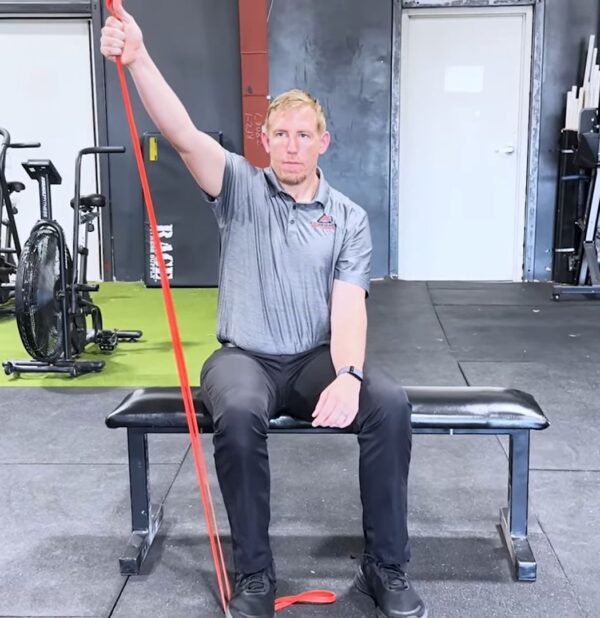
Purpose: Increase blood flow and promote healing directly to the bicep tendon while building strength in compromised positions.
Equipment Needed: Resistance band.
How to Do It
- Step on one end of a resistance band and hold the other end with your affected arm, thumb pointing up.
- Raise your arm to a 45-degree angle and hold for 5 seconds, feeling the tension in your shoulder.
- Continue lifting to shoulder height (90 degrees) and hold for another 5 seconds.
- Rather than lowering completely, alternate between these two positions, holding each for 5 seconds.
Sets: 2 sets of 30-50 seconds of continuous alternating holds.
Tip: Expect your shoulder to shake and burn during this exercise—this intense stimulus promotes healing and builds resilience in the exact range where your bicep tendon is most vulnerable. Start with lighter resistance and gradually increase as tolerated.
Getting Your Freedom
Bicep tendonitis responds excellently to the right combination of exercises when performed consistently. However, these exercises are just the beginning of your journey back to pain-free shoulder function. While this routine provides an excellent foundation for healing, lasting recovery requires identifying and addressing your specific root causes. Are your symptoms stemming from poor posture, muscle imbalances, movement patterns, or a combination of factors? A personalized approach ensures you not only eliminate current pain but also prevent future flare-ups.
About the Author: Dr. Joey Seyforth


