
Eliminate Shoulder Pain During Bench Press in 10 Minutes
Thousands of lifters deal with sharp, achy pain in the front of their shoulders every time they lower the bar. The truth is, your shoulder pain during bench press is a mobility crisis that extends far beyond your shoulder joint. When you can’t access the specific range of motion required for safe benching, your body triggers a chain of compensation patterns.
The good news? You can reverse this entire cascade in just 10 minutes with three targeted exercises that restore the exact mobility patterns your shoulder needs for pain-free benching.
Quick Reference Guide
- Total Time: 10 Minutes
- Targets: Shoulder capsule, posterior shoulder, extension mobility, movement patterns.
- Goals: Pain elimination, mobility restoration, movement re-education.
Test Your Current Mobility (30 Seconds Each)
Test 1: Shoulder Extension Assessment
- Stand with arms by your sides.
- Lift your arms behind you, keeping your chest tall.
- If your hands are at arm’s length from your back (roughly 45°), that’s a good sign. However, if your hand barely leaves your back, or if you feel the front shoulder pinching, you’re missing critical extension.
Test 2: Internal Rotation at 90 Degrees
- Bring your arm up like you’re throwing a football, elbow at 90°.
- Rotate your hand down toward the floor while keeping your elbow still.
- Your hand should easily reach past horizontal (60-70-degree). If it stops above horizontal or you feel back shoulder tightness, you’re missing internal rotation mobility.
The 10-Minute Shoulder Fix Protocol
Exercise 1: Banded Posterior Shoulder Mobilization

Purpose: Frees up the shoulder capsule to improve joint mobility and teaches correct bench press shoulder positioning.
Equipment Needed: Resistance band, anchor point at shoulder height.
How to Do It
- Attach the band at shoulder height and face away from the anchor point.
- Place the band around the front of the shoulder, close to the armpit, and step forward to create tension.
- Perform slow bench press motions, letting the band guide your shoulder into a better position.
- Focus on the band creating space in the joint as it moves through the pattern.
Sets: 2 sets of 15-20 reps.
Tip: Move slowly and with control – this teaches your shoulder the correct path for benching while improving mobility simultaneously.
Exercise 2: Prone Extension Liftoff
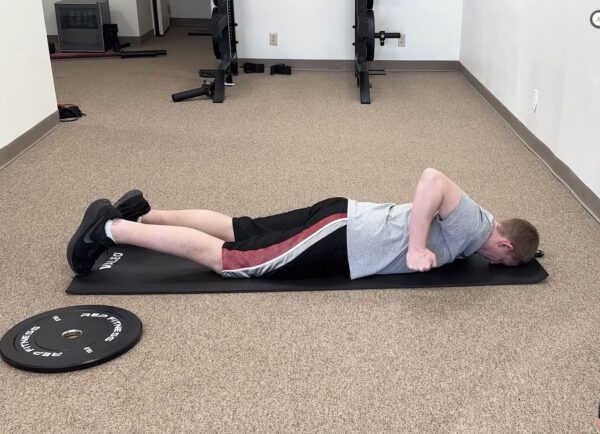
Purpose: Builds the exact extension pattern needed during the bench press lowering phase.
Equipment Needed: Floor space or exercise mat.
How to Do It
- Lie face down with arms by your sides.
- Lift arms straight up and back like you’re touching the ceiling behind you.
- Hold for 2 seconds at the top, feeling activation in the back of your shoulder.
- Lower with control and repeat.
Sets: 2 sets of 12-15 reps.
Tip: If you can’t lift without pain, start by holding your arms in various positions. Use a dowel in a standing position to assist the motion if needed.
Exercise 3: Banded Bench Press Pattern
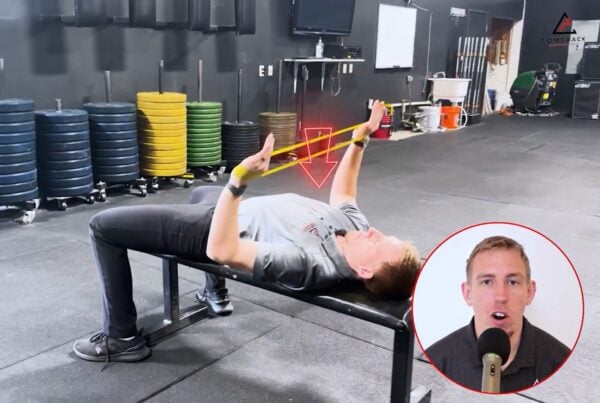
Purpose: Teaches perfect bench form while building engagement through the full range of motion.
Equipment Needed: Light resistance band.
How to Do It
- Loop the band around both wrists and lie on your back.
- Create tension by pulling apart into external rotation.
- Perform a bench press, maintaining band tension throughout.
- Move 3 seconds down, 3 seconds up with control.
Sets: 2 sets of 8-10 reps.
Tip: Use this as a warm-up before your regular bench press while your shoulder is fresh and responsive.
Retest and Track Your Progress
After completing these exercises, immediately retest your mobility.
- Try the shoulder extension test again – notice any difference? Even a 10-20% improvement means the exercises are working.
- Test your internal rotation – if either feels smoother or goes further without pain, you’ve proven your shoulder can improve rapidly.
Imagine how it’ll feel after 2-3 weeks of consistent daily work.
Your Path to Pain-Free Benching
These daily exercises will eventually compound into notable improvements, provided you do them correctly. You’ll notice immediate relief in joint comfort and mobility, but the transformation requires dedicated practice. Complete shoulder health requires a comprehensive approach that addresses all contributing factors to your pain and movement limitations.
Ready to eliminate your shoulder pain permanently and return to heavy benching without constant worry?
About the Author: Dr. Joey Seyforth


