
5 Hidden Reasons Your Shoulder Pain Won’t Go Away (What to Do Instead)
If you’re over 40 and have tried everything from physical therapy to chiropractic care, massage, and even injections, but your shoulder still screams at you during bench press, overhead movements, or simple daily tasks, you’re not alone. You’re also not broken. Traditional healthcare treats shoulder pain like fixing a single broken streetlight while ignoring the entire electrical grid that powers it. They do this by focusing on your shoulder joint while completely missing the network of connected systems that are drive the pain.
Today, you’ll discover the 5 critical areas that traditional rehab misses, why this “Big Five” system is the key to finally getting lasting relief, and the exact exercises you can start today to address each area.
Quick Reference
- Total Time: 15 Minutes Daily
- Targets: Your neck/nerves, thoracic spine, shoulder blade, shoulder joint, and loading patterns.
- Goals: To eliminate pain, ensure movement restoration, and long-term strength in your shoulders.
Exercise 1: Chin Retractions (Neck & Nerve Reset)

Purpose: To eliminate nerve referral from your neck that creates mysterious shoulder pain and night symptoms.
Equipment Needed: None
How to Do It:
- Sit tall in a chair with your shoulders relaxed
- Gently glide your head straight back like you’re making a double chin (don’t force it).
- Hold for 2 seconds, feeling a gentle stretch at the base of your skull
- Return to the starting position slowly.
Sets: 2 sets of 10 reps, twice daily
Tip: If you feel tingling or pain changes during the movement, you’ve found a major contributor to your shoulder issues.
Exercise 2: Wall Open Books (Thoracic Spine Mobility)

Purpose: Frees up your mid-back rotation so your shoulder doesn’t have to compensate and get jammed.
Equipment Needed: Wall space
How to Do It:
- Stand or half-kneel at a wall with your hip touching the wall
- Place both hands together in front of your chest
- Slowly open your top arm away from the wall like opening a book, following your hand with your eyes
- Return to the starting position with control
Sets: 2 sets of 8-10 reps per side
Tip: Notice if one side opens significantly less than the other—this asymmetry is often the root cause of one-sided shoulder pain.
Exercise 3: Wall Slides (Shoulder Blade Activation)

Purpose: To train your shoulder blade to rotate upward properly, preventing top-of-shoulder pinching during overhead movements.
Equipment Needed: Wall
How to Do It:
- Stand facing a wall with one foot slightly forward
- Place hands on the wall at shoulder height, pinkies touching the wall
- Press gently into the wall and slide arms up as high as comfortable without pinching
- Slowly slide back down, maintaining wall contact
Sets: 2 sets of 8-10 slow reps
Tip: Focus on feeling your shoulder blades glide up and around your ribs—this is the motion missing in most shoulder problems.
Exercise 4: Wall Axial Rotations (Shoulder Joint Mobility)
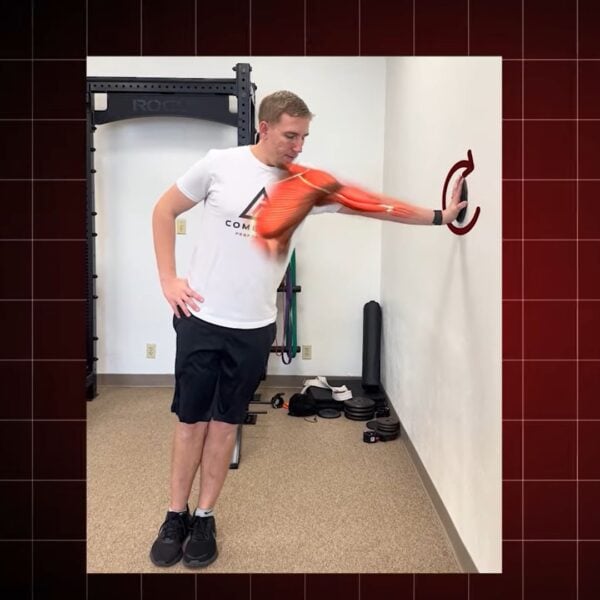
Purpose: To build rotation strength in safe ranges so your shoulder can handle the bottom of the bench press and overhead positions.
Equipment Needed: Wall space (optional: furniture slider)
How to Do It:
- Stand with your arm extended, hand pressing into the wall
- Keeping your hand on the wall, rotate your shoulder internally and externally
- Use a slider under your hand for easier movement if needed
- Stay in comfortable ranges—avoid the “pain cave.”
Sets: 2 sets of 8-10 reps each direction
Tip: If you hit a hard stop or get deep joint aching, you’ve identified the exact range your shoulder can’t handle—work just before that point.
Exercise 5: Bear Shoulder Taps (Smart Loading)
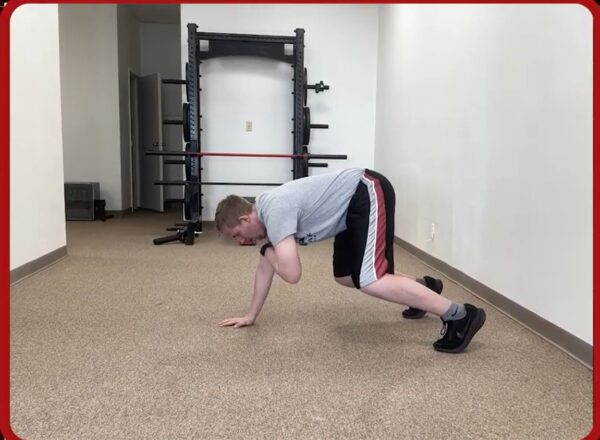
Purpose: To build shoulder stability under controlled load while teaching your system to handle progression safely.
Equipment Needed: Floor space
How to Do It:
- Get into bear position: hands under shoulders, knees under hips, knees hovering just off the ground
- Slowly lift one hand and tap the opposite shoulder.
- Return your hand to the floor and repeat with the other side, keeping your hips as steady as possible.
Sets: 2 sets of 20-30 seconds
Tip: When you return to lifting, follow the “change one thing” rule: modify either weight, volume, OR range—never all three at once.
Your Path to Permanent Shoulder Freedom
When traditional PT focuses only on the shoulder itself, you get temporary relief that disappears the moment you return to real-world activities. But when you address the entire Big Five system, your shoulder stops compensating and starts functioning the way it’s designed to. Do these five exercises daily, and you’ll likely notice changes in night pain and daily comfort within the first week. If you want a complete assessment of your shoulder system, we’ve got something in store for you!
About the Author: Dr. Joey Seyforth


