
Stop AC Joint Pain During Bench Press With These 3 Exercises That Actually Work
AC joint pain during bench press is actually your body’s way of telling you that certain shoulder movement patterns need correction. The solution to it starts with understanding the chain reaction that creates the AC joint compression itself. Then you can implement the three targeted exercises that restore proper mechanics in just minutes per day. When you address the root cause rather than just managing symptoms, remarkable transformations happen.
You’ll find these helpful exercises in this blog. So, read on…
Quick Reference Box
- Total Time: 10 Minutes
- Targets: AC joint, shoulder blade mechanics, posterior capsule
- Goals: Pain elimination, mobility restoration, movement pattern correction
Self-Assessment: Confirm Your AC Joint Pain
Test 1: Cross-Body AC Screen
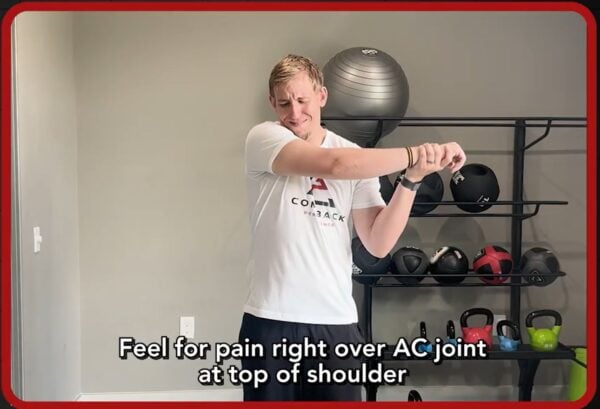
Purpose: To confirm the AC joint as your primary pain source.
How to Do
- Raise your affected arm to shoulder height.
- Use your opposite hand to pull the arm across your chest toward the other shoulder.
- Note if this reproduces the sharp pinch at the very top of your shoulder where the collarbone meets the shoulder blade.
Sets: Single assessment test.
Tip: If pain occurs elsewhere or deeper in the joint, the AC joint may not be your primary issue.
Test 2 – Bench Depth Tolerance Test
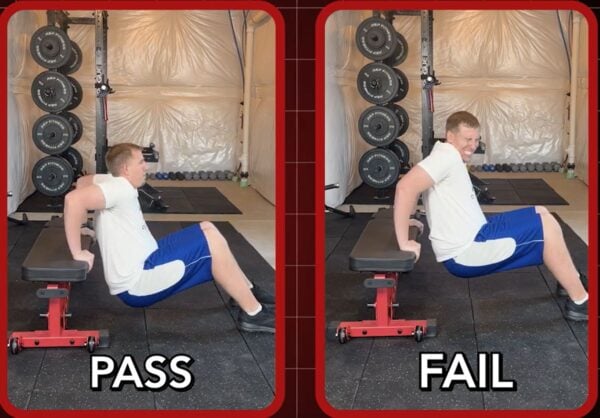
Purpose – To assess your current shoulder extension range limitation.
How to Do It
- Stand with your back to a bench or stable surface at hip height.
- Place both hands flat on the surface behind you.
- Slowly lower your hips like a reverse dip until you feel the familiar shoulder “bite”.
- Note how far you can descend before pain occurs.
Sets: Single assessment to establish baseline.
Tip: You should be able to break 90 degrees without pain.
Exercise Breakdown
Exercise 1 – Ball Posterior Capsule Mobilization
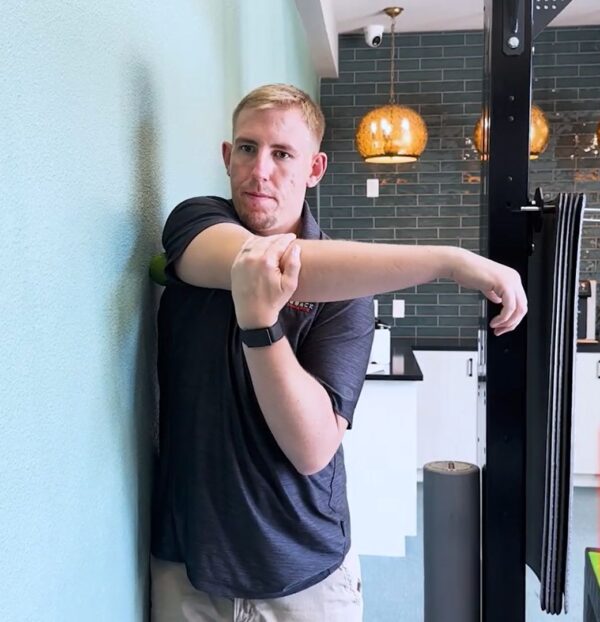
Purpose – To free up your posterior shoulder tightness that prevents you from doing proper bench press.
Equipment Needed: Lacrosse ball or baseball, wall.
How to Do It
- Place the ball between your shoulder blade area and wall in the “meaty” spot.
- Let your body weight sink into the ball while bringing your arm across your body.
- Use your opposite hand to guide the movement, feeling an intense stretch in the back of your shoulder.
- Work through 15 slow repetitions, letting the ball do the work.
Sets: 2 sets of 15 reps per side
Tip: If one side feels significantly stiffer, that’s almost always your bench press side.
Exercise 2: Crab Rocks
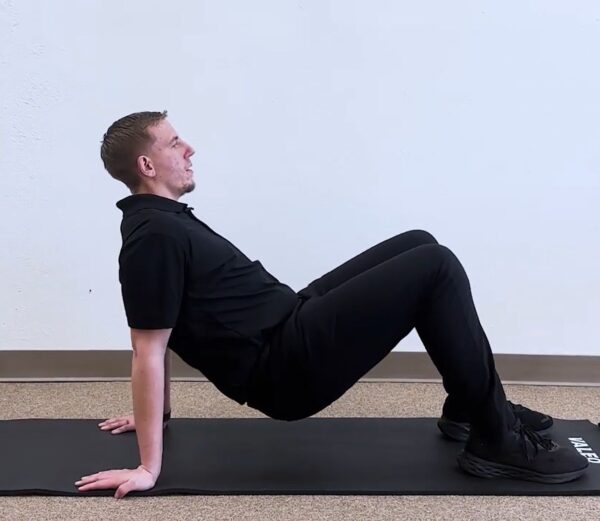
Purpose – To train your exact shoulder extension and blade control pattern needed for pain-free bench pressing
Equipment Needed: None
How to Do It
- Sit on the floor with hands behind you, fingers pointing away from your body.
- Press your hands into the ground and lift your hips into a reverse tabletop position.
- Rock forward and backward, allowing shoulders to move through full extension range.
- Feel your chest opening and shoulder blades setting as you rock forward.
Sets: Do 2 sets of 10 reps.
Tip: Bring your feet closer to your body or place your hands on an elevated surface like a bench.
Exercise 3: Banded Bench Press
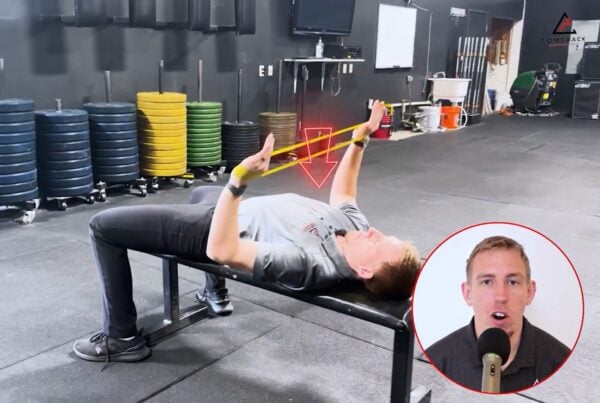
Purpose: To groove proper shoulder pressing mechanics while activating posterior stabilizers that keep AC joints decompressed.
Equipment Needed: Light resistance band.
How to Do It
- Lie flat with a band looped around both wrists.
- Pull hands slightly apart to create outward tension, engaging external rotators.
- Maintain outward tension while moving through bench press motion.
- Control the speed: 3 seconds down, 3 seconds up, feeling work between and behind shoulders.
Sets: 2 sets of 8-10 reps immediately before bench sessions.
Tip: Keep your shoulders down away from your ears, no shrugging, and expect shoulder burning.
Your Path to Pain-Free Bench Pressing
There’s no need to suffer through another painful bench session. Start with these three exercises today, use them consistently, and experience what it feels like to press without that sharp shoulder pinch. These three exercises target the root cause of AC joint pain by addressing posterior capsule restriction, training proper movement patterns, and activating the stabilizers that keep your shoulder joint healthy under load.
Ready to take the next step?
About the Author: Dr. Joey Seyforth


