
Stop Stretching Your Shoulder Pain: 5 Mobility Exercises That Actually Work
Are your shoulders always tight and painful no matter how much you stretch? You’re probably not doing anything wrong. Instead of five random stretches that act like band-aids, we need targeted mobility exercises that address what we call the “Big Five”. The Big Five includes your neck, thoracic spine, shoulder blade, shoulder joint, and nervous system. When these areas work together properly, shoulder pain often resolves naturally.
In this blog, you’ll find these powerful mobility exercises that will make a difference in your shoulders.
Quick Reference
- Total Time: 10 Minutes
- Targets: Neck, thoracic spine, shoulder blades, shoulder joints, nervous system
- Goals – Pain reduction, improved mobility, and restored shoulder function.
The Big Five Shoulder Mobility Exercises
Exercise 1 – Chin Tuck Reset

Purpose: To reset your neck position and reduce upper trap and nerve tension that commonly refers to the shoulder.
Equipment Needed: Chair
How to Do It
- Sit comfortably in a chair.
- Move your chin straight back like you’re making a double chin.
- Hold for 2 seconds, ensuring you don’t look down.
- Return to the starting position and repeat.
Sets: Do 2 sets of 15 reps
Tip: Don’t overstretch your neck so you don’t hurt yourself.
Exercise 2: Bench Opener

Purpose: Unlocks thoracic spine extension and opens tight lats to offload the shoulder joint.
Equipment Needed: Bench or couch, dowel or broomstick
How to Do It
- Kneel in front of a bench and place your elbows on the surface.
- Hold a dowel with both hands, palms facing up.
- Rock your hips back while allowing your chest to drop toward the floor.
- You should feel the stretch through your upper back and lats without forcing a shoulder blade pinch.
Sets: Do 2 sets of 10 reps (hold each rep for 3-5 seconds).
Tip: Focus on the thoracic spine movement rather than forcing shoulder blade retraction.
Exercise 3 – Wall Slide

Purpose – To improve shoulder blade rotation around the ribcage, which is essential for overhead movement.
Equipment Needed: Wall
How to Do It
- Face a wall with one foot forward in a split stance.
- Place your hands flat against the wall with elbows and forearms slightly away from the surface.
- Slide your hands upward while leading with your chest, moving toward the wall.
- Feel your shoulder blades moving up and around your ribs.
Sets: Do 2 sets of 10 reps.
Tip: If the blade doesn’t move well, the shoulder joint compensates and often becomes painful.
Exercise 4: Wall Axial Rotation
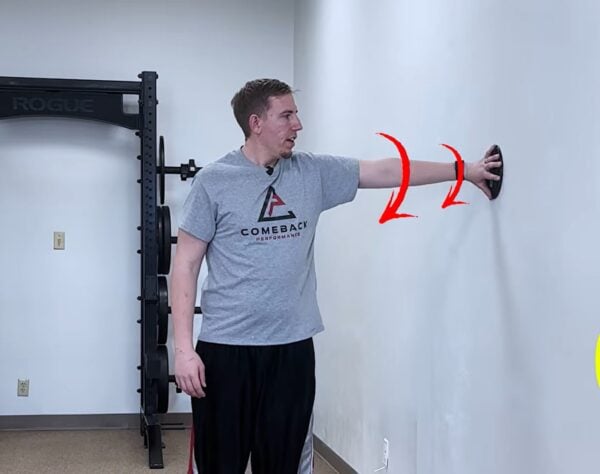
Purpose: Trains proper shoulder joint rotation while maintaining shoulder blade stability.
Equipment Needed – Wall
How to Do It
- Place one hand flat against the wall with your elbow straight.
- Lean slightly into your arm for light pressure.
- Rotate your forearm down and up like a windshield wiper movement.
- Keep your arm motion small and controlled so the joint and shoulder blade rotate together.
Sets: Do 2 sets of 12 reps per side
Tip: This movement should feel smooth and controlled. If you feel pinching or sharp pain, stop the exercise.
Exercise 5 – Windmill Plus Liftoff
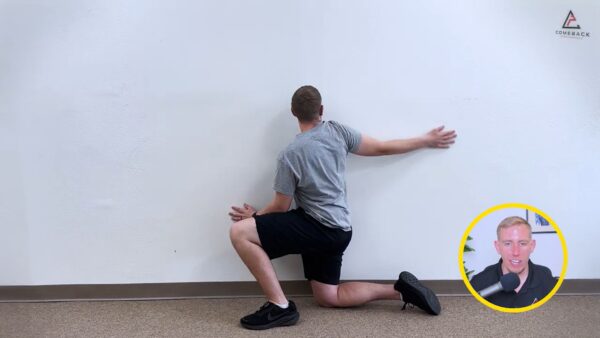
Purpose – To integrate all previous movements and challenges the shoulder at end range with nervous system integration.
Equipment Needed: Wall
How to Do It
- Half-kneel next to a wall with your hip lightly touching the surface.
- Slide the arm closest to the wall up and around in a windmill arc pattern.
- Follow your hand with your eyes throughout the movement.
- At the end of your comfortable range, gently lift your hand away from the wall before returning
Sets: Do 2 sets of 8-10 reps per side.
Tip: Only move your hand through ranges you can control smoothly.
When and How to Use This Routine
Optimal Timing – Use this routine daily in the morning, after prolonged desk work, before training, or whenever shoulder stiffness builds up throughout the day.
Frequency Guidelines – Complete the full routine once daily, but repeat individual movements that provide the most relief in small doses throughout your day.
Safety Parameters – Gentle pulling sensations and muscle work are normal and beneficial. However, sharp pain, increasing tingling, or forced end-range movements are warning signs to stop immediately.
Your Path to Long-Term Shoulder Health
These stretches are targeted mobility exercises designed to restore proper movement patterns throughout your entire shoulder complex. The chin tuck resets your neck position, the bench opener restores upper back motion, wall slides improve shoulder blade rotation, axial rotation trains joint mechanics, and the windmill liftoff integrates everything at challenging ranges. This is how you stop treating one painful spot and start changing your whole movement system for lasting results.
Take the next step toward pain-free shoulders and get back to the activities you love.
About the Author: Dr. Joey Seyforth


