
Fix Your Shoulder Impingement With These 3 Exercises That Are Easy To Do
If you’re between 35 and 65 and get that sharp pinch at the top or front of your shoulder every time you reach overhead or press that keeps coming back, no matter how much you rest or stretch, you’re not alone. That persistent shoulder pain that’s keeping you from your workouts, disrupting your sleep, and making everyday tasks miserable might be shoulder impingement.
With just 15 minutes and three targeted exercises, you can start addressing the real root causes that most physical therapists miss.
Quick Reference Box
- Total Time: 15 Minutes
- Targets: First rib, nerves, shoulder blade, shoulder joint
- Goals: Pain reduction, improved mobility, enhanced stability
The Simple Test: Do You Have Shoulder Impingement?
The Shoulder Clearing Test

Purpose: Identify if you’re dealing with true shoulder impingement
Equipment Needed: None
How to Do It
- Take your painful arm and place your hand on the opposite shoulder.
- Slowly lift your elbow towards your chin.
- Keep your body still—don’t twist your trunk to cheat.
- Note if this recreates that familiar pinch in the front or top of your shoulder.
Assessment: Rate your pain on a scale of 0-10 and remember this number.
Tip: A positive test means you feel that familiar pinching sensation—this confirms we’re on the right track
Exercise 1: Belt Rib Mobilizations

Purpose: Release tension at your first rib and the nerves that run under it.
Equipment Needed – Belt or strong strap
How to Do It
- Loop the belt over the top of your painful side shoulder, across the upper trap area.
- Pull the belt straight down towards your hips with both hands.
- While maintaining pressure, bring your neck down and in towards your shoulder (as if to sniff your armpit).
- Move up and away at a diagonal, creating a gentle stretch.
Sets: 2 sets of 12-15 slow reps.
Tip: Stay in the “green and yellow zone”—you should feel firm pressure and maybe a stretch, but no sharp zings down your arm.
Exercise 2: Banded Scapular Angels
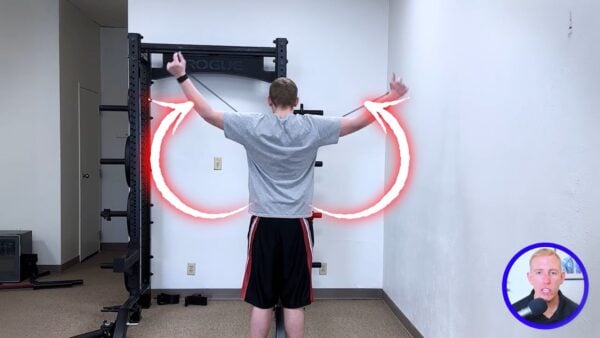
Purpose: Teach your shoulder blade to move properly and create space in the joint.
Equipment Needed: Light resistance band.
How to Do It
- Anchor the band at chest height and grab with both hands, walking back until there’s light tension.
- Start with your hands down by your pockets, arms straight, shoulders set down and back.
- Slowly sweep your arms up and out wide, like making a snow angel while standing.
- Only go as high as you can without reproducing the sharp pinch.
Sets: 2-3 sets of 10-12 reps
Tip: Think “shoulder blades tipping back and rotating up” as your arms rise—keep your ribs down and don’t arch your back to fake the range.
Exercise 3: Kettlebell Pull-Throughs
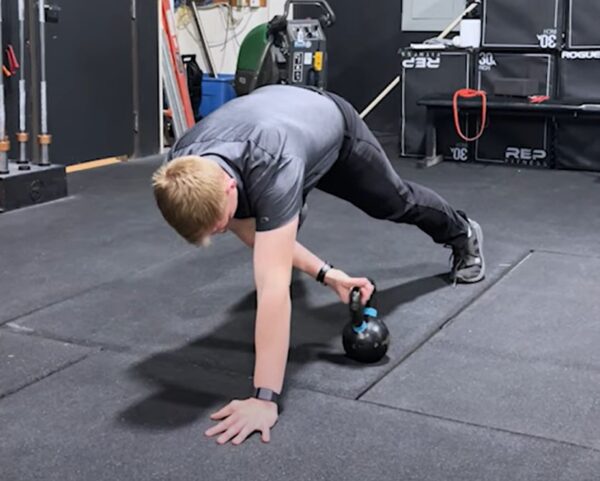
Purpose: Build shoulder stability in a safe, closed-chain position.
Equipment Needed: Light kettlebell or dumbbell.
How to Do It
- Set up in a high plank position with the weight just outside your right hand.
- Reach under your chest with your left hand and drag the weight across to the other side.
- Switch hands and pull it back, keeping your hips as steady as possible.
- Focus on pushing the floor away with the planted shoulder.
Sets: 2-3 sets of 6-8 pulls each side.
Tip: Small hip motion is fine, but avoid big rotations—if your chest sags or hips twist excessively, lighten the weight.
What Next?
After completing these three exercises, retest your shoulder using the same clearing test. Most people see an immediate reduction in pain—even just a couple points on the 0-10 scale proves your impingement isn’t just “bone on bone” or a mystery condition.
One client, Tom, used the approach we shared in this blog. And it helped him to go from experiencing painful shoulder impingement that limited his bench press to eventually setting a powerlifting world record. That’s the difference between just managing pain and actually fixing the root cause.
Ready to permanently fix your shoulder pain? The exercises you learned today are just the beginning. To see how all five pieces of the shoulder system fit together with simple tests and exercises for each,
About the Author: Dr. Joey Seyforth


