
4 Simple Exercises to Eliminate Thoracic Spine Stiffness
Does your upper back always feel locked up, stiff, or just plain uncomfortable? Maybe you’ve been sitting too long at your desk, pushed yourself too hard at the gym, or find that even moving your torso feels like a challenge. If this sounds familiar, you don’t have to live with this tightness, especially when you can do these thoracic spine mobility exercises!
The thoracic spine—those 12 vertebrae between your neck and lower back—is designed to move in four crucial directions: flexion, extension, side bending, and rotation. But our modern lifestyles are working against us every single day.
Think about it: we spend countless hours hunched over our phones, laptops, and steering wheels. This constant forward posture creates a domino effect throughout your entire body.
When your thoracic spine lacks mobility, your body doesn’t just accept it—it compensates. Your neck, shoulders, shoulder blades, and lower back start picking up the slack during workouts and daily activities. If you can’t extend properly through your upper back, you can only raise your shoulders so much. But when you restore that extension, you’re able to move your arms into all positions more freely and smoothly.
With just 15 minutes a day, you can
- Eliminate upper back stiffness and pain.
- Restore natural thoracic spine mobility in all four directions.
- Prevent compensatory pain in your neck, shoulders, and lower back.
- Improve your posture and movement quality.
- Enhance your workout performance and daily activities.
- Feel immediate relief that builds into long-term freedom.
Quick Reference Guide
- Total Time: 15 Minutes.
- Targets: Thoracic spine, upper back muscles, shoulder mobility.
- Goals: Restore extension, improve rotation, and eliminate compensations.
Exercise 1: Bench Opener

Purpose: Teaches your upper back to move into proper extension while stretching tight lat muscles.
Equipment Needed: Bench or chair, PVC pipe (optional).
How to Do It
- Get into a kneeling position in front of a bench with your elbows on the surface.
- Keep your palms facing up and drop your hips back toward your feet.
- Allow your chest to drop toward the floor, feeling the stretch in your lats and upper back.
- Move gently in and out of this position, sinking deeper on the second set.
Sets: 2 sets of 12 reps.
Tip: Don’t force the stretch—let gravity do the work and sink lower only as it feels comfortable.
Exercise 2: Thread the Needle
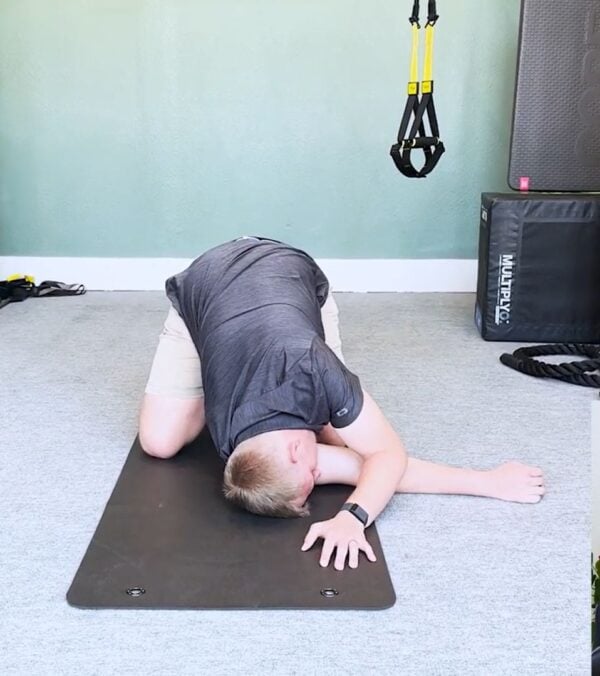
Purpose: Improves thoracic rotation and melts tension in your upper back and shoulders.
Equipment Needed: None.
How to Do It
- Start in an all-fours position with hands under shoulders and knees under hips.
- Take one arm and thread it under your body as far as you can reach.
- Let your shoulder and head gently rest on the floor while reaching across.
- Hold for 5-10 seconds, then return to the start and repeat.
Sets: 10 reps on each side.
Tip: Take note if one side moves more freely than the other—this indicates imbalances that need attention.
Exercise 3: Windmill + Lift Off
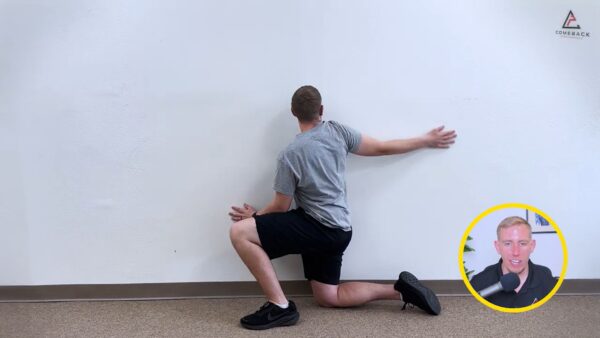
Purpose: Advanced mobility exercise addressing neck, thoracic spine, and shoulder movement together.
Equipment Needed: Wall.
How to Do It
- Get into a half-kneeling position facing the wall.
- Slide your arm up the wall into a rainbow position to end range.
- Lift your arm off the wall while keeping your hip connected to the wall.
- Move through whatever range you can achieve comfortably.
Sets: 2 sets of 10 on each side.
Tip: If you can’t achieve the full range with lift-off, work within your available motion—progress comes with consistency.
Exercise 4: Wall Contours
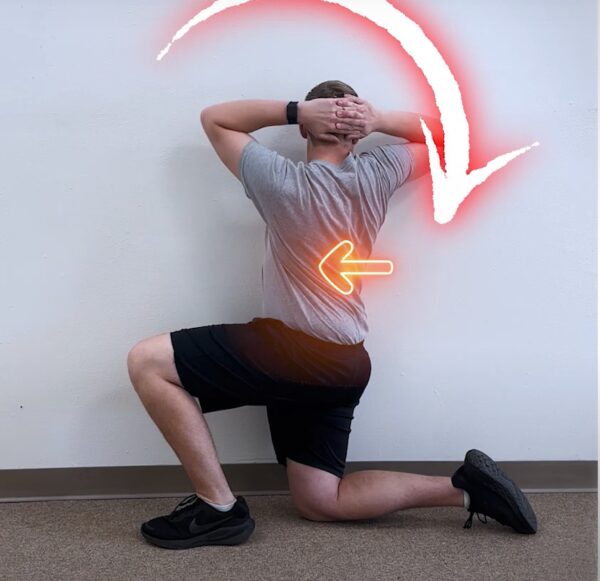
Purpose: Combines extension and rotation of the thoracic spine for comprehensive mobility.
Equipment Needed: Wall.
How to Do It
- Stay in the same half-kneeling position with your hip against the wall.
- Place your hands behind your head and extend up through your upper back.
- Rotate over to one side, then reverse the motion back to start.
- Focus on upper back extension, not lower back compensation.
Sets: 2 sets of 10 on each side.
Tip: Keep the movement in your upper back—if you feel it in your lower back, reduce the range of motion.
Free Your Upper Back Now!
These four exercises will allow you to extend and rotate without compensations. By targeting thoracic extension with bench openers, working rotation with thread the needle, building dynamic mobility with windmill lift-offs, and blending it all with wall contours, you’re addressing every aspect of upper back stiffness. Incorporate these exercises into your daily routine—whether as a morning wake-up sequence or pre-workout warm-up. You’ll notice improvements in movement quality almost immediately, with significant pain reduction building over the first week of consistent practice.
About the Author: Dr. Joey Seyforth


