
Say Goodbye to Rhomboid Pain: 4 Simple Exercises for Instant Shoulder Blade Relief
Do you feel like someone’s stabbing a knife between your shoulder blades every time you lift something, sit at your desk, or even take a deep breath? That sharp, nagging pain that makes you want to reach behind your back and dig your fingers into that stubborn knot? That’s the rhomboid pain, and it’s one of the most common complaints we see at Comback Performance and Wellness, where we’ve helped over a thousand people worldwide eliminate their shoulder pain through targeted exercise therapy. In this post, we’ve outlined some powerful yet simple exercises for relieving rhomboid pain between the shoulder blades.
Rhomboid pain is a problem that starts with poor posture, weak supporting muscles, and overworked rhomboids that are desperately trying to compensate for dysfunction elsewhere in your body.
Your rhomboid muscles don’t work in isolation. They’re intimately connected to your neck, thoracic spine, and shoulder blade mechanics. When these areas become tight or weak, your rhomboids have to work overtime, leading to that constant burning and stabbing sensation. Once we address these root causes with targeted exercises, the pain can finally go away for good.
With just 10 minutes a day, you can
- Eliminate that sharp stabbing pain between your shoulder blades.
- Improve your posture while sitting and working.
- Restore natural shoulder blade movement and flexibility.
- Strengthen weak supporting muscles to prevent future flare-ups.
- Reduce neck tension that contributes to rhomboid pain.
- Get back to pain-free workouts and daily activities.
Quick Reference Guide
- Total Time: 10 Minutes.
- Targets: Rhomboids, neck, shoulder blades, mid/lower traps.
- Goals: Pain reduction, improved mobility, and postural strength.
Exercise Breakdown
Exercise 1: Chin Tucks + Extensions

Purpose: Release neck tension that directly contributes to rhomboid pain and restore proper cervical spine mobility.
Equipment Needed: None.
How to Do It
- Sit up tall with your shoulders relaxed.
- Retract your chin back toward your shoulder blades (like making a double chin).
- From this position, slowly look up toward the ceiling.
- Return to the starting position and repeat.
Sets: 2 sets of 10 reps.
Tip: Don’t push into pain – you should feel a gentle stretch in your neck and possibly your shoulders. If you feel pinching or sharp pain during the upward motion, reduce your range of motion.
Exercise 2: Wall Slides

Purpose: Teach your shoulder blades proper upward rotation while stretching tight rhomboid muscles.
Equipment Needed: Wall space.
How to Do It
- Stand facing a wall with one foot in front of the other.
- Place both hands flat against the wall at shoulder height.
- Slide your arms up the wall while leaning your chest forward.
- Focus on feeling your shoulder blades move up and around the ribcage.
Sets: 3 sets of 10 reps.
Tip: Keep your hands in contact with the wall throughout the entire movement. If you can’t maintain contact, you’ve found your current mobility limit – work within that range.
Exercise 3: Banded Open Books
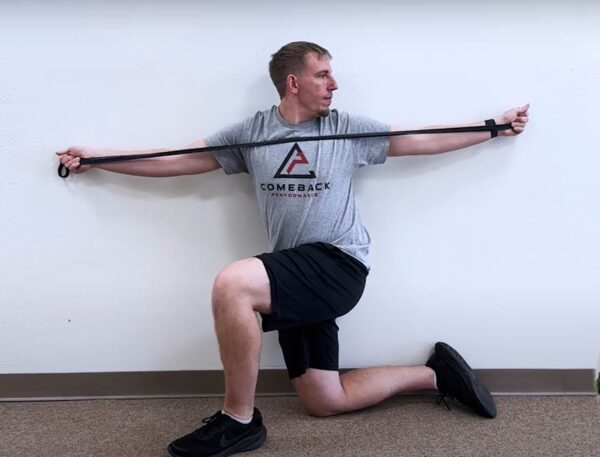
Purpose: Combine neck and thoracic spine rotation while building strength to address multiple contributing factors simultaneously.
Equipment Needed: Resistance band.
How to Do It
- Get into a half-kneeling position next to a wall.
- Hold a resistance band attached to the wall with both hands, palms facing up.
- Rotate away from the wall, following your top hand with your eyes.
- Return to the starting position with control.
Sets: 2 sets of 12 reps on each side.
Tip: Pay attention to which side rotates further – asymmetries often contribute to rhomboid pain. Focus extra attention on the more restricted side.
Exercise 4: Prone Swimmers

Purpose: Strengthen your mid and lower traps to take the workload off overactive rhomboid muscles.
Equipment Needed: Floor space.
How to Do It
- Lie face down with your neck relaxed into the floor.
- Lift both arms straight up off the ground.
- Slowly bring your arms behind your back without touching the floor.
- Return to the starting position with control.
Sets: 3 sets of 5-8 reps.
Tip: If you can’t keep your arms off the ground during the transition, this reveals weakness in your mid/lower traps – a key contributor to rhomboid pain. Start with smaller ranges of motion and build up gradually.
Your Path to Pain-Free Living
Consistency is your secret weapon. These four exercises address the root causes of rhomboid pain. You’ll notice improvements such as reduced muscle tension, improved range of motion, and decreased pain within the first week. While these exercises provide an excellent starting point, they’re just the beginning of a comprehensive approach to eliminating rhomboid pain permanently. Don’t let rhomboid pain control another day of your life. Take action now – your pain-free future is just a session away.
About the Author: Dr. Joey Seyforth


