
Skip the Surgery: 3 Essential Rotator Cuff Exercises That Actually Eliminate Shoulder Pain
A rotator cuff tear may cause you to struggle to sleep through the night because of shoulder pain. It can prevent you from reaching overhead without wincing. More than one in four people will experience a rotator cuff tear in their lifetime, yet most are told surgery is their only option. By the time you finish reading this blog, you’ll have learned 3 essential rotator cuff exercises to help you avoid surgery.
As you’re probably aware, most people don’t realize that their rotator cuff isn’t just one muscle! It’s a complex system of four interconnected muscles that work together to stabilize your entire shoulder joint. When one part fails, the whole system suffers. Think of your shoulder like a golf ball sitting on a tee. Your rotator cuff muscles work together to keep that ball perfectly centered. When these muscles are weak or torn, the ball starts rolling off the tee, causing your shoulder to rub against ligaments, tendons, and other structures—creating that nagging pain you feel daily.
The good news is that you can restore stability and eliminate pain with just 15 minutes of targeted exercises daily—no surgery required.
Quick Reference Guide
- Total Time: 15 Minutes.
- Targets: Supraspinatus, Infraspinatus, Teres Minor, and Subscapularis muscles.
- Goals: Pain reduction, improved stability, and restored shoulder function.
Exercise Breakdown
Exercise 1: Sidelying Shoulder Flexion
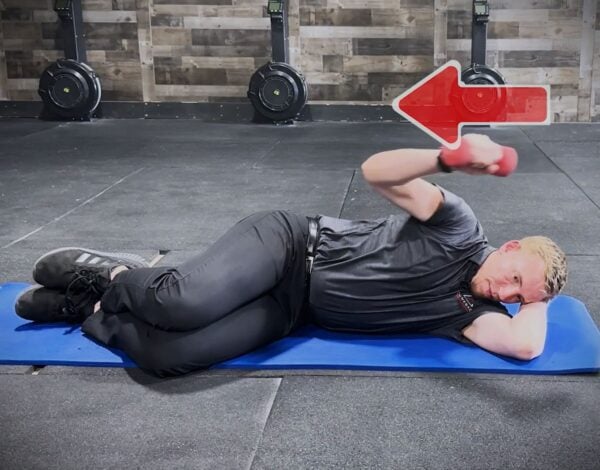
Purpose: Targets the supraspinatus muscle—the most commonly torn rotator cuff tendon—to restore overhead strength and reduce pain.
Equipment Needed: Light dumbbell (2-5 lbs).
How to Do It
- Lie on your unaffected side with a light dumbbell in your top hand.
- Keeping your arm straight, slowly raise it toward your ear.
- Lower back down with control.
- Keep pain levels at 1-3 out of 10 maximum.
Sets: 3 sets of 10-12 reps.
Tip: If you feel sharp pain or your arm drops uncontrollably, reduce the weight or perform without any weight initially.
Exercise 2: Banded W Hold

Purpose: Strengthens the infraspinatus and teres minor muscles to improve external rotation and posterior shoulder stability.
Equipment Needed: Resistance band.
How to Do It
- Hold a resistance band with palms facing up, elbows bent at 90 degrees by your sides.
- Pull the band apart while keeping your elbows tucked against your body.
- Hold this “W” position for 8 seconds.
- Feel the burn in the back of your shoulders.
Sets: 2 sets of 4 reps with 8-second holds.
Tip: Your shoulders should shake slightly during the hold—this means the muscles are working correctly.
Exercise 3: Banded Subscap Punch
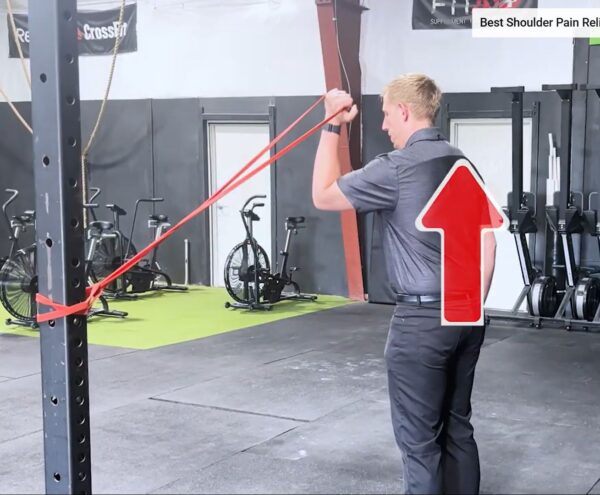
Purpose: Activates the subscapularis muscle to eliminate front shoulder pain and improve internal rotation strength.
Equipment Needed: Resistance band attached to a sturdy anchor.
How to Do It
- Stand sideways to the anchor with the affected shoulder closest to it.
- Hold the band with the elbow bent at 90 degrees.
- Slowly raise your arm toward your ear while maintaining the bent elbow.
- Control the movement back to the starting position.
Sets: 3 sets of 10 reps.
Tip: Walk further from the anchor to increase difficulty, or closer to make it easier.
It Won’t Happen Overnight!
Remember, healing doesn’t happen overnight. Commit to these exercises daily for at least 4-6 weeks to see significant improvements. Most people report reduced pain within the first week and major functional improvements by week four. You’ll likely notice better sleep quality within days as your shoulder gains stability and inflammation decreases. While these exercises provide excellent relief, a comprehensive shoulder rehabilitation program addresses all aspects of shoulder health – from mobility to strength to functional movement patterns.
About the Author: Dr. Joey Seyforth


