
Why Your Shoulder Still Feels Stuck After SLAP Surgery (And 4 Exercises That Actually Fix It)
If you’ve had SLAP tear surgery, been cleared by your doctor, and your shoulder still feels stiff, tight, or sketchy during overhead movements, you’re one among thousands of patients who experience this frustrating reality.
While SLAP surgery anchors the labrum and can improve stability, it creates a cascade effect throughout the shoulder system. The front and top of your joint become tighter, making external rotation and certain overhead positions much more difficult to achieve
Most post-surgical rehab programs focus only on the shoulder joint itself with generic band exercises, completely ignoring the connected systems that must work together for pain-free movement. This narrow approach is why you can be “healed on paper” but still feel stuck in real life.
Here are some simple exercises you can do to address a stuck shoulder.
Quick Reference Guide
Total Time: 15-20 Minutes
Target: Your shoulder joint, shoulder blade, upper back, neck, and nervous system
Goal: To restore mobility and rebuild stability in your shoulder
Exercise 1: Bench External Rotation Liftoff

Purpose: To restore controlled external rotation in your shoulder (which surgery often limits)
Equipment Needed: A flat bench.
How to Do It
- Lie on a flat bench with your upper arm at 90° from your side and elbow bent to 90°, forearm pointing down off the bench.
- Slowly rotate your hand up into external rotation, lifting it toward the ceiling.
- Pause briefly at the top, then slowly lower back down with control.
- Move only in a pain-free range—focus on control, not forcing the range.
Sets: 2-3 sets of 8-10 slow, controlled reps.
Tip: Keep your neck relaxed and avoid shrugging your shoulders toward your ears during this movement.
Exercise 2: Banded Scapular Angel
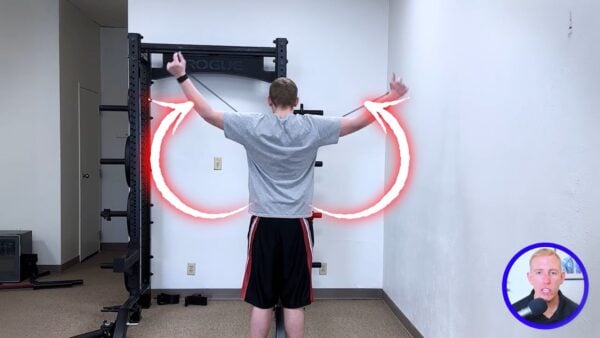
Purpose: To improve your shoulder blade mobility and overhead range without overloading your repair.
Equipment Needed: A light resistance band
How to Do It
- Anchor a light band in front of you at chest height and grab with both hands while keeping your elbows straight.
- Walk back to create light tension, then bring your hands back toward your pockets.
- Slowly raise your arms out to the sides into an “angel” position, ending with your biceps near your ears if comfortable.
- Return down with control, focusing on initiating shoulder blade movement.
Sets: 2 sets of 8-10 slow reps.
Tip: Tip your shoulder blades back at the start of the motion, then rotate up as you raise your hands.
Exercise 3: Incline Row + External Rotation + Press
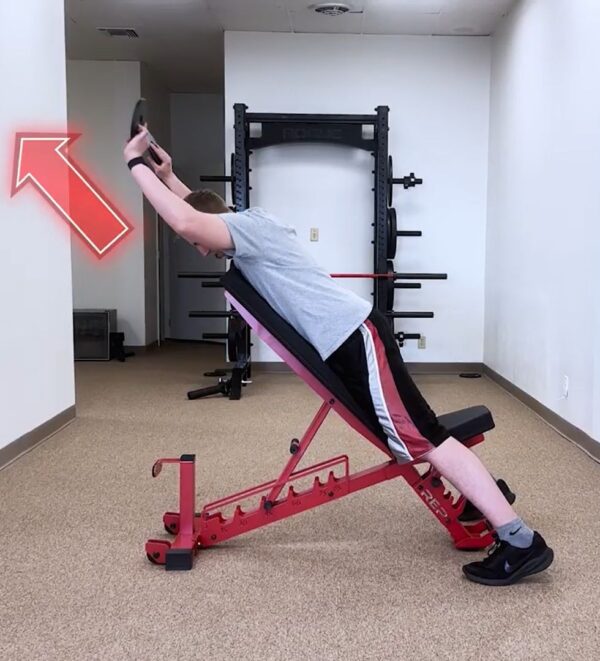
Purpose: Build strength through external rotation and pressing in a controlled, post-surgery-friendly sequence.
Equipment Needed: Incline bench, light dumbbells (or bodyweight).
How to Do It
- Set an incline bench and lie chest down with light weights.
- First, row by pulling your elbows back while keeping them at 90 degrees.
- Move into external rotation by rotating your forearms up toward the ceiling.
- Press your hands up slightly, then reverse the sequence and lower them.
Sets: 2-3 sets of 8 controlled reps
Tip: Move slowly and smoothly through all phases—no jerking. Feel the work in your back and sides of your shoulders, not your neck.
Exercise 4: Banded Bear Sliders
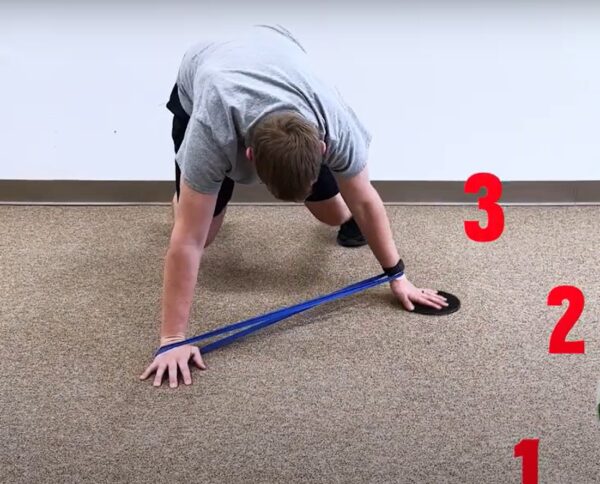
Purpose: Develop closed-chain shoulder stability to make your joint feel safe and trustworthy again.
Equipment Needed: Light resistance band.
How to Do It
- Put a light band around your wrists and get into a bear position (hands under shoulders, knees under hips).
- Lift your knees slightly off the ground.
- Slide one hand in small, controlled steps forward and back, side to side, and diagonally if tolerated.
- Keep your torso as still as possible—no big hip movements.
Sets: 2 sets of 5 slow reps in each direction per arm.
Tip: Think “quiet core, busy shoulders.” The challenge is maintaining stability through the core while the shoulders move dynamically.
From Stuck to Strong
If you’re months out from SLAP surgery and still struggling with pressing, back squats, or overhead sports, remember this: it’s likely not because your repair failed. It’s because your external rotation and overhead mechanics were never fully rebuilt.
The good news is that with consistent daily practice of these exercises, you can start feeling improvements in your shoulder mobility and confidence within just a few weeks. However, these exercises are just the starting point for rebuilding your complete shoulder system.
If you’re ready to dive deeper,
About the Author: Dr. Joey Seyforth


