
3 Exercises That Fix Front Shoulder Pain During Bench Press
Most lifters make the same mistake of stretching the front of the shoulder, taking a week off, then jumping back in, only to get hit with the same sharp, achy pain at the bottom of their bench press. Front shoulder pain during bench press isn’t just a shoulder problem. It is actually your nervous system’s alarm bell, signaling that your joint is being forced into ranges it hasn’t yet mastered.
When you force your shoulder into positions it hasn’t earned through proper mobility, a dangerous compensation pattern emerges
- The ball glides forward in the shoulder socket
- Your elbow flares out uncontrollably
- Front shoulder tissues get compressed and irritated
- Your nervous system responds with pain as a protective mechanism
You can start fixing this today with just 10 minutes of targeted work. The same process that helped Tom, a national champion and world record holder in the 90kg class, overcome 20 years of shoulder pain and break a world record, can work for you too.
Quick Reference Box
- Total Time: 10 Minutes
- Targets: Shoulder extension, internal rotation, joint stability
- Goals: Pain reduction, mobility improvement, movement control
Before you begin these exercises, test your shoulders with these two exercises.
Test 1: Shoulder Extension Assessment
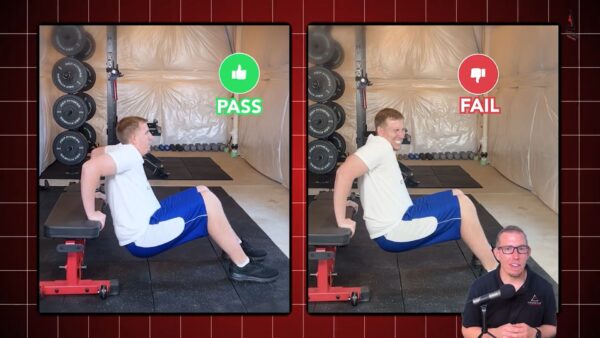
Purpose: Determine whether you have sufficient shoulder extension for safe bench pressing.
Equipment Needed: None
How to Do It
- Stand tall with arms relaxed by your sides, chest up, no back arching.
- Lift your hands straight back behind you as far as comfortable.
- Observe how far your hands travel from your body.
- Note any sharp pain in the front of the shoulder.
Goal: Hands should reach about forearms-width away from your body (roughly 45°) with no sharp front shoulder pain.
Red Flags: If your hands barely leave your sides or your front shoulder “bites” at you, you’re missing the extension bench press requires.
Test 2: Internal Rotation at 90 Degrees
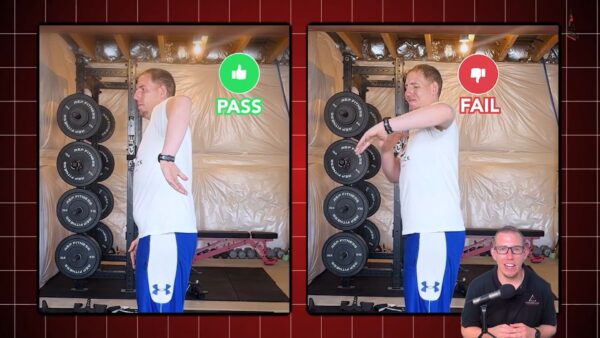
Purpose: Assess if your shoulder can tolerate the rotation demands of the bench press setup.
Equipment Needed: None.
How to Do It
- Bring your arm out to the side with your shoulder at 90°, elbow at 90°, and forearm vertical.
- Keep your elbow still and rotate your forearm down towards the floor.
- Observe how far your hand can travel past the horizontal.
- Note any blocks or sharp pain in the front or back of the shoulder.
Goal: Hand should move past horizontal toward the floor at approximately 60-70°, with no heavy block or sharp pain.
Red Flag: If you feel a hard block, it indicates you’re missing internal rotation for safe bench pressing.
Exercise Breakdown
Exercise 1: Banded Posterior Shoulder Mobilization

Purpose: Create space in the front of the joint so the ball isn’t jamming forward at the bottom position.
Equipment Needed: Resistance band, anchor point at shoulder height.
How to Do It
- Anchor band at shoulder height and face away from the anchor point.
- Loop the band around the front of your shoulder, close to your armpit.
- Step forward until there’s firm tension pulling your shoulder back into the socket.
- Perform small bench press motions, letting the band gently glide the shoulder back as you move.
Sets: 2 sets of 15-20 reps per side.
Tip: Stay relaxed and keep your movement range small and controlled.
Exercise 2: Crab Rocks
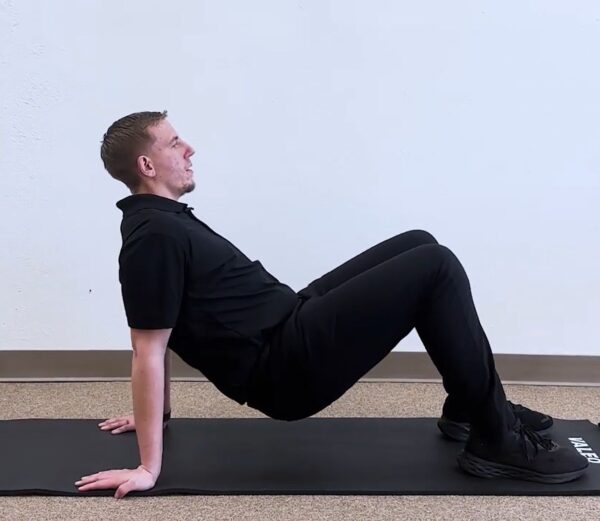
Purpose: Build extension mobility and stability in the exact direction the bench press demands.
Equipment Needed: None
How to Do It
- Sit on the floor with your hands behind you, fingers pointing out or slightly back, knees bent, feet flat.
- Lift your hips a few inches off the ground into a crab position.
- Support yourself on your hands and feet, then gently rock forward and back to mobilize the shoulder.
- Maintain a proud chest throughout the movement.
Sets: 2-3 sets of 8-10 rocks.
Tip: You should feel this in the back of your shoulders, not just in your wrists or low back. Focus on shoulder extension rather than hip movement alone.
Exercise 3: Banded Bench Press
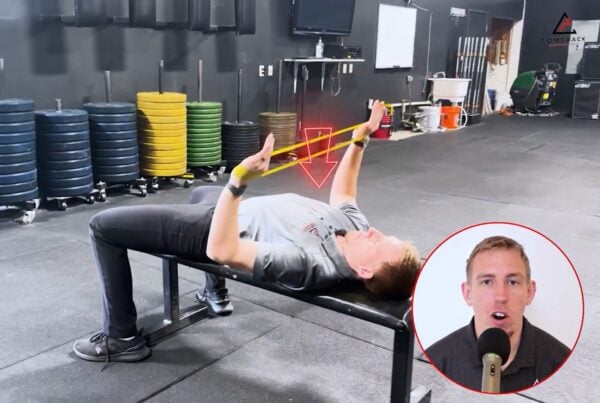
Purpose: Reinforcing external rotation and control.
Equipment Needed: Light resistance band + bench + optional light weights/dumbbells.
How to Do It
- Lie on the bench with a light band around your wrists in the bench press setup position.
- Set your feet flat with a slight arch, and your shoulder blades tucked and slightly pulled apart to create external rotation tension.
- Perform a bench press with only the band, maintaining outward tension throughout.
- Focus on 3 seconds down, 3 seconds up with controlled movement.
Sets: 2 sets of 6-8 reps as part of warm-up.
Tip: Think about “bending the bar” and maintaining external rotation throughout your movement. Keep elbows in a strong, controlled path rather than flared out wide.
Retest and Track Your Progress
After completing the exercise sequence, retest both shoulders
Extension Retest: Arms by your sides, lift hands behind you
Internal Rotation Retest: Arm up to side like throwing, rotate hand down
If either test shows a greater distance, feels smoother, or has less front shoulder bite, that’s evidence that your shoulder can change. This immediate feedback shows that your tissues are responding and adapting to the targeted mobility work.
Your Path to Pain-Free Benching
These exercises provide instant feedback and often lead to improvements in range of motion and comfort. While these exercises provide powerful immediate relief, lasting change requires addressing the entire kinetic chain of your shoulder system.
For a customized plan tailored to your bench press technique, shoulder limitations, and training goals, consider working with a qualified shoulder rehabilitation specialist.
About the Author: Dr. Joey Seyforth


