
5 Shoulder Pain Mistakes You Must Stop Making (And What to Do Instead)
If you’re over 40, work out regularly, and your shoulder keeps nagging you during workouts, at work, or when you try to sleep, you’re not alone. Most people your age are either pushing through the pain, hoping it goes away, or slowly giving up the exercises and activities they enjoy. That’s how you end up in the “no upper body workouts and no sports” club.
But here’s the good news: your shoulder pain isn’t just about age, and surgery isn’t inevitable. The real problem is that most over-40 shoulders are treated incorrectly – either by ignoring the pain and pushing through, or by stopping everything and hoping it magically heals. Neither approach actually changes the mechanics that are overloading your shoulder.
With just 15-20 minutes of targeted work daily, you can start reversing years of shoulder dysfunction and get back to the activities you love.
Quick Reference
- Total Time: 15-20 Minutes
- Targets: Neck, thoracic spine, shoulder blade, shoulder joint, and nerves
- Goal: To reduce your shoulder pain and improve your shoulder mechanics.
Your New Shoulder-Saving Exercise Routine
Exercise 1: Banded Scap Angels
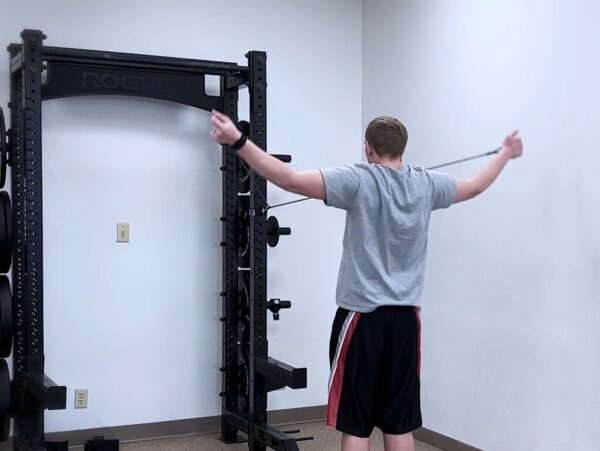
Purpose: Teach the shoulder blade to move properly instead of jamming the joint.
Equipment Needed: Light resistance band.
How to Do It
- Anchor band at chest height and grab with both hands, elbows straight.
- Walk back to create tension as you’re bringing your hands to your hips.
- Slowly move arms into a wide-angle position, with biceps near the ears if comfortable.
- Return with control, thinking shoulder blades tipping back and rotating up.
Sets: 2 sets of 8-10 slow reps
Tip: Keep ribs down – don’t turn this into a big low back arch.
Exercise 2: Belt First Rib Mobilization

Purpose: To reduce the nerve pressure that causes you night pain and movement restrictions.
Equipment Needed: Belt, dog leash, or strap.
How to Do It
- Loop the belt over the painful side of the shoulder, just above the collarbone.
- Angle down toward the opposite hip, holding with both hands.
- Apply gentle downward pressure on the upper shoulder/first rib area.
- Bring your head down toward your shoulder, then look up and away diagonally.
Sets: 2 sets of 12-15 slow reps.
Exercise 3: Kettlebell Pull-Throughs
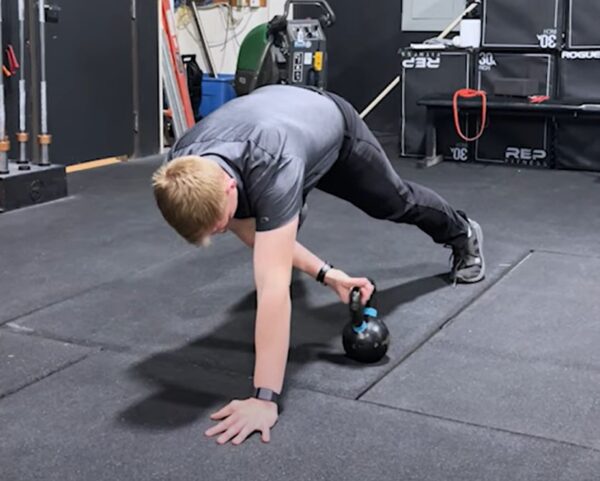
Purpose: Builds real-world shoulder and trunk stability in loaded positions
Equipment Needed: Light kettlebell
How to Do It
- Get into a high plank position (hands on the floor or a bench).
- Place the kettlebell outside one hand.
- Reach across with the opposite hand, grab the handle, and pull the kettlebell to the other side.
- Plant the hand, then repeat on the other side.
Sets: 2-3 sets of 6-8 pull-throughs per side
Tip: Focus on quiet hips, quiet ribs, strong shoulders – this is about control, not max weight
The 5 Critical Mistakes to Stop Making Now
Mistake #1: Pushing Through Bad Pain and Ego Maxing
The Problem: Stop teaching your shoulder that certain positions are unsafe if every time you press/row/reach, you feel sharp, electric, or catching pain, and you keep going because “it’s just part of training”.
The Solution – Use the Pain Traffic Light System
- Green: Feeling fine, mild discomfort – proceed normally
- Yellow: Mild increase that settles within 24 hours – proceed but monitor
- Red: Sharp, catching, or worsening symptoms – modify exercise range or load immediately
You don’t have to quit training. You have to stop ignoring red lights.
Mistake #2: Only Stretching the Spot That Hurts
The Problem: Most people over 40 stretch the front or side of the joint endlessly and call it mobility work. But if your neck, upper back, and shoulder blade are stiff, stretching the painful spot is just yanking on the symptoms.
The Solution: Warm up the entire system, not just the sore spot. Get your upper back moving, your shoulder blades rotating, and your shoulder joint feeling centered before any workout.
Mistake #3: Going Straight to Imaging and Injections
The Problem: Many people get an MRI, are told they have a mild tear, arthritis, or bursitis, and then get an injection. This sometimes provides short-term relief but rarely fixes how you move.
The Solution: Start with a movement-based evaluation. Ask questions like
- How is my neck moving?
- How is my upper back moving?
- How do my shoulder blades move when I reach or load?
- What positions actually hurt, and which feel okay?
Imaging can be useful, but it shouldn’t be your first and only move.
Mistake #4: Ignoring Night and Sleep Pain
The Problem: If your shoulder wakes you up at night, that’s not just “part of being older.” It’s a sign that your nerves, first rib, and shoulder position are unhappy under pressure.
The Solution: Treat night pain as a diagnostic clue. Adjust your sleeping position and use pre-bed drills to reduce pressure on nerves and the first rib.
Mistake #5: Random Band Rehab Forever with No Progression
The Problem: Doing the same three sets of 10 with the same red band for years means no progression, no load, and no real return to activities you care about.
The Solution: Rebuild strength and stability progressively. Use bands and bodyweight as a phase, not a life sentence. Move towards loaded patterns that train your shoulder and trunk together.
Getting Rid of The Pain
Start your recovery by implementing these three exercises daily and avoiding the five critical mistakes. You’ll see immediate improvements and gains in strength and function. Just 15-20 minutes a day can mean the difference between retiring from activities you love and thriving in them for decades to come.
Ready to take the next step?
About the Author: Dr. Joey Seyforth


