
The 5-Minute Bicep Tendonitis Warm-Up That Finally Fixed My Shoulder Pain
Like many active adults, you might be skipping upper-body days or doing random stretches, hoping your bicep tendon won’t flare up again. Your bicep tendon isn’t the real villain—it’s actually the victim.
The true culprits are hiding in your neck, upper back, and shoulder blade movement patterns. When these areas don’t work properly, your bicep tendon becomes an overworked firefighter, trying to stabilize positions it was never meant to handle on its own.
That’s when you feel that familiar front shoulder ache during curls, sharp pain at the bottom of your bench press, or burning sensation with chin-ups.
But instead of retiring from training, you can fix this with a targeted 5-minute warm-up routine that addresses the real problem areas.
Quick Reference Box
- Total Time: 5 Minutes
- Targets: Shoulder blades, posterior shoulder muscles, core stability
- Goals: Improve shoulder blade mobility, reduce bicep tendon strain, and build joint stability.
Your 5-Minute Bicep Tendonitis Warm-Up Routine.
Exercise 1: Banded Scap Angels
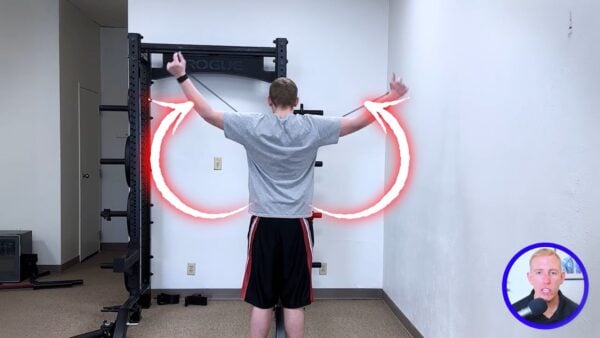
Purpose: To teach your shoulder blades to move properly and clear space in the front of the joint.
Equipment Needed: A simple/light resistance band.
How to Do It
- Anchor a light band at chest height and grab with both hands, elbows straight.
- Walk backwards while holding the bands to create light tension then bring your hands toward your hips to set your shoulders down and back.
- Slowly raise arms up and out into a Y position (biceps near ears if comfortable).
- Return with control, focusing on the shoulder blades tipping back and rotating up.
Sets: Do 12 controlled reps.
Tip: Keep your ribs down and don’t arch your lower back.
Exercise 2: Banded Extension (+External Rotation)

Purpose: To strengthen the back of your shoulder.
Equipment Needed: A light resistance band
How to Do It
- Place the band around your wrists behind your back, arms straight, and hands near your hips
- Pull the band apart slightly to create external rotation tension
- While holding tension, move your shoulders slightly back into extension.
- Return to the start position and repeat the steps.
Sets: Do 10 reps of this exercise.
Tip: Feel for changes between and behind your shoulders.
Exercise 3: Shoulder Taps
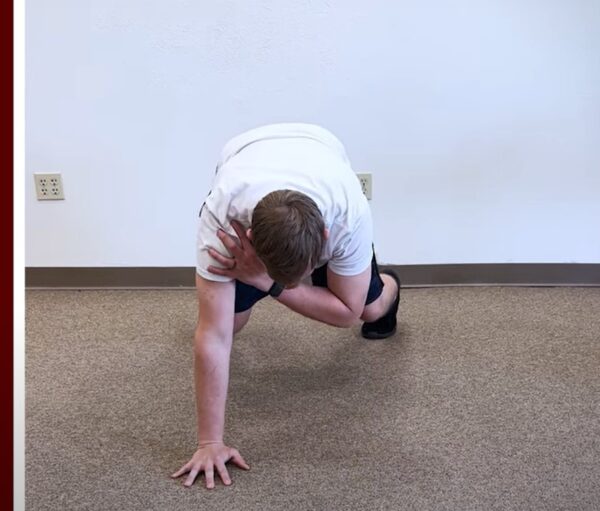
Purpose: To build closed-chain stability so shoulders feel safe under load.
Equipment Needed: None.
How to Do It
- Start in push-up position with feet slightly wider than hip-width.
- Shift weight and tap the opposite shoulder with one hand
- Switch sides while keeping the torso as still as possible
- Think “quiet hips, quiet ribs, busy shoulders.”
Sets: Do 8 taps per side
Tip: Quality over speed—start slow and focus on minimal body movement
Important Safety Guidelines
As you move through these exercises, it’s okay to feel:
- Muscles working
- A light stretch in the front of your shoulder
- Mild fatigue in your upper back
Stop immediately if you feel:
- Sharp, catching pain
- Electric or jolting sensations
- Pain that’s clearly worse afterward
If you hit any “red light” pain, shorten the range of motion or skip that exercise until things calm down.
What to Expect
After completing both rounds, you should feel:
- Your upper back and posterior shoulder are “awake” and engaged
- The front of your shoulder feels lighter, not more irritated
- More stable and confident when gripping weights
One client, Armand, an active gym-goer who was experiencing pain with all pushing movements, reported: “I feel the difference. I feel my muscles in the back firing and going up and down, with no pain. Once I’ve stabilized the shoulder and bulletproofed the routine…”
Make This Your New Upper Body Ritual
Remember, bicep tendonitis isn’t just a bicep issue—it’s usually a shoulder blade and joint stability problem. Use this warm-up before every upper-body session for best results. For a comprehensive approach to eliminating your shoulder pain and getting back to the training you love, consider seeking professional guidance here!
About the Author: Dr. Joey Seyforth


