
How to Keep Lifting with Shoulder Arthritis: 3 Joint-Protecting Exercises That Actually Work
If you’ve been told you have shoulder arthritis or you’re “bone on bone,” you’ve probably heard the same advice: stop lifting, avoid sports, and “manage it.” But most people in your position don’t realize that the problem isn’t just your shoulder joint. It’s how your entire upper body moves together.
In this blog, you’ll learn how to perform three specific exercises that protect your shoulder joints while keeping you active.
Quick Exercise Overview
- Total Time: 15 Minutes
- Targets: Upper back, shoulder blade, shoulder joint muscles
- Goals: Improve mobility, reduce joint stress, build protective strength.
The Exercises
Exercise 1: Wall Slides

Purpose: To train your shoulder blade and joint to move together overhead in a controlled, arthritis-friendly way.
Equipment Needed: Wall.
How to Do It
- Stand facing a wall with one foot slightly in front for balance.
- Place your forearms or hands on the wall at shoulder height and gently press in.
- Slowly slide your arms upward while letting your chest move slightly toward the wall.
- Only go as high as you can without experiencing a sharp pinching or hard blocking.
- Slide back down with smooth, controlled motion.
Sets: 2-3 sets of 10-12 reps
Tip: Feel your shoulder blades moving up and around, not just your arms cranking out. This is like gently guiding the joint along a better path so the cartilage isn’t bearing all the load.
Exercise 2: Wall Open Books for Upper Back Freedom

Purpose: Free up your upper back and rib cage so your shoulder doesn’t have to steal motion.
Equipment Needed: Wall.
How to Do It
- Get into a half-kneeling position with your hip connected to the wall.
- Place your hands together in front of your chest.
- Keep your lower body quiet while opening the top arm away from the wall.
- Rotate your chest and follow your hand with your eyes.
- Return to the start position.
Sets: 2 sets of 8-10 reps per side.
Tip: Note if one side rotates more easily as this imbalance could be contributing to your shoulder symptoms.
Exercise 3: Banded Pulses
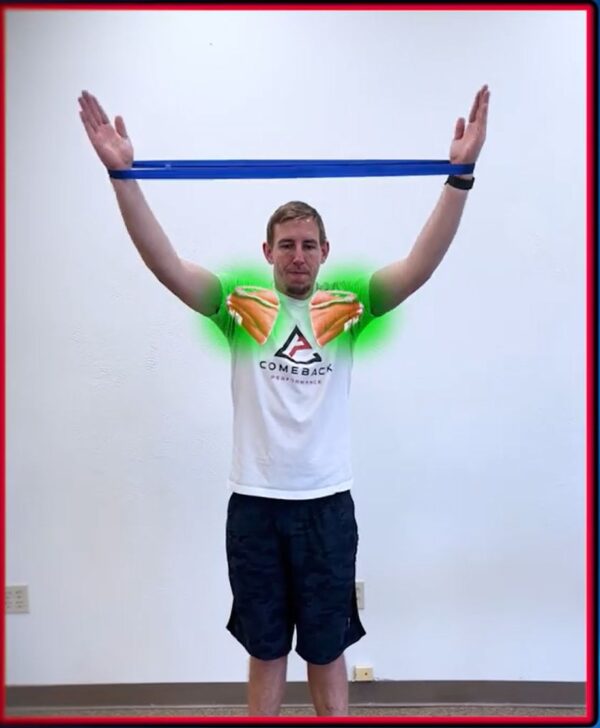
Purpose: Build gentle strength in muscles supporting the joint without heavy loading.
Equipment Needed: A resistance band.
How to Do It
- Stand tall with the band around your wrists, arms by your sides.
- Gently pull the band apart a few inches and maintain that tension.
- Perform small outward pulses (external rotation) while lifting arms to a comfortable range.
- Keep the motion small and controlled—this is about waking things up, not maxing out.
Sets: 2-3 sets of 8-10 reps
Tip: Feel this in the back and sides of your shoulder, not your neck. The muscles around the joint share the workload, so the arthritic surfaces aren’t doing all the work.
Ready to Take Control of Your Shoulder Health?
For a comprehensive approach to shoulder health, download our free Big Five Shoulder Fix Guide that covers all five key areas: neck, thoracic spine, shoulder blade, shoulder joint, and nerves—plus specific tests and exercises for each.
If your pain is severe and constant, you have major medical conditions and haven’t been cleared to exercise, or you’ve been told surgery is your only option right now, use this information as education and talk to your provider about what’s safe for you.
About the Author: Dr. Joey Seyforth


