
Fix Bicep Tendonitis in 10 Minutes: The Real Cause Isn’t What You Think
If you experience a sharp, stabbing pain in the front of your shoulder, this blog is for you. That sharp pain isn’t just “getting older”; it’s a warning sign that your body’s movement system has gone haywire. You may be dealing with bicep tendonitis.
Your bicep tendon, sitting right in the front groove of your shoulder, may be acting as both a shock absorber and steering wheel. Over time, this constant grinding leads to inflammation, pain, and the fear that you’ll “snap something”.
Here’s how you can fix it!
Quick Reference Box
- Total Time: 10 Minutes.
- Targets: Upper back, shoulder blade, posterior shoulder, bicep tendon.
- Goals: Pain reduction, improved mechanics, restored mobility.
Before we fix the problem, we need to confirm what we’re dealing with. Speed’s Test is the gold standard for identifying bicep tendon irritation.

How to Perform Speed’s Test
- Stand tall with good posture.
- Raise your painful arm straight out in front of you to shoulder height.
- Use your opposite hand to press straight down on your wrist while you resist.
- Keep your trunk still – don’t cheat with your body.
What to Look For: If this creates sharp, familiar pain in the front of your shoulder or upper bicep, that’s a positive test. Rate your pain from 0-10, and remember this feeling – we’ll retest after the exercises to measure improvement.
Exercise 1: Banded Extension + External Rotation

Purpose: Teaches the shoulder ball to sit back properly and trains the posterior shoulder to take the load off the bicep tendon.
Equipment Needed: Light resistance band
How to Do It
- Place a light band around both wrists behind your back.
- Stand tall with shoulders relaxed and pulled away from your ears.
- Gently pull your hands apart until you feel tension in the band (external rotation).
- Keeping that tension, slide your hands slightly back behind you so your shoulders move into extension.
- Pause for 2-3 seconds, then slowly return to the start.
Sets: Do 2-3 sets of 8-10 reps daily.
Tip: Focus on feeling this in the back of your shoulders, not your neck. Use the pain traffic light system: green (muscle working) is good, yellow (mild awareness) is okay, and red (sharp pain) means stop.
Exercise 2: Banded Scap Angels
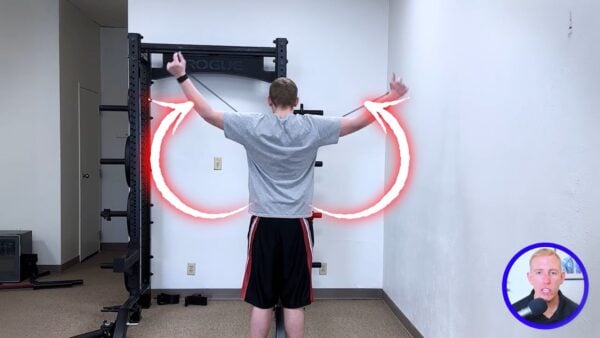
Purpose: To get your shoulder blades rotating properly.
Equipment Needed: Light resistance band and anchor point.
How to Do It
- Anchor a light band at chest height in front of you.
- Grab the band with both hands, elbows straight, and walk back until there’s light tension.
- Start with your hands down by your pockets, arms straight, shoulders set, and back.
- Slowly sweep your arms out in a snow angel motion, stopping before any pinching.
- Return with control, thinking about shoulder blades tipping back and rotating up.
Sets: 2-3 sets of 8-12 reps as part of your warm-up.
Tip: Keep your ribs down and avoid arching your lower back to fake the range of motion. Your neck should stay long and relaxed throughout the movement.
Exercise 3: Banded Open Book
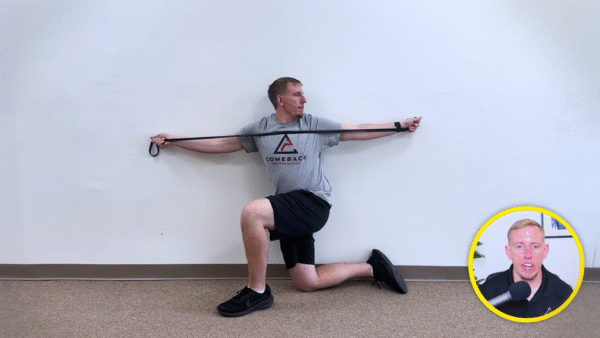
Purpose: Frees up your upper back mobility so your shoulder doesn’t have to steal motion from other areas.
Equipment Needed: Light resistance band and wall.
How to Do It
- Kneel next to a wall holding a resistance band.
- Grab the band with both hands, arms straight out in front of your chest.
- Keep your hips facing forward while slowly rotating your chest and arm away from the anchor.
- Move like you’re opening a book, going as far as comfortable.
- Pause, then return with control.
- Repeat facing the other direction for the opposite side.
Sets: 2 sets of 8-10 reps each direction.
Tip: Let your eyes follow your hands and ensure the rotation comes from your upper back and ribs, not your lower back. Take note if one side opens easier than the other – this asymmetry often contributes to bicep tendon compensation.
Retest and Measure Your Progress
After completing all three exercises, it’s time to retest using Speed’s Test. Use the same arm position, same pressure, and same resistance direction. Rate your pain again from 0-10.
Becoming Pain Free!
Practice these exercises daily, even if it’s just for 10 minutes. You’ll be surprised to learn that these small, consistent actions create lasting change in your movement patterns. Also, bear in mind that they’re just the beginning of retraining your body to move the way it was designed to. The Big 5 framework addresses every component that contributes to bicep tendonitis, giving you a comprehensive approach to bulletproofing your shoulders.
Find out about it below!
About the Author: Dr. Joey Seyforth


