
Is Your Shoulder Blade Behind That Pinch? Test It and Fix It With 3 Exercises
If you keep getting a pinching pain in your shoulder every time you reach up, your posture probably isn’t to blame. Your shoulder blade is. In this article, you’ll learn a quick test to check your shoulder, why the pinch keeps coming back, and three exercises you can start today.
When your shoulder blade doesn’t rotate upward enough, the ball of your shoulder gets squeezed between the shoulder and the shoulder blade as your arm rotates. That squeeze is the impingement, and it can press on different tissues, including the bursa.
With these three exercises we’ve shared in this blog, you can:
- Ease that pinch when you reach overhead or across your body.
- Train your shoulder and shoulder blade to rotate together through a full range.
- Wake up and strengthen the back of your rotator cuff.
- Build shoulder stability that carries over to pressing and pushing.
- Find out if your pain is coming from mechanics.
Quick Reference Guide
- Total Time: A few minutes, including the test and retest
- Targets: Your shoulder Blade, Rotator Cuff (especially the back of the cuff), and Shoulder Joint.
- Goals: To reduce the pinch, Restore Full Shoulder Rotation, and Build Shoulder Stability.
Do the Shoulder Impingement Test at Home
Before any exercise, test your shoulder so you have something to compare to later.
The Cross-Body Clearing Test
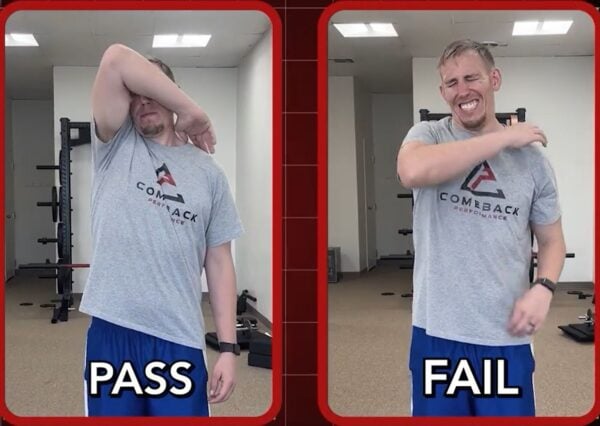
- Place the hand of your painful side on your opposite shoulder.
- Lift your elbow.
- Pay attention to what you feel.
If you get that familiar sharp pinch at the front or top of your shoulder, the same pain you get reaching overhead, that’s a positive sign. Remember exactly how it feels, because you’ll retest after the exercises.
The 3 Exercises to Fix Shoulder Impingement
Exercise 1: Wall Axial Rotation
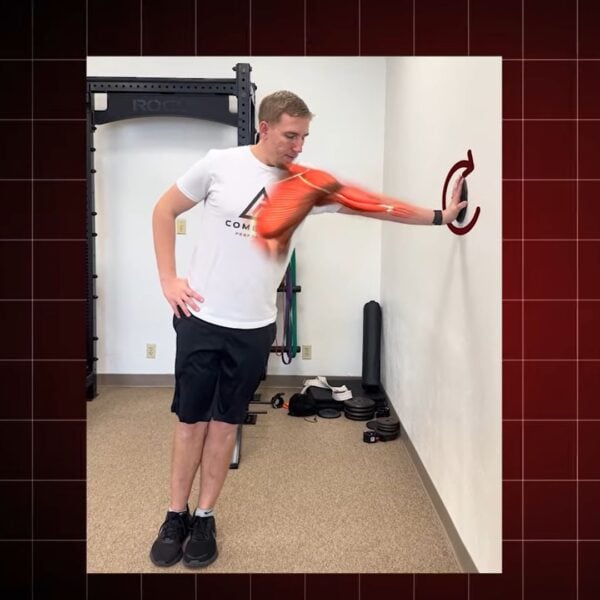
Purpose: Trains your shoulder to rotate through its full range so the shoulder and shoulder blade work together without jamming the front of the shoulder.
Equipment Needed: Wall, slider or small towel
How to Do It
- Stand with your side facing a wall and place your hand on it with your elbow fully straight. Put a slider or small towel under your hand.
- Gently lean your body weight into that arm so your shoulder is actively supporting you.
- Rotate your forearm like a windshield wiper, down toward internal rotation and up toward external rotation.
- Keep the movement small, slow, and controlled.
Sets: Do 2-3 sets of 8-10 slow rotations.
Tip: Stay entirely inside a pain-free arc.
Exercise 2: Banded Extension Plus External Rotation

Purpose: To wake up the back of the rotator cuff and build control at the back of your shoulder.
Equipment Needed: A resistance band
How to Do It
- Place your arms behind your back and loop a light band around your wrists.
- Pull your hands apart against the band to create outward tension.
- Holding that tension, slowly move your shoulders backward into extension, away from your ears.
- Return slowly with no jerking.
Sets: Do 2-3 sets of 8-10 reps.
Tip: Keep your shoulders down and don’t shrug toward your ears.
Exercise 3 – Banded Bear Slider
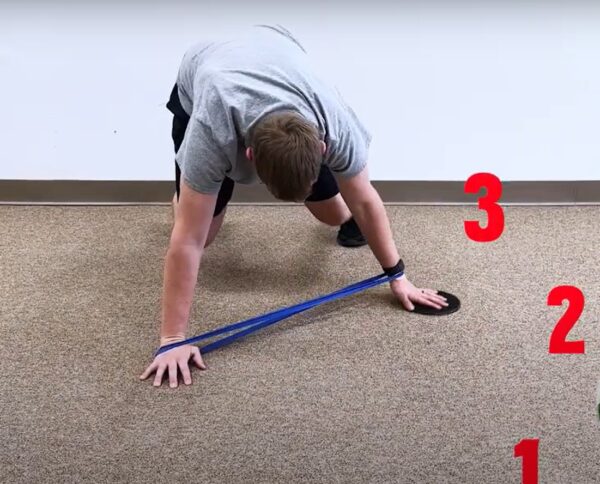
Purpose: To improve shoulder control in a weight-bearing position.
Equipment Needed: Light resistance band.
How to Do It
- Place a light band around your wrists and get on all fours, hands under your shoulders and knees under your hips.
- Lift your knees a few inches off the ground into a bear crawl hover.
- Slide your hands in three directions: forward, out to the side, and back.
- Keep your torso as still as possible, with no big hip sways.
Sets: 2 sets of 5 reps. All three directions count as one rep.
Tip: If your hips start swaying, slow down.
Now go back to the clearing test. Hand on your opposite shoulder, lift your elbow, and compare the pinch to what you felt at the start. If it feels better, that’s your answer. This was mechanics, not damage.
You Deserve A Pain-Free Life
If you feel like you’ve tried everything and the pinch keeps coming back, it’s time for a different approach. We’ve helped thousands of people get rid of shoulder impingement without injections or surgery through one-on-one online coaching and rehab because the comeback is always stronger than the setback.
About the Author: Dr. Joey Seyforth


