
3 Exercises to Stop Biceps Tendonitis That Won’t Go Away
Biceps tendonitis is one of the most common front-of-shoulder problems, and one of the most misunderstood. It usually shows up as a sharp, pinpoint ache at the front of the shoulder when you curl, press, reach overhead, or lift your arm away from your body.
For a lot of lifters, it’s that nagging shoulder pain when lifting your arm out in front of you that never quite goes away. If your bicep tendonitis keeps coming back no matter how much you rest it, read this piece to the end.
Because, in this article, you’ll get one quick test to see if your biceps tendon may be involved, learn why that tendon is getting overloaded in the first place, and walk away with three exercises that take stress off the front of your shoulder so you can stay in the gym.
Quick Check: Try Speed’s Test
Before doing anything else, try this simple test.

- Put your arm straight out in front of you, palm facing up, elbow completely straight.
- Use your other hand to press down on your forearm while you resist.
- Pay attention to where you feel it.
If you feel a sharp, familiar pain right at the front of your shoulder, in that little groove where the biceps tendon runs, that’s a positive test. General arm fatigue doesn’t count. A positive test is the long head of your biceps telling you it’s overworked.
Remember exactly how that felt. You’ll test it again after the exercises.
3 Exercises for Shoulder Pain From Biceps Tendonitis
Exercise 1: Banded Scap Angels
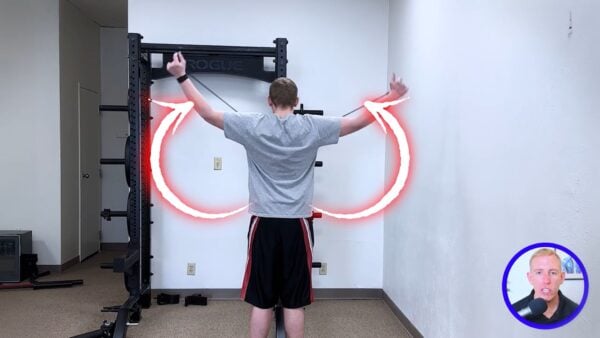
Purpose: To help the shoulder blade rotate up so the front of the shoulder doesn’t have to take all the stress.
Equipment Needed: Light resistance band
How to Do It:
- Anchor a light band at chest height. Keep your elbows straight and create light tension.
- Bring your hands toward your hips.
- Slowly move your arms up and out into an angel or “Y” position.
- Think about your shoulder blades tipping back and rotating up.
Sets: 2 sets of 10–12 reps
Tip: Keep your ribs down. Don’t arch your low back to fake the range.
Exercise 2: Crab Rocks
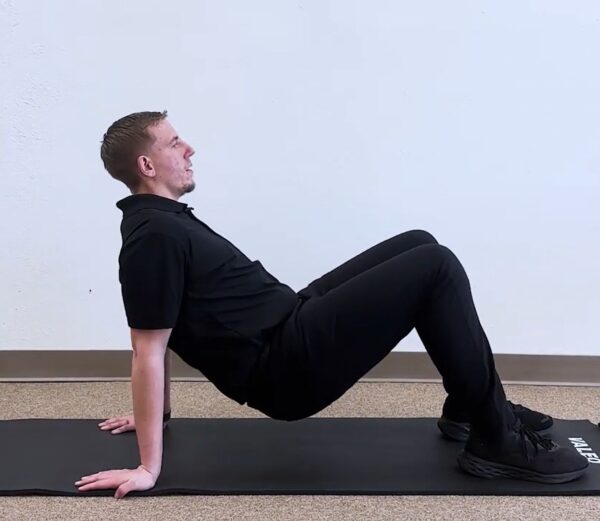
Purpose: To work shoulder extension and shoulder blade control under load, which helps with pressing, dips, push-ups, and reaching behind you.
Equipment Needed: None (a bench or chair is optional)
How to Do It:
- Sit with your hands behind you, knees bent, and feet flat.
- Lift your hips slightly into a low crab position.
- Gently rock forward and backward.
- Keep your shoulders active and away from your ears the whole time.
Sets: 2 sets of 10 controlled rocks
Tip: If the floor feels too aggressive, put your hands on a bench or chair instead.
Exercise 3: Kettlebell Pull-Through
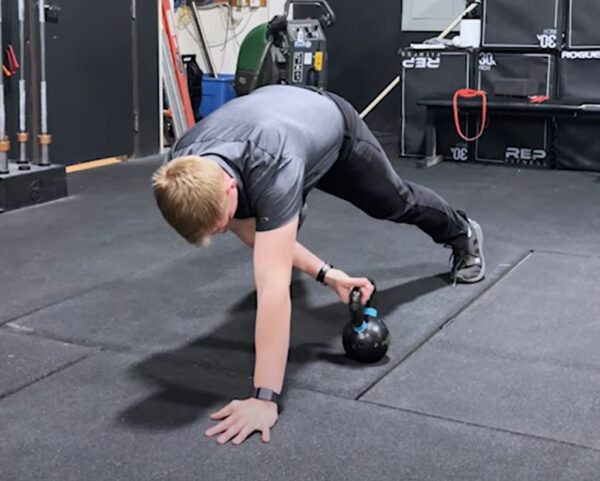
Purpose: To make your shoulder stabilize while your trunk resists rotation, which is much closer to real training.
Equipment Needed: Kettlebell
How to Do It:
- Get into a high plank with your feet wide.
- Place a kettlebell beside one hand.
- Reach underneath with the opposite hand and pull it across to the other side.
- Hold tension through your trunk the whole time.
Sets: 2–3 sets of 8 reps per side
Tip: Keep your hips and low back as quiet as possible. If they’re twisting, you’re losing the point of the exercise.
Now redo Speed’s Test and compare it to what you felt at the start. If that front-of-shoulder pain has dropped even a little, that’s your proof. The problem was mechanics, not the tendon itself.
Building a Shoulder That Stays Pain-Free
Stick with this routine four times a week. Use banded scap angels for shoulder blade upward rotation, crab rocks to mobilize into shoulder extension, and kettlebell pull-throughs to build stability. Done consistently, these exercises for shoulder pain give you a solid starting point and quick relief you can feel.
But if your bicep tendonitis keeps coming back even when you’re doing your exercises, it’s usually not a lack of effort. It’s other triggers you haven’t found yet that won’t let the tendon fully heal.
We’re here to help with that.
About the Author: Dr. Joey Seyforth


