
3 Exercises to Fix The Knot Between Your Shoulder Blade and Spine
Pain between the shoulder blades is one of the most common problems we see at Comeback Performance. A lot of this pain in the shoulder blade area is actually referred down from your neck. It just shows up right in that knot. So if all you’ve done is chase the knot, you’ve been treating the one spot that was never the cause.
In this article, we’ll walk through the real root cause of that knot, two quick tests to find your restriction, and three exercises to start giving you long-term relief.
What You Can Gain From This Routine
The good news? This is a mobility and control problem, which means it’s changeable, not permanent. With these two tests and three exercises, you can:
- Pinpoint where your restriction is actually coming from
- Address the neck referral that may be feeding the knot
- Unlock rotation in your upper back so your shoulder blade stops compensating
- Train your shoulder blade to rotate upward instead of staying stuck
- Notice real changes in pain and mobility when you retest
- Get relief that lasts longer than stretching ever could
Before you jump into the exercises, take a minute to test yourself. Remember how these feel, because you’ll repeat them at the end.
Test 1: Shoulder Abduction (Your Shoulder Blade)
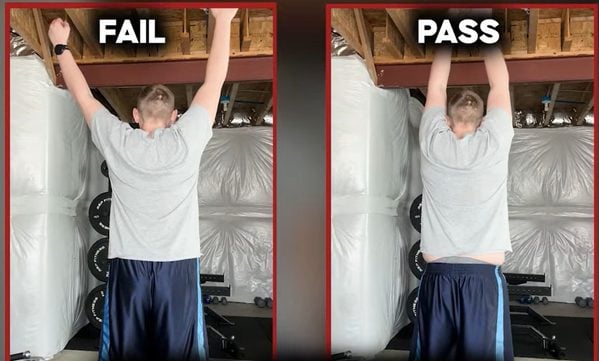
Stand tall and slowly raise your arm out to the side and overhead. Notice how it feels and how far it goes.
Test 2: Thoracic Rotation (Your Midback)
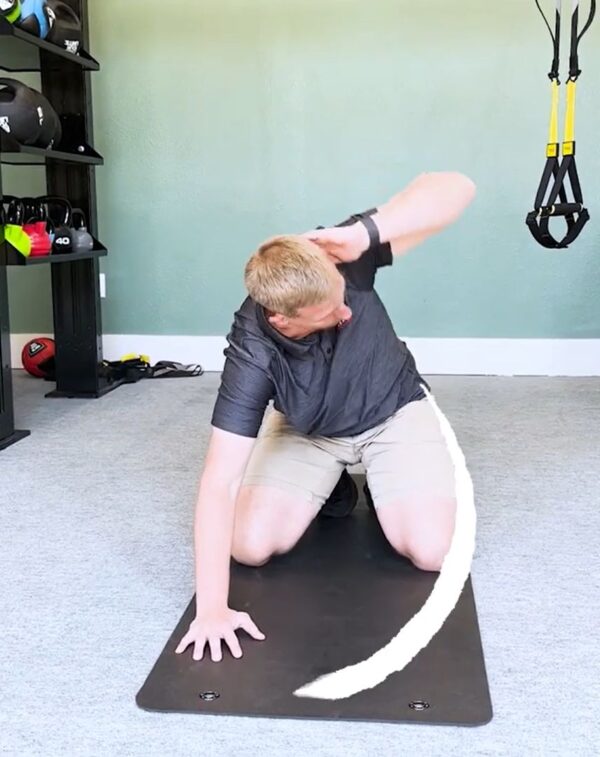
Get on all fours, rock your hips back, then rotate up and out.
As you do both tests, compare sides. You’re looking for pain, a difference from one side to the other, or limited motion. That asymmetry is your clue.
The 3 Exercises for Lasting Relief
Exercise 1: Chin Tuck Plus Extension

Purpose: This addresses the neck and helps you see whether neck movement is contributing to that referred pain.
Equipment Needed: None
How to Do It
- Sit tall.
- Gently pull your chin straight back, like you’re making a double chin. Don’t look down.
- From that tucked position, slowly look upward into a comfortable amount of extension.
- Return to neutral and keep the movement smooth.
Sets: 2 sets of 12 slow reps.
Tip: If looking up feels too aggressive, stick with the chin tuck only. If you notice an immediate change in that spot, it’s a strong sign your neck is feeding into the pain.
Exercise 2: Banded Open Book
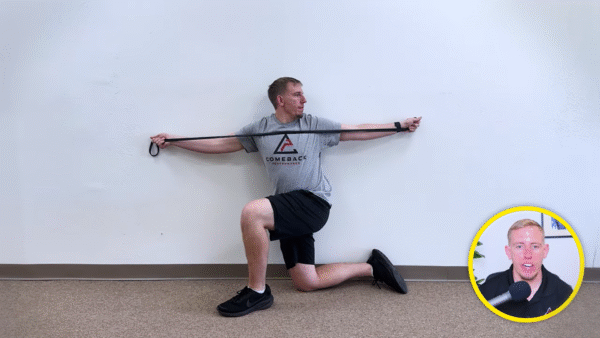
Purpose: This targets thoracic rotation so your shoulder blade doesn’t steal motion from a stiff upper back.
Equipment Needed: Light Resistance Band, Wall
How to Do It
- Get into a half-kneeling position next to a wall, keeping your hip connected to the wall.
- Hold a light band with your palms up. Keep one hand centered in front of you while the other arm opens away from the wall.
- Follow the moving hand with your eyes and rotate through your upper back, not your low back.
- Go only as far as you can control, then return.
Sets: 2 sets of 8–10 reps per side.
Tip: Compare how each side moves. If one side rotates more, that may explain why the knot keeps having to compensate.
Exercise 3: Banded Scap Angel
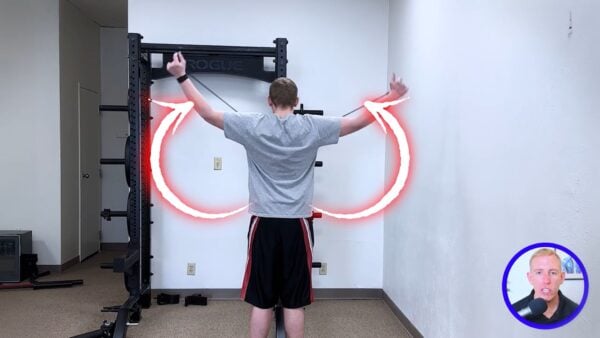
Purpose: Now that the neck and mid-back are opened up, this trains your shoulder blade to rotate upward instead of staying stuck.
Equipment Needed: Light Resistance Band, Anchor Point
How to Do It
- Anchor a light band in front of you at about chest height. Grab it with both hands, elbows straight, and create light tension.
- Bring your hands back toward your hips.
- Slowly move your arms up and out into an “angel” position.
- Think about your shoulder blades tipping back and rotating up while you keep your ribs down.
Sets: 2 sets of 8–10 controlled reps.
Tip: Don’t arch your low back to fake the range. Smaller and controlled beats bigger and sloppy.
Now go back and redo your two tests: shoulder abduction and thoracic rotation. Look for changes in your pain or your mobility. Either one is a positive sign that these exercises are exactly what you need, and proof that the knot between your shoulder blade and spine is something you can change.
Building Long-Term Shoulder Pain Relief
These exercises are a great starting point, but they aren’t the complete long-term solution. To find out why the knot keeps showing up no matter what you do, you need a proper assessment that looks at the areas above and below your shoulder.
About the Author: Dr. Joey Seyforth


