
Fix Biceps Pain: Why It’s Not Your Biceps (+ 4 Exercises)
If front-of-shoulder pain is stopping your push-ups, bench press, or even reaching overhead, you might have been told it’s “biceps tendonitis”—rest it, ice it, stretch it. Then the pain dies down, you return to training, and it flares right back up. Frustrating. Good news: it’s rarely just your biceps. In this blog, we’ll show you how to fix biceps pain.
But before we begin, understand that your body works as a connected system. The neck, thoracic spine (mid-back), shoulder blade, shoulder joint, and even your nervous system all influence how your biceps feel and function.
When those areas lack mobility, positioning, or strength, your body compensates. During presses and push-ups, if your mid-back can’t extend, your shoulder blade can’t rotate up, or your head sits forward, your biceps tendon gets overloaded to make up the difference—leading to irritation and pain.
With just a few targeted drills, you can reduce biceps pain by improving the way your shoulder complex moves.
First, here’s a quick self-check:
Speed’s Test (screens the biceps tendon): Extend your arm straight in front at shoulder height with your palm up. With your other hand, press down on the forearm while the test arm resists upward. If you feel pain in the front of the shoulder, the biceps tendon is likely irritated. This tells you the biceps are aggravated—but not why. The exercises below address the “why.”
Safety note: You should never push through sharp pain, numbness/tingling, or a sense of instability. If symptoms are severe, traumatic, or worsening, consult a licensed clinician.

With just 12 minutes a day, you can:
- Reduce front-of-shoulder ache during pressing and daily reaching.
- Improve thoracic extension so your shoulders stop “borrowing” motion from your biceps.
- Restore healthy shoulder blade mechanics to create space at the front of the shoulder.
- Build posterior shoulder strength to prevent forward shoulder posture that overloads the biceps.
- Improve core-shoulder stability so your arm doesn’t have to muscle through every rep.
- Get back to push-ups, bench press, overhead press, and daily tasks with more confidence.
Quick Reference Box For The Exercises
- Total Time: 12 minutes
- Targets: Thoracic spine, shoulder blade (scapula), rotator cuff/posterior shoulder, shoulder joint mechanics, core stability; addresses nerve tension indirectly by improving mechanics.
- Goals: Reduce anterior shoulder/biceps tendon pain, improve mobility and scapular mechanics, and build shoulder stability and resilience.
Exercise 1: Bench Opener (Thoracic Extension + Front-Shoulder Decompression)

Purpose: Restore thoracic extension and reduce front-of-shoulder compression so the biceps stop overworking.
Equipment Needed: Bench or sturdy chair; PVC/broomstick (optional).
How to Do It:
- Kneel facing a bench and place your elbows on it, hands holding a stick with palms up (optional).
- Sit your hips back as you drop your chest toward the floor.
- Pause where you feel a stretch across your upper back and lats (not pain), then return.
Sets: 2 sets of 12 slow reps (2–3 second pause each).
Tip: Keep your ribs down and neck long; avoid letting your lower back sag into an excessive arch.
Exercise 2: Wall Slides (Scapular Upward Rotation + Positioning)

Purpose: Retrain the shoulder blade to move “up and around,” creating space at the front of the shoulder.
Equipment Needed: Wall.
How to Do It:
- Stand with one foot slightly forward, forearms/hands on the wall, elbows off the wall.
- Slide arms up as you gently lean your chest toward the wall.
- At the top, feel your shoulder blades rotate up and around your ribcage; return with control.
Sets: 2 sets of 10 reps.
Tip: Avoid shrugging your shoulders to your ears; keep light pressure on the wall and breathe.
Exercise 3: Banded Uppercuts (Posterior Shoulder Strength + Joint Mechanics)

Purpose: Strengthen the back of the shoulder to counter forward shoulder posture that overloads the biceps.
Equipment Needed: Light-to-moderate resistance band.
How to Do It:
- Stand or half-kneel; hold the band with palms up and elbows tucked to your sides.
- Pull hands slightly apart to create tension, then guide elbows outward.
- Lift elbows to about eye height, then lower with control while keeping band tension.
Sets: 2 sets of 12 reps.
Tip: Keep ribs stacked over hips and neck relaxed; feel the work behind the shoulder blades, not in the front.
Exercise 4: Kettlebell Pull-Through (Core + Shoulder Stability Integration)
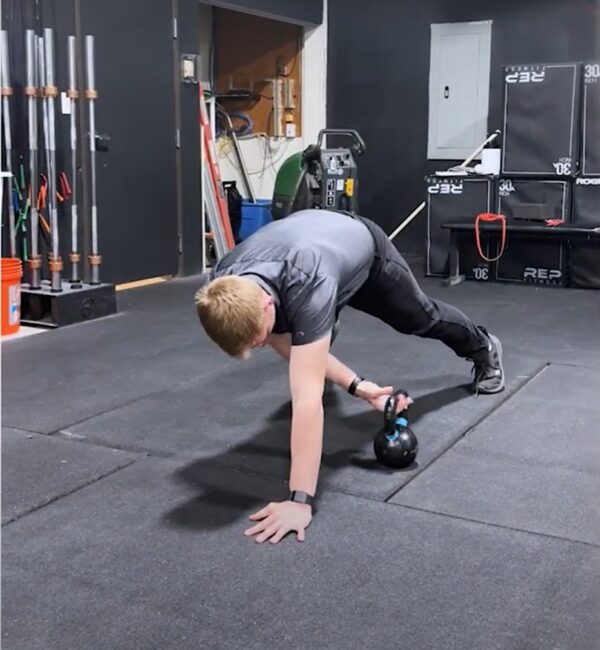
Purpose: Integrate core control with shoulder stability so the biceps don’t compensate for poor trunk control.
Equipment Needed: Kettlebell or dumbbell.
How to Do It:
- Set up in a high plank with feet wider than hips, kettlebell just outside one hand.
- With the opposite hand, pull the bell across to the other side—minimize hip rocking.
- Alternate sides, keeping glutes and abs engaged the entire time.
Sets: 2 sets of 8 pull-throughs per side.
Tip: Move slowly; aim to keep your belt buckle facing the floor the whole time.
Closing
Do these drills daily for 2–3 weeks. Most people feel relief within days as the shoulder moves better and the biceps stop doing overtime. Less pinching at the front of the shoulder, easier reaching and pressing, and better posture without “forcing” it.
To stay pain-free, you’ll want a plan that also screens your neck, thoracic spine, scapular control, shoulder rotation, and possible nerve tension—then upgrades strength in the patterns you use most.
Safety disclaimer: Stay below a 3/10 discomfort; stop any drill that causes sharp pain, numbness/tingling, or a feeling of instability. Seek medical care if you have a traumatic injury, visible deformity, severe night pain, progressive weakness, or symptoms that don’t improve.
About the Author: Dr. Joey Seyforth


