
Bicep Tendonitis Pain? Do THIS Before You Tear Something
If you’ve been dealing with that nagging bicep tendonitis pain that shoots down your arm and stops you from lifting, reaching overhead, or even sleeping comfortably, you’re not alone. Bicep tendonitis pain affects thousands of people who thought traditional physical therapy would be their answer.
The real culprits behind persistent bicep tendonitis are five interconnected areas that create a perfect storm of shoulder overload: your neck and thoracic spine mobility, shoulder blade mechanics, shoulder joint function, and nerve tension from above. When these areas fail to work in harmony, your bicep tendon becomes the unfortunate victim, taking on stress it was never designed to handle.
The good news? You can address the root cause of your bicep tendonitis with just four targeted drills that take less than 15 minutes a day. These aren’t your typical bicep stretches or ice-and-rest protocols; they are specific movement patterns that retrain your entire shoulder system to function properly, giving your bicep tendon the break it desperately needs.
With just 15 minutes a day, you can
- Experience immediate pain relief by addressing nerve tension that keeps your muscles in protection mode.
- Restore proper shoulder mechanics that prevent future bicep tendon overload.
- Regain full overhead mobility without that sharp, limiting pain
- Sleep through the night without waking up to shoulder stiffness
- Return to your favorite activities with confidence and zero pain
- Build long-term shoulder resilience that prevents recurring injuries
Quick Reference Box
- Total Time: 15 Minutes.
- Targets: Bicep tendon, shoulder complex, thoracic spine, first rib area.
- Goals: Pain reduction, improved mobility, restored shoulder mechanics.
Exercise Breakdown
Exercise 1: Belt First Rib Mobilization

Purpose: This drill addresses nerve tension by mobilizing the first rib area and opening up space for the nerve bundle that feeds your entire shoulder complex.
Equipment Needed: Resistance band or belt.
How to Do It
- Sit on the band/belt and bring it over your upper trap and first rib area.
- Use your hands to create downward tension on the band.
- Look down and in towards your armpit on the belt side, then look up and out towards the opposite side.
- Move slowly and deliberately through each direction.
Sets: 2 sets of 10 alternating movements per side.
Tip: If you don’t address this nerve tension first, those bigger muscles like your traps and pecs will stay locked in protection mode, keeping you stuck in that frustrating cycle where stretching provides temporary relief but the tightness always returns.
Exercise 2: Wall Slides

Purpose: This movement retrains proper shoulder blade mechanics and teaches your scapula to move up and around to that crucial 60-degree position, preventing impingement and irritation.
Equipment Needed: Wall
How to Do It
- Stand facing a wall with one foot in front of the other.
- Place your hands on the wall with elbows slightly off the surface.
- Slide your arms up the wall while leaning your chest forward at the top.
- Focus on feeling your shoulder blades moving up and around, not just down and back.
Sets: 2 sets of 10 repetitions.
Tip: Don’t force the motion – as you perform more repetitions, you’ll naturally feel your hands reaching higher up the wall as your shoulder blade mobility improves.
Exercise 3: Banded I Formation
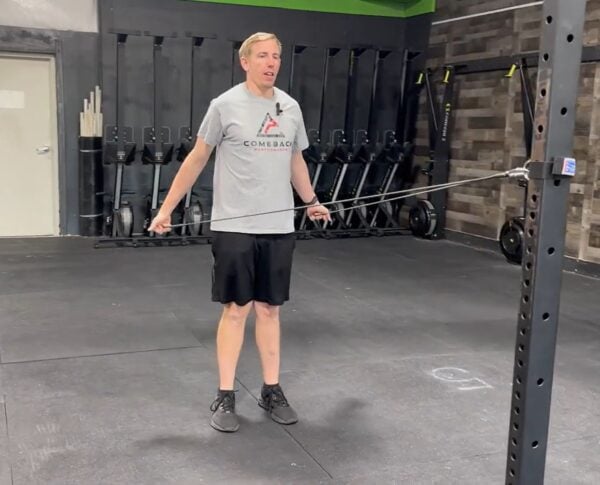
Purpose: This exercise strengthens the posterior shoulder muscles that support proper shoulder positioning and dramatically reduce the stress placed on your anterior shoulder structures.
Equipment Needed: Resistance band anchored in front of you.
How to Do It:
- Hold the band with both hands and pull it back, extending your elbows.
- Form an “I” shape with your arms while focusing on the posterior tilt of your shoulder blades.
- Emphasize external rotation of your shoulders as you pull back.
- Hold briefly at the end position before returning to the start.
Sets: 2 sets of 10 repetitions.
Tip: Think about pulling your shoulder blades down and back while externally rotating – this combination is key to reducing anterior shoulder stress that overloads your bicep tendon.
Exercise 4: Row + External Rotation + Press Combo

Purpose: This compound movement trains proper shoulder mechanics while strengthening the entire shoulder complex through its full range of motion with correct sequencing.
Equipment Needed: Resistance band.
How to Do It
- Start by rowing the band straight back with control.
- From the row position, externally rotate your shoulders outward.
- Press overhead while maintaining the external rotation.
- Reverse the sequence to return to the starting position.
Sets: 2 sets of 8 complete sequences.
Tip: This drill is incredibly powerful because it combines strengthening with motor pattern retraining – you’re literally teaching your body how to move properly while building the strength to support that movement long-term.
Fix Your Bicep Tendonitis
The key to eliminating your bicep tendonitis isn’t doing these exercises once or twice – it’s about consistent daily practice that retrains your movement patterns and addresses the root cause of your pain. Just 15 minutes a day can create dramatic changes in how your shoulder functions. You’ll likely notice reduced pain and improved mobility within the first week of consistent practice.
While these four drills provide an excellent foundation for addressing bicep tendonitis, everyone’s body is different. A proper movement assessment can identify your specific limitations and create a more targeted approach. Traditional PT often fails because it treats bicep tendonitis as an isolated problem, but your bicep tendon exists within a complex system that requires comprehensive evaluation.
About the Author: Dr. Joey Seyforth


