
Rhomboid Pain Fix: 3 Shoulder Blade Exercises for Fast Relief
Shoulder blade pain can make simple tasks—like sitting at your desk, turning your head while driving, reaching overhead, or lifting your kids—feel stiff, achy, and frustrating. If you’ve been foam-rolling, stretching randomly, or smashing a lacrosse ball without lasting relief, you’re not alone.
Good news—your pain likely isn’t permanent. Shoulder blade (scapular) pain often isn’t just a “rhomboid problem.” It commonly involves limited shoulder blade mobility, neck restrictions that refer pain between the blades, and weak postural muscles that fatigue under daily demands.
When the scapula doesn’t move well, the neck and shoulder compensate. Tight rhomboids can lock the area down, while nerve or muscle tension from the neck can refer pain right between the shoulder blades. Weak postural muscles then struggle to keep up—resulting in that familiar burning, nagging ache.
With 10–12 focused minutes a day, these three exercises can reduce shoulder blade pain fast while also building the mobility and postural strength you need for long-term relief.
Time Investment: 10–12 minutes per day
With just 10 minutes a day, you can
- Reduce that tight, pinching pain between your shoulder blades
- Improve shoulder blade mobility so reaching and lifting feel easier
- Decrease neck-driven “referral” pain into the upper back
- Build endurance in postural muscles for better sitting and standing tolerance
- Restore comfortable head-turning for driving and daily tasks
- Feel looser and more supported during workouts and long desk sessions
Quick Reference Box
Total Time: 10–12 minutes
Targets: Rhomboids, mid/lower traps, serratus anterior, deep neck flexors, cervical extensors, scapulothoracic joint
Goals: Improve mobility (scapula + neck), reduce pain and tension, build postural strength and endurance.
The 3 Exercises (Step-by-Step)
Exercise 1: Banded Bear Hug (Scapular Protraction)
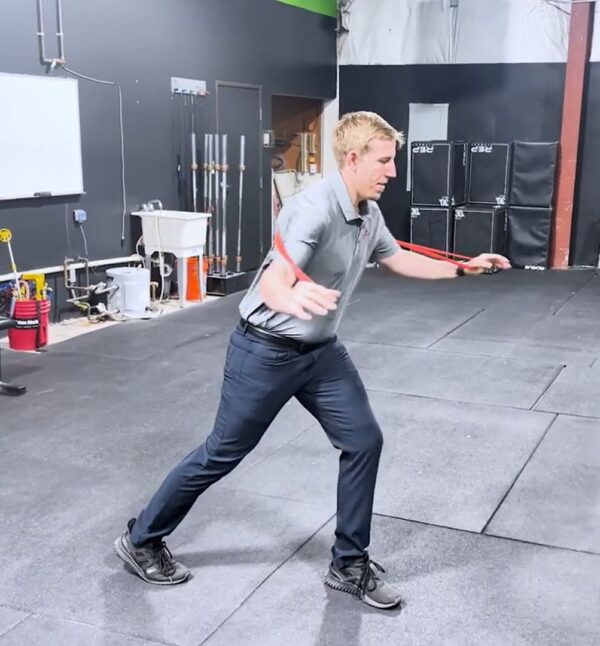
Purpose: Gently frees up tight tissue between the shoulder blades and restores healthy shoulder blade movement.
Equipment Needed: Light-to-moderate resistance band
How to Do It
- Loop a band around your mid-back (under the shoulder blades) and hold the ends in your hands.
- Stagger your stance, soften your knees, and brace lightly through your core.
- Reach your arms forward, “hugging a tree,” letting the shoulder blades glide up and around your ribcage.
- Return slowly and with control to the start position.
Sets: 3 sets of 10 reps
Tip: Think “shoulder blades sliding around the ribs.” Avoid shrugging your shoulders toward your ears or arching your lower back.
Exercise 2: Chin Tuck

Purpose: Improves neck mobility and reduces referred pain into the shoulder blade region.
Equipment Needed: None
How to Do It:
- Sit or stand tall. Place two fingers on your chin.
- Gently press your chin straight back (not up or down) into a retracted “double-chin” position.
- Hold for 3 seconds, then relax to neutral.
- Move within comfort—no forcing through sharp pain.
Sets: 3 sets of 12 reps with a 3-second hold each rep
Tip: The motion is straight back. Avoid tipping the head up or down. Mild pulling at the base of the skull, neck, or shoulder blade area is normal and should ease with reps.
Exercise 3: Banded I (Postural Pull-Down)
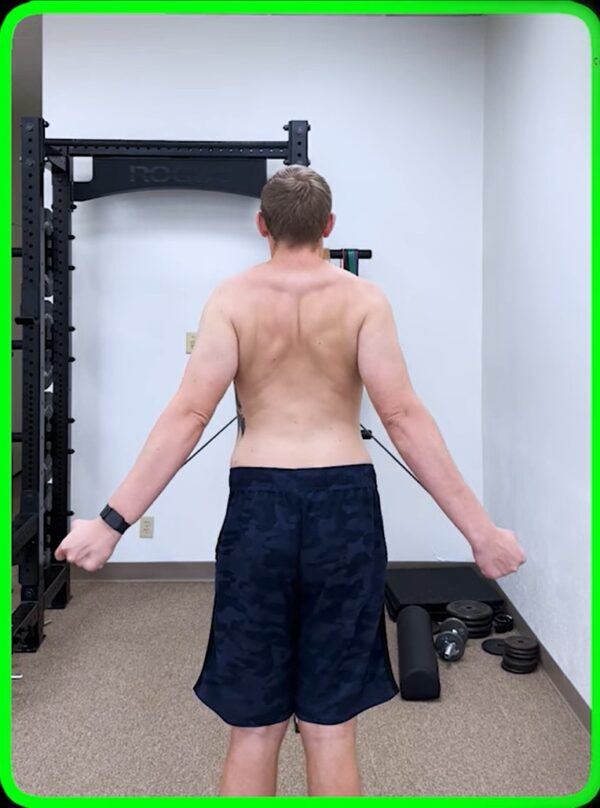
Purpose: Strengthens the mid-back/postural muscles that stabilize the shoulder blades all day long.
Equipment Needed: Light-to-moderate resistance band anchored in front or overhead
How to Do It
- Hold the band with straight elbows and arms by your sides or slightly forward.
- Pull straight back/down to your sides, keeping elbows long (forming an “I” shape).
- Squeeze the shoulder blades down and back at the end range.
- Return slowly with control.
Sets: 4 sets of 10 reps with a 2-second pause at the bottom
Tip: Keep ribs down and neck long. If you feel your upper traps (tops of shoulders) taking over, lighten the band and focus on pulling the shoulder blades into your back pockets.
Subdue That Rhomboid Pain Now!
A few focused minutes daily beats occasional long sessions. Do these three exercises 5–6 days per week for the next 2–3 weeks and track your pain and mobility. Expect your upper-back tension to ease, your neck to move more freely, and your posture to feel more supported—often after the first few sessions. If your pain is driven by deeper mobility limits, referred neck issues, or specific strength deficits, a targeted assessment can fast-track your progress and prevent flare-ups.
Book a shoulder assessment to identify your root cause and get a step-by-step program tailored to you.
About the Author: Dr. Joey Seyforth


