
How to Fix Shoulder Impingement: The 3-Exercise Solution That Actually Works
If you’ve been dealing with that sharp, pinching pain in your shoulder every time you reach overhead—and you’ve already tried rest, ice, and basic rotator cuff exercises without lasting success—you’re not alone. That nagging shoulder impingement is preventing you from simple daily activities like reaching for items on high shelves, getting dressed comfortably, or even sleeping on your favorite side.
Your shoulder blade needs to rotate upward by 60 degrees for pain-free overhead movement. Without this crucial rotation, your rotator cuff tendons get pinched in the narrow space between your arm bone and shoulder blade, creating that familiar impingement pain.
With just three targeted exercises that address the complete shoulder system—not just where it hurts—you can create more space in that joint, retrain your mechanics, and experience significant relief in as little as 10 minutes.
Quick Reference Box
- Total Time: 10-15 Minutes
- Targets: Shoulder joint capsule, shoulder blade muscles, posterior shoulder stabilizers
- Goals: Joint mobility, proper scapular mechanics, long-term stability
Exercise Breakdown
Exercise 1: Banded Posterior Shoulder Mobilization
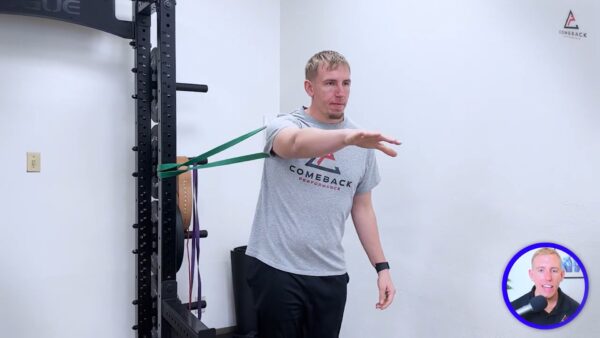
Purpose: Creates immediate space in the shoulder joint where impingement occurs, providing instant relief.
Equipment Needed: Resistance band and a sturdy anchor point at shoulder height.
How to Do It
- Attach the resistance band to a sturdy object at shoulder height and wrap it around the front of your affected shoulder.
- Step forward to create tension in the band, allowing it to pull your shoulder backward.
- Gently move your arm in and out of a chest press position while the band maintains backward pressure.
- Move slowly and in control—let the band create the space.
Sets: 2 sets of 15 repetitions.
Tip: This isn’t a stretch—it’s a gentle mobilization. You should feel immediate relief as space is created in the front of your shoulder. Don’t force the movement; let the band do most of the work.
Exercise 2: Banded Scapular Angels
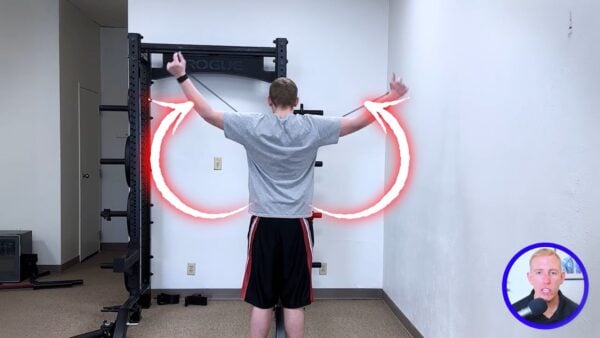
Purpose: Teaches your shoulder blade the proper 60-degree upward rotation needed for pain-free overhead movement.
Equipment Needed: Resistance band, anchor point in front of you.
How to Do It
- With the band anchored in front of you, pull it back with your elbows extended.
- Enter an “angel” motion by extending your arms to the sides.
- Continue the motion until your biceps are by your ears, then return down.
- Focus on posterior tilt and external rotation of the shoulder blade throughout.
Sets: 2 sets of 8 repetitions.
Tip: You should feel this working in your mid-back and rear shoulders. Maintain constant tension on the band throughout the entire movement to properly train the shoulder blade mechanics.
Exercise 3: Extension Rocks

Purpose: Builds stability to maintain proper shoulder blade position under load, preventing impingement from returning.
Equipment Needed: None (just floor space).
How to Do It.
- Sit on the floor with your hands placed under your hips and your knees bent.
- Lift your buttocks off the ground into a reverse table position.
- Rock forward and backward, mobilizing your shoulders into extension.
- Keep your hands planted throughout the entire movement.
Sets: 2 sets of 10 repetitions.
Tip: Work within your comfortable range—don’t force into pain. Focus on controlled forward and backward movement while feeling your shoulder stabilizers engage.
Testing Your Progress
Before starting these exercises, perform this simple clearing test:
- Place your affected side hand on your opposite shoulder
- Lift your elbow toward the ceiling
- Rate any pain in the front of your shoulder on a scale of 1-10
After completing all three exercises, repeat this test. Most people experience a significant reduction in their pain score immediately.
Now You’re Relieved.
Perform this routine daily, especially before activities that typically trigger your shoulder pain. Retraining your entire shoulder system for proper movement is important, and these exercises help you to do that. Many people experience relief after just one session because these exercises address the actual cause of the impingement: poor shoulder blade mechanics and limited joint space. If you’ve been struggling with persistent shoulder impingement despite trying various treatments, it may be time for a comprehensive assessment.
About the Author: Dr. Joey Seyforth


