
Exercises to Fix Stuck Shoulder Pain When Reaching Overhead
Does your shoulder feel tight, blocked, or stuck every time you try to lift your arm overhead? If your answer is yes, you’ll find the three simple exercises in this post helpful.
You’ve probably tried stretching the front of your shoulder, rested for a few days, or simply started avoiding overhead movements altogether – only to find the problem returns the moment you try again.
Your shoulder pain isn’t just about a tight joint. It’s a complex chain reaction involving multiple body parts that are no longer working together properly. When your upper back becomes stiff, your shoulder blade loses its natural movement pattern, and your shoulder joint can’t glide smoothly in its socket, everything upstream gets jammed.
The good news? This mechanical problem has a mechanical solution. Instead of masking symptoms or avoiding movements, you can address the root causes with targeted exercises. These exercises will help restore proper movement patterns throughout your entire shoulder chain.
Quick Reference Box
Total Time: 10-15 Minutes
Targets: Thoracic spine, shoulder blades, shoulder joint stability
Goals: Improved mobility, reduced pain, restored overhead function
The 3-Exercise Solution – Targeting the Root Causes
Exercise 1: Windmill + Lift-Off
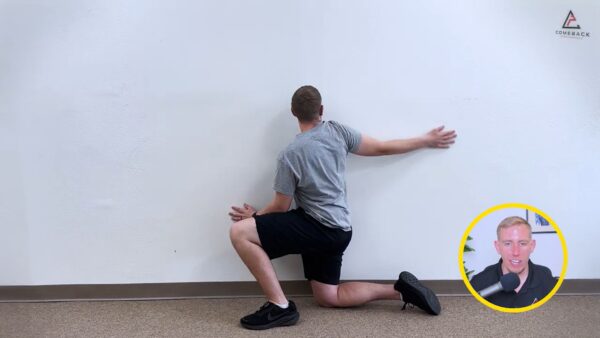
Purpose: Restores thoracic extension and rotation so your shoulder doesn’t have to compensate.
Equipment Needed: Wall.
How to Do It
- Position yourself in a half-kneeling stance next to a wall, with your hip lightly touching the wall.
- Place your arm against the wall and slowly slide it upward, following the wall’s surface.
- At the end of the movement, add a gentle “lift-off” by moving your arm slightly away from the wall.
- Focus on rotating your ribcage toward the sky, not just moving your arm.
Sets: 2 sets of 8-10 reps per side.
Tip: Don’t force the movement if you feel sharp pain. You should exercise within your available range of motion and gradually progress as your mobility improves.
Exercise 2: Banded Scap Angels
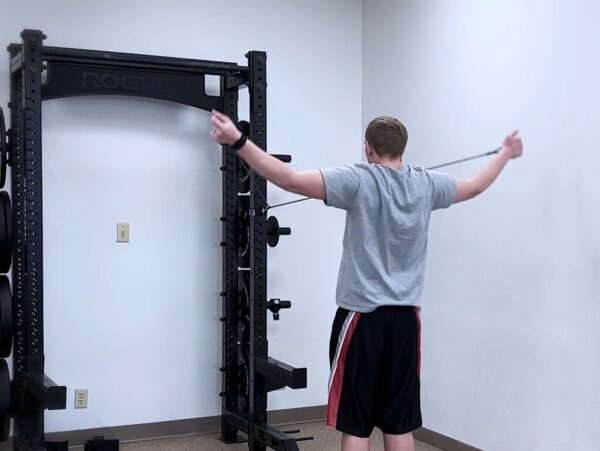
Purpose: To teach your shoulder blades to rotate upward and create space instead of jamming the joint.
Equipment Needed: Light resistance band.
How to Do It
- Anchor a light band in front of you at chest height.
- Grab the band with both hands while keeping your arms straight, and walk back to create light tension.
- With your hands near your hips, slowly raise your arms into an “angel” position.
- End with your biceps near your ears if comfortable, then return with control.
Sets: 2 sets of 8-10 slow reps.
Tip: Focus on your shoulder blades rotating upward and back as your arms rise. Keep your ribs down and avoid arching your lower back to fake the overhead motion.
Exercise 3: Crab Rocking
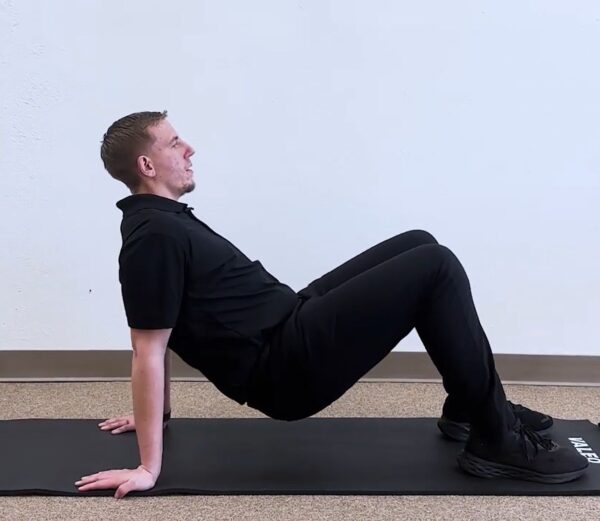
Purpose: To build shoulder stability for easier overhead movement.
Equipment Needed: None (optional: bench for easier modification).
How to Do It
- Sit on the floor with your hands behind you, fingers pointing outward or slightly back, and keep your knees bent.
- Lift your hips a few inches off the ground into a crab position.
- Gently rock your body forward and backward while maintaining the position.
- Keep your shoulders away from your ears and maintain a proud chest.
Sets: 3 sets of 6-8 gentle rocks.
Tip: If this feels too challenging, place your hands on a bench or adjust your foot position. Focus on feeling your shoulders work to support you without collapsing.
Understanding Your Body’s Signals: The Pain Traffic Light System
Before starting these exercises, it’s crucial to understand how to monitor your body’s response:
- Green Light: Muscles are working and feeling okay – continue with confidence.
- Yellow Light: Slight increase in symptoms that settles within 24 hours – proceed but monitor closely.
- Red Light: Increased symptoms lasting 24-48 hours after exercise – reduce intensity or take a break.
This system helps you stay in the therapeutic zone where healing happens, rather than pushing into the danger zone where you might aggravate your condition.
Why Your Shoulder Gets Stuck: The Real Mechanical Problems
Most people don’t realize that shoulder problems often start in the upper back. Your thoracic spine (the middle section of your back) needs to extend and rotate to help your arm reach overhead. When this area becomes stiff from poor posture, desk work, or inactivity, your shoulder has to “steal” motion to compensate.
This compensation pattern forces the front of your shoulder joint into an unnatural position, creating that familiar blocked or pinchy feeling. It’s like trying to open a door when the hinges are rusted – something’s going to give, and it’s usually not in a good way.
The Shoulder Blade Mystery: Lost in Translation
Your shoulder blade isn’t just along for the ride when you lift your arm overhead. It’s supposed to rotate upward and around your ribcage in a precise pattern, creating space for your arm bone to move freely. This coordinated movement is called scapulohumeral rhythm, and when it breaks down, the shoulders feel tight and restricted.
When your shoulder blade gets stuck in a downward and forward position – often from rounded shoulder posture or weak supporting muscles – the ball of your shoulder bone jams up into the roof of the socket. This creates impingement, inflammation, and that unmistakable feeling that something is “catching” when you reach up.
The Socket Stability Problem: When Control Goes Missing
The final piece of the puzzle involves your shoulder’s ability to maintain proper positioning within its socket. Your shoulder joint needs to be able to drop slightly and glide smoothly as your arm rises overhead. This requires good extension control and stability from the muscles around your shoulder and trunk.
When you’ve lost this extension control – often from spending too much time hunched forward – the ball of your shoulder sits high and forward in the socket. Every time you try to reach overhead, you hit what feels like a hard stop, as if something is physically blocking your movement.
Signs It’s Working: What to Look For
Over the course of days to weeks, you should notice:
- Less pinching sensation when you’re reaching overhead.
- Smoother, more fluid motion during daily activities.
- Reduced “sketchy” feeling at the top of your overhead range.
- Increased confidence in movements you’ve been avoiding.
- Better sleep quality due to less nighttime shoulder discomfort.
- Improved performance in exercise and sports.
These improvements indicate that you’re addressing the underlying mechanical issue rather than just managing symptoms. Your body is learning to move the way it was designed to.
Building Long-Term Shoulder Health
While these three exercises can provide significant relief, lasting shoulder health requires a comprehensive approach. You can get the help you need to get your shoulder back on track. Start with these three exercises today, listen to your body’s signals, and permit yourself to move confidently again. Your shoulders – and your future self – will thank you.
About the Author: Dr. Joey Seyforth


