
Shoulder Pain Sabotaging Your Workouts? Here’s Your 3-Step Recovery Plan
If shoulder pain is forcing you to skip exercises, modify your workouts, or avoid the gym altogether, you’re not alone. That nagging ache when you press overhead or the sharp pain during bench press isn’t just frustrating—it’s keeping you from reaching your fitness goals. Here’s what most people don’t realize: shoulder pain isn’t just about your shoulder. Your nervous system, sleep quality, stress levels, and even your shoulder blade mobility all play crucial roles in whether you’ll lift pain-free or pay for it later.
Think of your shoulder as part of an interconnected system. When your shoulder blades are tight (like wearing a restrictive shirt), your shoulders compensate by working harder. Add poor sleep and high stress to the mix, and you’ve created the perfect storm for chronic pain. With just 10-15 minutes of targeted work and some simple lifestyle adjustments, you can get back to lifting pain-free while building resilient shoulders that can handle whatever you throw at them.
With just 15 minutes a day, you can
- Eliminate pain during overhead presses and bench press.
- Sleep through the night without shoulder discomfort.
- Build a stronger foundation to prevent future injuries.
- Reduce flare-ups by 80% or more.
- Regain confidence in your lifting routine.
- Stop the guessing game of “will this exercise hurt”?
Quick Reference Guide
- Total Time: 10-15 Minutes.
- Targets: Rotator cuff, shoulder blades, upper back mobility.
- Goals: Pain reduction, mobility improvement, and nervous system regulation.
Exercise Breakdown
Strategy 1: The Pain Traffic Light System

Purpose: Monitor your pain levels to know when to push forward and when to modify.
Equipment Needed: None.
How to Use It
- Rate your pain on a 0-10 scale (0 = no pain, 10 = worst imaginable).
- Green Zone (0-3): Safe to continue or slightly increase activity.
- Yellow Zone (4-5): Modify by reducing weight, reps, or switching exercises.
- Red Zone (6+): Stop and reassess—this triggers the fight-or-flight response.
Implementation: Apply during every workout and monitor for 24 hours post-exercise.
Tip: If you’re a 2/10 during exercise but wake up at 8/10, you pushed too hard—scale back next time.
Exercise 1: Wall Slides

Purpose: Free up shoulder blade movement for better overhead positioning.
Equipment Needed: Wall.
How to Do It
- Place hands on the wall with forearms off, one foot forward for stability.
- Slide hands up the wall while letting chest come forward.
- Feel your shoulder blades moving up and around your upper back.
- Return to the starting position with control.
Sets: 2 sets of 10 reps (aim higher on the second set).
Tip: This mimics taking off a tight shirt—you should feel immediate freedom of movement.
Exercise 2: Prone Swimmers

Purpose: Activate and strengthen the posterior shoulder muscles.
Equipment Needed: Floor/mat.
How to Do It
- Lie face down with neck relaxed into the mat.
- Lift arms overhead, then alternate bringing them toward your butt.
- Keep your hands off the ground during transitions.
- Focus on extension, abduction, and flexion movements.
Sets: 2 sets of 10-15 alternating reps.
Tip: This should burn—that’s your rotator cuff waking up and getting stronger.
Exercise 3: Banded Cheerleaders

Purpose: Prime the rotator cuff for pushing and pulling movements.
Equipment Needed: Resistance band.
How to Do It
- Hold the band with palms up, arms straight in front.
- Pull apart (horizontal), return to center.
- Move to diagonal (one arm up, one down), return.
- Switch diagonal direction (all three positions = 1 rep).
Sets: 5 reps with 2-3 second holds at each position.
Tip: This gets blood flowing to all the small stabilizer muscles before heavy lifting.
Strategy 2: Build a Bigger Cup (Stress Management)
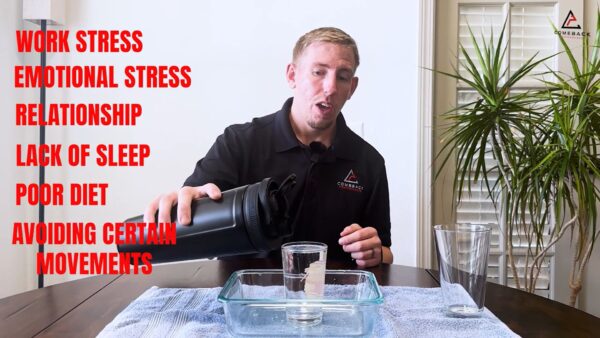
Purpose: Enhance your body’s ability to withstand physical and mental stressors.
Equipment Needed: None.
How to Implement
- Identify your stressors: work, relationships, poor sleep, diet.
- Remove what you can: delegate tasks, set boundaries.
- Build resilience through consistent exercise, quality sleep, and effective stress management.
Daily Practice: Spend 5 minutes before bed reviewing your stress levels.
Tip: Pain flare-ups often correlate with life stress, not just gym activities.
You’ll See Results
While these tips provide significant relief, chronic shoulder pain often requires personalized guidance. Most people experience noticeable relief within the first week, including having better sleep, less pain during workouts, and improved confidence in the gym. It’s time for a comprehensive approach if you’ve tried physical therapy, chiropractic care, or even injections without lasting results then book a consult and we can starting getting you answers and results.
About the Author: Dr. Joey Seyforth


