
I Fixed 1,000 Shoulders: The 5-Area System That Actually Works
If you’re reading this, chances are you’ve already tried everything for your shoulder pain. Physical therapy sessions that felt like cookie-cutter routines; cortisone injections that provided temporary relief before the pain came roaring back. Maybe you’ve even been told surgery is your only option.
Here’s what I’ve discovered after helping over 1,000 people overcome chronic shoulder pain: the problem isn’t your shoulder. Your shoulder pain is a chain reaction problem involving five interconnected areas that traditional medicine completely ignores.
Most shoulder treatments fail because they focus solely on treating the symptoms, not the underlying cause. That’s why you should keep in mind that your shoulder doesn’t exist in isolation—it’s connected to your neck, spine, core, and nervous system. Treating just the shoulder is like trying to fix a car by only looking at one tire while ignoring the wheel alignment.
The good news? When you address the actual root causes using the right system, shoulder pain becomes completely solvable. I’ve developed a movement-based approach that’s given 93% of my clients complete pain relief in just 12 weeks.
Here are actionable steps you can take to fix your shoulder pain when physical therapy fails.
With just 15 minutes of targeted movement daily, you can:
- Eliminate chronic shoulder pain without injections or surgery
- Restore full range of motion for overhead activities
- Sleep comfortably on your affected side again
- Return to your favorite sports and exercises pain-free
- Build lasting strength that prevents future injuries
- Break free from the endless cycle of temporary fixes
Quick Reference: The 5-Area Shoulder Fix System
- Total Time: 15 minutes daily
- Targets: Neck, thoracic spine, shoulder blade, shoulder joint, nerve pathways
- Goals: Pain elimination, mobility restoration, movement pattern correction
The 5 Critical Areas Every Shoulder Treatment Must Address
Area 1: Neck Positioning and Mobility
Purpose: Restore proper cervical spine alignment to prevent compensatory shoulder stress. When your neck can’t extend and rotate properly, your shoulder has to pick up the slack, leading to impingement and pain.
Solution: Do chin tucks with extension.

Equipment Needed: None
How to Do Chin Tucks with Extension:
- Sit or stand with your back straight
- Gently pull your chin back to create a “double chin”
- From this position, slowly tilt your head back to look up
- Hold for 3 seconds, return to neutral
Sets: 3 sets of 10 repetitions, twice daily
Tip: If you feel pinching in the back of your neck, you’re going too far. Focus on the gentle chin tuck first before adding the extension.
Area 2: Thoracic Spine Extension and Rotation
Purpose: Unlock mid-back mobility to reduce shoulder compensation patterns. If you have a stiff thoracic spine, it’ll likely force your shoulder blade and shoulder joint to work overtime. And when this overworking situation happens, you’ll begin to experience irritation and pain.
Solution: Do wall contours.
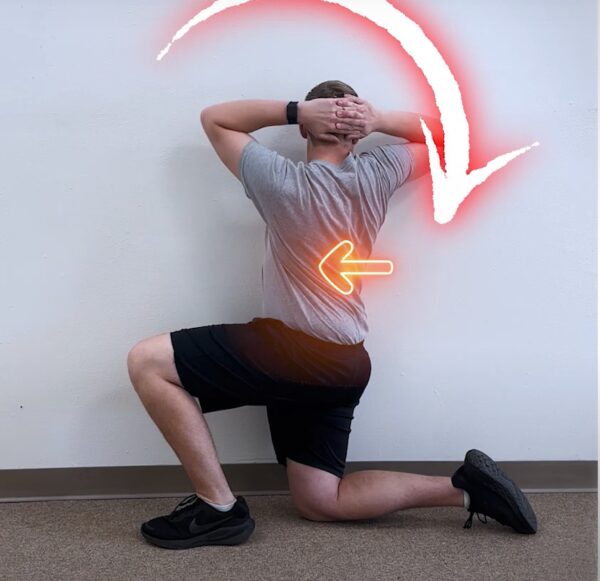
Equipment Needed: Wall
How to Do Wall Contours:
- Get yourself into a half-kneel position, hands on head.
- Keep a hip connected to the wall.
- Extend up in the upper back and rotate towards the wall and the other side
- Reverse on the way back. Take note of any differences as you go from side to side.
Sets: 2 sets of 8 each side.
Tip: Keep your ribs down and avoid compensating with your lower back. The movement should come from your mid-back only.
Area 3: Shoulder Blade Mechanics
Purpose: Retrain proper scapular movement patterns to eliminate impingement. Most people are taught “down and back” for shoulder blades, but healthy shoulder blades need to move up and around to 60 degrees during overhead motion.
Solution: Do wall slides.
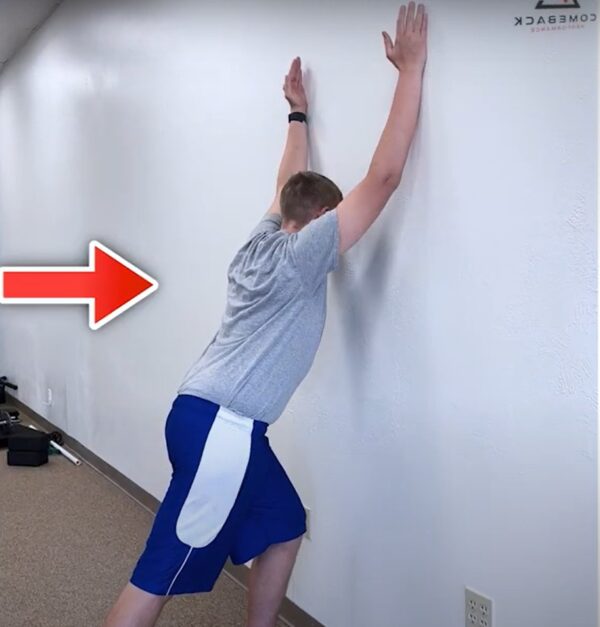
Equipment Needed: Wall
How to Do Wall Slides:
- Head over to the wall and place one foot in front of the other.
- Place your hands on the wall with elbows off the wall.
- You are going to slide your arms up the wall and lean your chest forward at the top
Sets: 2 sets of 12
Tip: If you can’t keep your arms against the wall, step further away. The key is maintaining contact throughout the entire movement.
Area 4: Shoulder Blade & Shoulder Joint Mobility
Purpose: Restore full ball-and-socket joint function in all planes of motion. Traditional strengthening exercises are given to shoulders that can’t even get into half the required positions.
Solution: Do banded scap angels.

Equipment Needed: Resistance band
How to Do Banded Scap Angels:
- Get a band anchored in front of you.
- Pull the band back with your elbows extended.
- Then move into an angel motion.
- Bring your arms out to the side and end with your biceps by your ears, and then return down.
Sets: 3 sets of 8
Tip: Focus on the posterior shoulder blade tilt and external rotation. This offloads pressure from the front of your shoulder, where most pain occurs.
Area 5: Shoulder Stability
Purpose: Improve the strength and stability of the shoulder in a close chain position to focus on control.
Solution: Do Banded Bear Sliders.
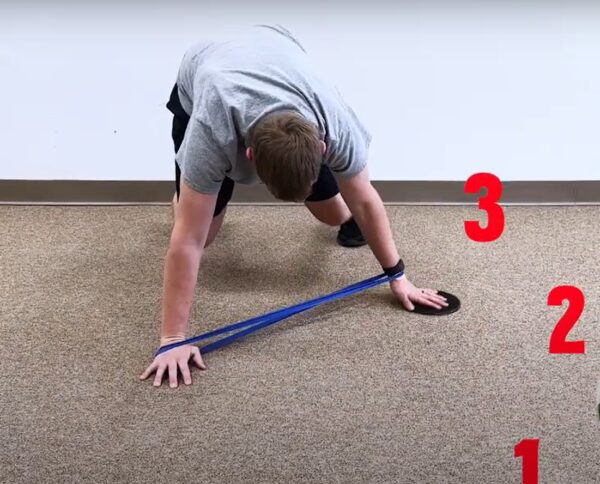
Equipment Needed: Resistance band
How to Do Banded Bear Sliders
- Get into a bear position with your hands under your shoulders.
- Keep your knees under your hips.
- Put a band around your wrists.
- Lift your hips and slide in all three directions.
Sets: 2 sets of 6
Tip: If you experience tingling or numbness, you should reduce the range of motion for this exercise. The goal is challenging mobility without aggravating nerve symptoms.
Why This System Succeeds When Everything Else Fails
- We treat the system, not just the injury: Your shoulder is part of a kinetic chain where every link matters
- Movement as medicine: Instead of passive treatments that create dependency, we give you tools for self-treatment.
- Root cause focus: We eliminate what’s causing pain signals rather than just masking symptoms
- Individualized approach: This system adapts to your needs, whether you’re an athlete or just someone who wants to sleep through the night.
Your Path to Permanent Shoulder Relief
Consistency is everything. These exercises work because they address the real reasons your shoulder hurts, not just the symptoms. Start with 15 minutes daily, and many people notice improvements within the first week.
The immediate benefits include reduced morning stiffness, better sleep position tolerance, and improved daily function. Long-term, you’ll build the movement patterns and strength needed to prevent future shoulder problems.
However, if you’ve been dealing with persistent shoulder pain for months or years, you may need personalized guidance to identify which of the five areas needs the most attention for your specific case.
Ready to eliminate your shoulder pain permanently?
About the Author: Dr. Joey Seyforth


