
Why Your Shoulder Pain Won’t Go Away + What To Do
If you’ve already done physical therapy, chiropractic stretches, and injections but your shoulder still hurts, this post is for you. Your shoulder pain results from a chain reaction involving five interconnected areas of your body. When one area becomes restricted or dysfunctional, your shoulder compensates, leading to the pain, impingement, and limitations you’re experiencing right now.
The good news? When you address all five areas systematically using these exercises we’ve shared below, you can experience relief.
Quick Reference
- Total Time: 15 Minutes Daily
- Targets: Neck, thoracic spine, shoulder blade, shoulder joint, and Nerve pathways.
- Goals: Pain reduction, mobility restoration, and Long-term pain prevention.
The Exercises
Exercise 1: Chin Tuck + Extension

Purpose: Reset neck position and take pressure off nerves feeding into the shoulder.
Equipment Needed: None
How to Do It
- Sit comfortably and gently tuck your chin straight back, as if you’re making a double chin (not looking down).
- From that tucked position, slowly nod your head up like you’re saying “yes”.
- Return to neutral position with control.
- If the Extension feels uncomfortable, focus only on the chin tuck position.
Sets: 2 sets of 10 slow reps
Tip: Think “double chin first, then look up”. This sequence ensures you’re resetting the neck position before adding movement.
Exercise 2 – Wall Open Book

Purpose: Restore rotation in the upper back so your shoulder doesn’t have to compensate for lost motion.
Equipment Needed: Wall space
How to Do It
- Get into a half-kneeling position next to a wall, with your hip and knee touching it.
- Place your hands together in front of your chest.
- Rotate your top arm away from the wall, following the movement with your eyes.
- Go as far as comfortable, then return to the starting position.
Sets: 2 sets of 8-10 reps per side.
Tip: Pay attention; if one side rotates significantly less than the other, that restriction could be a major contributor to your shoulder pain.
Exercise 3: Banded Scap Angel
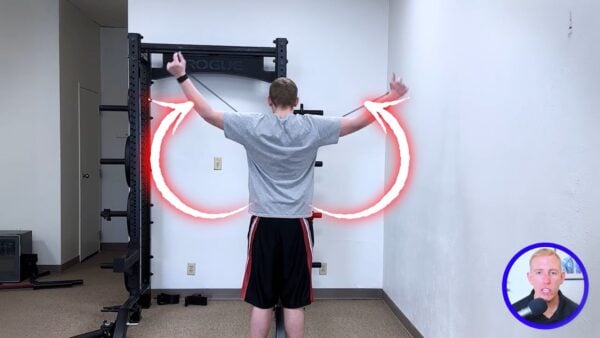
Purpose: Teach the shoulder blade to move up and around the rib cage instead of staying stuck and jamming the shoulder joint.
Equipment Needed: Light resistance band.
How to Do It
- Anchor a light band in front of you at chest height.
- Grab the band with both hands, elbows straight, and walk back to create light tension.
- Bring your hands toward your pockets, then slowly move your arms up and out into a Y shape.
- End with your biceps by your ears, then return down with control.
Sets: 2 sets of 8-10 controlled reps.
Tip: Focus on the shoulder blades moving around your rib cage rather than just lifting your arms—the blade movement is what creates the therapeutic effect.
Exercise 4: Shoulder Taps
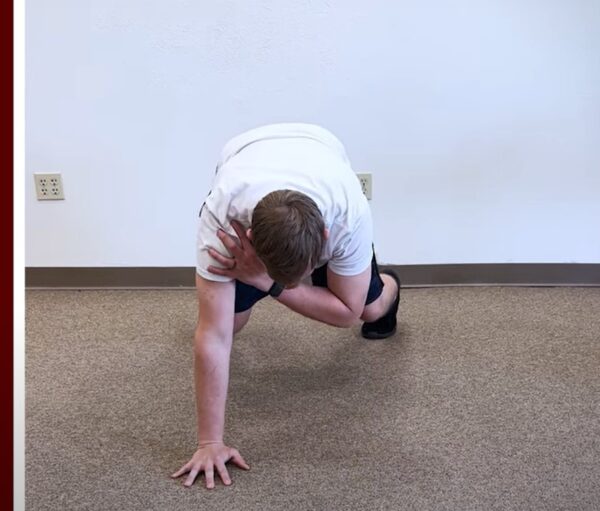
Purpose: Build core stability around your shoulder, so it can support your weight safely during daily activities.
Equipment Needed: None (bench or countertop for modifications).
How to Do It
- Get into a push-up position (or place your hands on a bench/countertop if a full push-up is too challenging).
- Keep feet slightly wider than normal for better balance.
- Shift weight slightly and tap the opposite shoulder with one hand, then switch.
- Keep your torso as still as possible throughout the movement.
Sets: 2 sets of 8-10 taps per side.
Tip: If you’re shaking or your hips are swaying significantly, elevate your hands on a higher surface to make the exercise more manageable while still getting the stability benefits.
Exercise 5: Belt First Rib Mobilization

Purpose: Reduce pressure on the first rib and upper nerve areas that often drive stubborn shoulder pain and sleep issues.
Equipment Needed: Belt or long strap
How to Do It
- Loop a belt over the top of your painful shoulder so it sits just above your collarbone.
- Angle the belt down toward your opposite hip and hold the other end.
- While maintaining light downward pressure on the belt, bring your head down and in toward the targeted side (as if you’re sniffing your armpit).
- Then move your head up and away at a diagonal, feeling a gentle stretch at the top of the shoulder and side of the neck.
Sets: 2 sets of 8-10 slow reps.
Tip: This exercise works best when performed 5 minutes before bed, especially if you have trouble sleeping on the affected shoulder. You should feel a gentle stretch, never a sharp pinch.
Breaking Free From the Endless Cycle
When you start addressing your neck, thoracic spine, shoulder blade, shoulder joint, and nerve pathways together, you stop fighting the same fire with the same tiny bucket of water. The five exercises we covered are just a glimpse of what happens when you work with your whole system instead of against it.
If you’re looking forward to building the foundation for long-term shoulder health, we’re here to help.
About the Author: Dr. Joey Seyforth


